
Commercial Solar Battery Storage in London: The 2026 Strategic Guide

In London’s high-demand urban landscape, the local grid is no longer a reliable safety net for your business operations. Relying solely on external power is a significant risk as tariffs fluctuate and carbon penalties increase. You've likely felt the pressure of meeting Part L building regulations while researching commercial solar battery storage London options to support expanding EV charging demands. It's a complex challenge that requires a methodical, expert-led approach to onsite power.
This strategic guide provides a roadmap for integrating bespoke storage solutions that secure your energy independence. We'll show you how to optimise operational resilience during peak hours and reduce annual energy spend. You'll learn how to leverage current tax incentives, such as the 100% first-year Annual Investment Allowance, and prepare for 2027 battery passport requirements. This isn't just about utility costs. It's a long-term investment in your company's future-readiness and compliance.
Table of Contents
The Business Case for Commercial Battery Storage in London
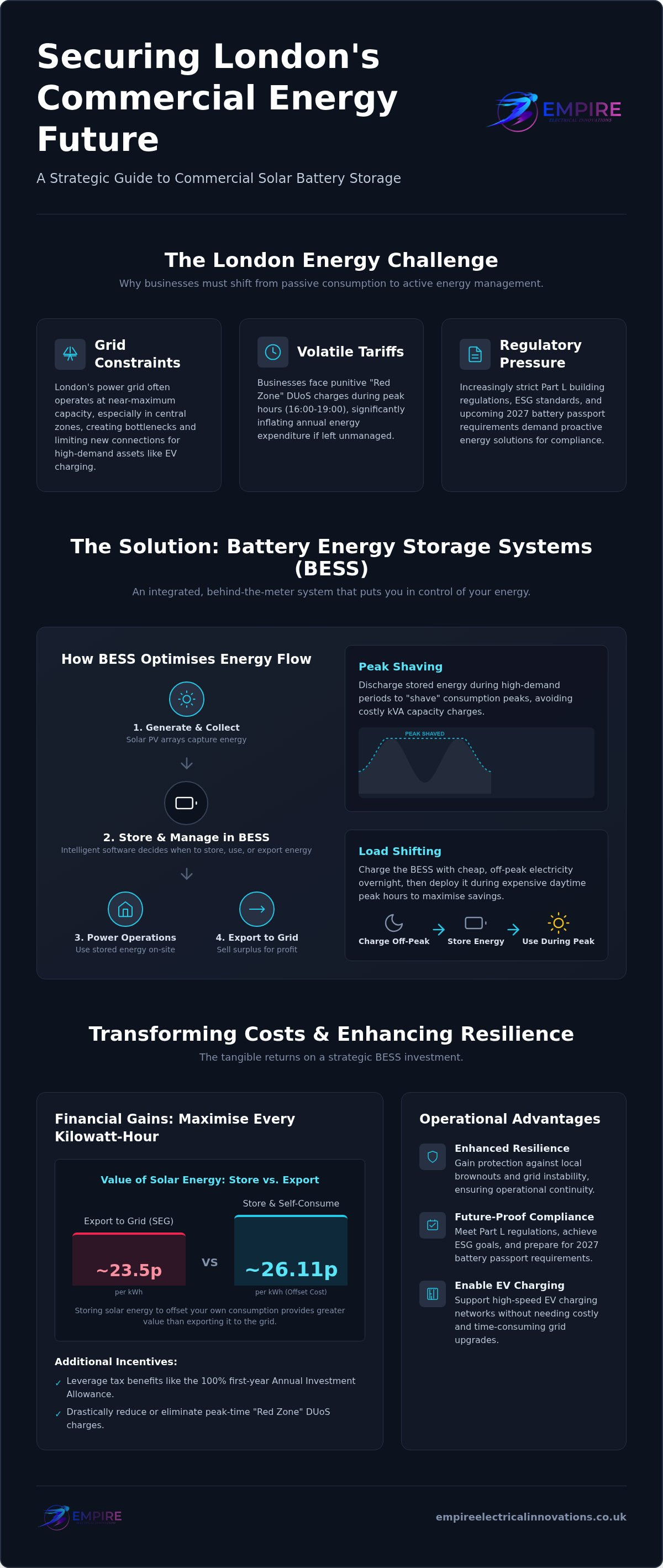
London's commercial sector is undergoing a fundamental shift. Businesses are moving away from passive reliance on the national grid toward active energy management. This transition isn't merely about environmental optics; it's a strategic response to the capital's unique infrastructure pressures and volatile tariff structures. For property developers and managers, energy is no longer a fixed cost. It's a variable that can be controlled with the right technical architecture.
Understanding BESS: More Than Just a Battery
A battery energy storage system (BESS) is an integrated technology suite comprising high-capacity cells, sophisticated power conversion systems (PCS), and hybrid inverters. For London enterprises, these systems are typically installed "behind-the-meter." This means the storage is located on your premises, allowing you to manage energy before it ever reaches the wider distribution network. This differs from "front-of-the-meter" systems, which are utility-scale installations designed to support the grid itself.
This setup enables a seamless flow between your solar PV array and your operational load. Whilst solar panels generate power, the BESS decides whether to use that energy immediately, store it for later, or export surplus to the grid under the Smart Export Guarantee (SEG). A BESS acts as a strategic asset for London commercial resilience, providing a reliable buffer between your business and an increasingly congested grid.
London Grid Constraints and the Need for Autonomy
London businesses face infrastructure challenges that regional sites rarely encounter. UK Power Networks (UKPN) often operates at near-maximum capacity in central zones, leading to strict limits on new grid connections for EV charging infrastructure. When demand peaks, the grid becomes a bottleneck. Commercial solar battery storage London solutions allow you to bypass these constraints by creating a private energy reserve.
The financial incentives for this autonomy are substantial. London enterprises are subject to "Red Zone" Distribution Use of System (DUoS) charges during peak afternoon hours, typically between 16:00 and 19:00. These charges can significantly inflate annual bills. By discharging stored energy during these windows, you avoid the most expensive rates on the market. This methodical approach to load management offers several practical benefits:
Reduction in maximum demand charges by smoothing out consumption spikes.
Enhanced protection against local brownouts or grid instability.
Direct compliance with Part L building regulations and evolving ESG standards.
Immediate support for high-load assets like rapid EV charging stations without requiring costly grid upgrades.
Future-proofing your site today ensures that grid capacity limits don't throttle your growth tomorrow. It's a disciplined investment in longevity and precision.
Technical Architecture: How BESS Optimises London Operations
Efficient energy management in the capital requires more than just hardware; it demands a sophisticated operational strategy. Modern commercial solar battery storage London systems utilise intelligent software to orchestrate energy flow based on real-time grid pricing and site-specific demand. This technical layer ensures that every kilowatt-hour generated or purchased is used at its maximum financial value.
Peak Shaving and Load Shifting Strategies
Peak shaving is the process of using stored energy to "shave" the tops off your consumption spikes. For London businesses, this is vital for avoiding expensive kVA (kilovolt-ampere) capacity charges. By discharging the battery during these high-intensity windows, you keep your grid draw below a pre-set threshold. This prevents the financial penalties associated with exceeding your agreed capacity with UK Power Networks.
Load shifting complements this by leveraging smart tariffs. With electricity price caps at 26.11p per kWh as of July 2026, businesses can charge batteries overnight whilst rates are lower. You then deploy this cheap energy during the day. This synergy is particularly effective when combined with Commercial EV Charging Infrastructure in Hertfordshire or London, where fleet demands often peak during business hours. Maximising self-consumption of your own solar generation is also essential. Instead of exporting surplus for a 23.5p per kWh SEG rate, you store it to offset your own 26.11p per kWh consumption cost.
Enabling High-Speed EV Charging
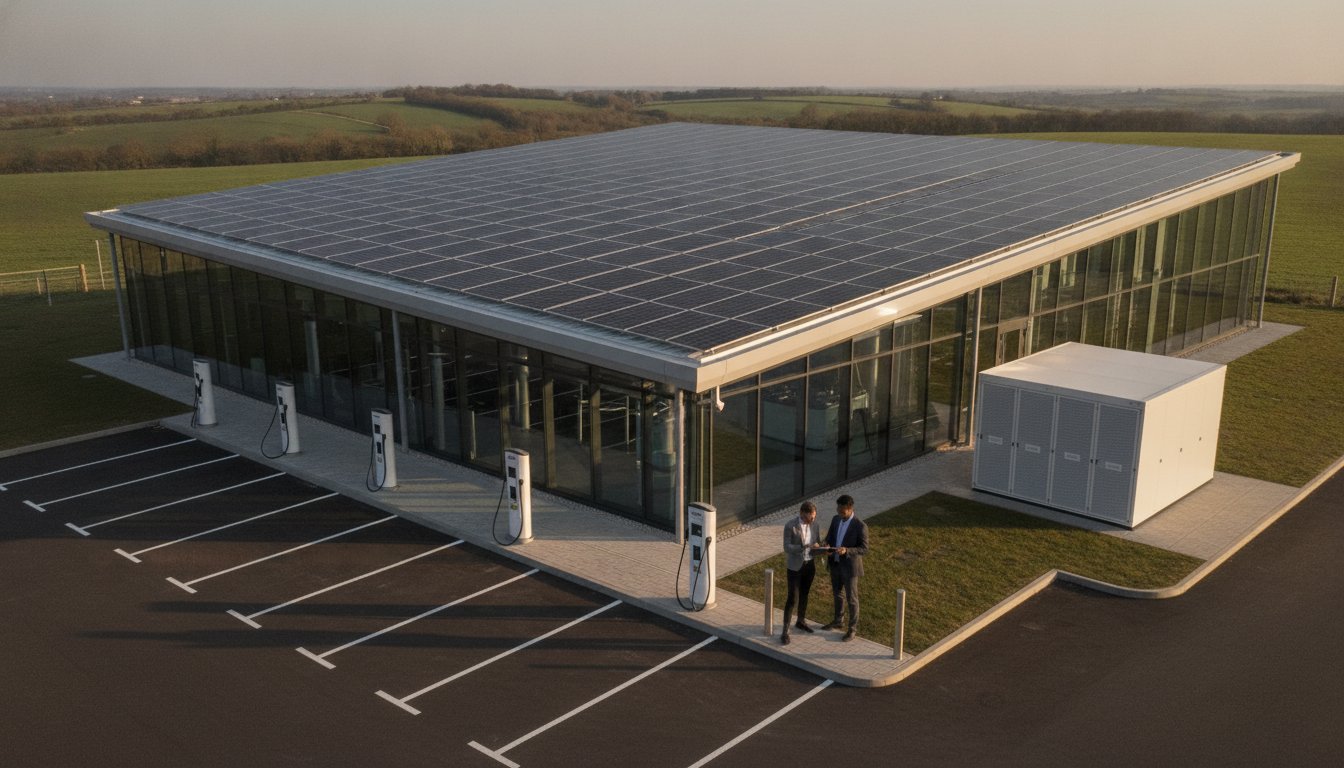
One of the most significant barriers to urban office electrification is limited grid capacity. When implementing commercial solar battery storage London businesses can bypass the need for costly substation upgrades. Installing Rapid DC chargers often requires a power boost that the local grid cannot provide. A BESS acts as a buffer. It stores energy at a slow, steady rate and then discharges it rapidly to support high-speed charging bays.
Smart distribution software manages the load between your building’s essential operations and the charging bays. It prioritises critical systems whilst ensuring vehicles are ready when needed. This methodical approach to load balancing preserves the longevity of your electrical components. If you're planning a transition to an electric fleet, consulting with a specialist can help you design a system that scales with your business needs. It’s about precision, performance, and long-term value.
Selecting the Right Scale: Capacity, Chemistry, and Compliance
Precision in scaling is the foundation of a high-performing energy system. It isn't simply a matter of choosing the largest capacity available. For commercial solar battery storage London enterprises must match discharge capabilities to specific operational demands whilst ensuring the hardware fits within the spatial constraints of urban sites. Selecting the wrong architecture leads to inefficient cycling and diminished return on investment.
Battery Chemistries: Safety and Longevity
In the commercial sector, the choice between Lithium Iron Phosphate (LFP) and Nickel Manganese Cobalt (NMC) is clear. LFP is the industry standard for stationary storage due to its superior thermal stability and fire safety ratings. This is particularly critical in dense London environments where batteries are often installed in basements or near occupied office spaces. LFP cells don't suffer from the "thermal runaway" risks associated with older chemistries.
Beyond safety, LFP offers significantly better longevity. A high-quality commercial LFP battery in 2026 typically provides a cycle life of between 6,000 and 10,000 cycles at 90% depth of discharge. This ensures the system remains operational for well over a decade. Precision engineering and Tier 1 components, such as those found in GivEnergy systems, are essential to meet the stricter sustainability and disclosure obligations of the 2026 EU Battery Regulation. By February 2027, all industrial batteries will require a digital "battery passport" for lifecycle traceability, making compliant hardware a mandatory requirement for future-ready businesses.
Modularity and Future-Proofing
Bespoke design is always superior to off-the-shelf "DIY" kits for commercial applications. A modular approach allows you to scale your storage capacity as your business grows or as you expand your EV fleet. It's often more cost-effective to install a system that allows for the addition of battery modules later, rather than over-specifying on day one. This flexibility is a core part of maximising efficiency with solar battery installation in Hertfordshire and London sites.
Inverter sizing is equally vital. The inverter must be capable of handling the maximum instantaneous load of your machinery or charging infrastructure. If the discharge rate is too low, you'll still end up drawing expensive power from the grid during peak periods, undermining the benefits of peak shaving discussed earlier. We focus on matching the power conversion system to your specific peak demand to ensure seamless performance. Investing in Tier 1 components today secures your ROI by minimising maintenance costs and ensuring compatibility with future smart-grid technologies.
Planning and Implementation in Urban London Environments
Deploying commercial solar battery storage London solutions in a high-density city requires more than technical skill. It demands a deep understanding of local regulatory frameworks and physical space limitations. Every installation must balance operational efficiency with strict safety standards. We focus on a methodical approach that simplifies the transition from design to commissioning.
DNO Applications and Grid Compliance
UK Power Networks (UKPN) manages the infrastructure across the capital. For any system exceeding 3.68kW per phase, a formal G99 application is mandatory. This process ensures your installation doesn't compromise the stability of the wider distribution network. It's a critical step that requires precise technical data and professional oversight.
The application typically takes 4 to 8 weeks to process. Costs for these applications generally range between £500 and £8,000 depending on the complexity of the site and the existing grid capacity. Our team handles this technical bureaucracy on your behalf. We coordinate directly with UKPN to manage export limitations and ensure all grid-tie requirements meet the latest standards. This proactive management prevents project delays and ensures your system is legally compliant from day one.
Space Constraints and Safety in London
Urban offices rarely have surplus floor space. We utilise innovative placement strategies to integrate storage into existing footprints. This includes reinforced rooftop platforms, dedicated basement enclosures, or external containerised units for larger industrial sites. Each solution is bespoke to the site's architecture and operational flow.
Safety remains the primary priority in dense urban environments. All installations must adhere to rigorous fire safety standards and insurance requirements. We ensure every project includes:
Integrated fire suppression systems tailored for specialised battery chemistries.
Strategic ventilation systems to manage thermal loads in enclosed spaces.
Full compliance with Part L Building Regulations and Solar Panels for new developments.
These regulations are essential for modern commercial developments aiming for high EPC ratings. Our specialists ensure that every design meets these benchmarks whilst supporting your long-term energy goals. To begin your site assessment and ensure full regulatory compliance, partner with our expert installation team today.
Future-Proofing with Empire Electrical Innovations
Investing in commercial solar battery storage London is a long-term commitment to operational excellence. Technology alone isn't enough to secure energy independence; it requires a partner who understands the intersection of technical infrastructure and specific commercial loads. We provide the methodical oversight necessary to transition from high energy dependency to a resilient, self-sustaining power model. Our focus remains on precision, longevity, and the highest professional standards.
Bespoke Design vs. Standard Installations
London’s diverse commercial architecture makes a "one-size-fits-all" approach impossible. Every site requires a unique electrical survey to assess existing switchgear, roof load capacity, and internal consumption patterns. We don't provide off-the-shelf kits. Instead, we design bespoke systems that integrate seamlessly with Commercial Solar Panel Installers London workflows. This ensures that your generation and storage architectures are perfectly aligned.
Our status as accredited GivEnergy battery storage installers allows us to deploy high-end hardware with confidence. We prioritise workmanship over speed. Every installation is a disciplined exercise in technical precision, ensuring that cabling, inverters, and battery modules are optimised for both performance and safety. This commitment to quality is what distinguishes a "Trusted Specialist" from a general contractor. We handle the complex integration of telecoms and electrical infrastructure, providing a unified solution that supports your business's future-readiness.
Start Your Energy Transition
The most successful energy projects begin with early-stage consultation. By involving specialists during the design phase, property developers and managers can avoid costly retrofitting later. We work as a reassuring partner, guiding you through the technical requirements of Part L building regulations and the nuances of UK Power Networks compliance. Our partnership-first approach means we stay with you long after the initial commissioning. We provide ongoing monitoring and performance optimisation to ensure your system continues to deliver the maximum possible ROI.
Securing your site’s energy future starts with a professional assessment. We offer comprehensive site surveys across London and the Home Counties to identify the most effective storage strategy for your specific operational needs. This methodical evaluation provides the clarity needed to make informed investment decisions. It's time to move beyond volatile grid pricing and take control of your energy destiny. Contact Empire Electrical Innovations today to book your professional site survey and experience the quiet authority of a specialist who gets the job done right.
Securing Your Energy Independence
London's commercial landscape is moving toward a decentralised power model. Relying on the grid alone is a risk that modern enterprises don't need to take. By adopting commercial solar battery storage London businesses gain a methodical way to manage peak demand and volatile tariffs. This isn't just about reducing today's utility bills; it's about ensuring your infrastructure remains compliant with Part L building regulations and future battery traceability standards. Precision design and high-quality hardware are the foundations of this transition.
As accredited GivEnergy installers, we specialise in bespoke urban energy solutions that address your site's specific constraints. We value workmanship and clear communication over empty promises. Our team is ready to act as your trusted partner in navigating the technical complexities of the 2026 energy market. It's time to transform your energy strategy into a high-performing asset that supports long-term growth.
Book a bespoke site survey for your London business to begin your transition to a resilient energy model. We're here to help you build a future-ready operation with confidence and precision.
Frequently Asked Questions
Do London businesses need planning permission for solar battery storage?
Most commercial installations fall under Permitted Development rights, meaning formal planning permission isn't typically required. However, London businesses in conservation areas or listed buildings must consult their local planning authority before proceeding. We recommend checking specific borough constraints during the initial site survey. It's essential to ensure the installation doesn't negatively impact the building's structural integrity or aesthetic character in protected urban zones.
How long does a commercial solar battery system typically last?
A high-quality commercial solar battery storage London system utilising Lithium Iron Phosphate (LFP) technology generally lasts between 10 and 15 years. These systems handle 6,000 to 10,000 charge cycles whilst maintaining approximately 80% of their original capacity. Longevity depends on depth of discharge and ambient temperature management. Regular performance monitoring and professional maintenance ensure the hardware operates within optimal parameters for its entire service life.
What is the average ROI for commercial battery storage in London?
London enterprises typically see a return on investment within five to eight years. This varies based on energy consumption patterns. Businesses can accelerate ROI by utilising the 100% first-year Annual Investment Allowance (AIA) for tax deductions. Additionally, the current 10-year exemption on business rates for renewable installations significantly lowers overheads. Storing cheap overnight energy to offset peak daytime rates provides immediate and measurable reductions in annual energy spend.
Can battery storage help my business avoid peak DUoS charges?
Yes, battery storage is a highly effective tool for mitigating Distribution Use of System (DUoS) charges. By discharging stored energy during London's "Red Zone" peak hours, typically between 16:00 and 19:00, you avoid the highest grid tariffs. This strategy, known as peak shaving, reduces your maximum demand profile. It prevents the financial penalties associated with exceeding agreed capacity limits and ensures your operational costs remain predictable despite market volatility.
Is a G99 application necessary for all commercial battery installations?
A G99 application is mandatory for any system with a generation capacity exceeding 3.68kW per phase. This includes almost all commercial solar battery storage London projects. This process involves notifying UK Power Networks to ensure the local grid can safely handle the potential export or load. We manage the entire technical application on your behalf. This includes coordinating with the Distribution Network Operator (DNO) to secure approvals before installation begins.
How much space is required for a commercial-scale BESS in an urban office?
Space requirements vary depending on capacity, but modular systems are remarkably compact. A 50kWh system often occupies a footprint similar to a standard server rack. For London offices with limited internal space, we design bespoke solutions for rooftops, basements, or external containerised units. Our methodical site surveys identify the most efficient placement to ensure safety and accessibility whilst minimising the impact on your usable commercial area.
Can I integrate battery storage with my existing commercial solar PV system?
Retrofitting battery storage to an existing solar PV array is a straightforward process using AC-coupling technology. This allows the battery to sit alongside your current inverter without requiring a complete system overhaul. It's a disciplined way to enhance an older installation. You can store surplus generation that would otherwise be exported. This integration increases your self-consumption rates and provides the resilience needed to support new infrastructure like EV charging points.
What fire safety regulations apply to indoor commercial battery storage?
Indoor installations must comply with strict fire safety standards, including Part L building regulations and specific insurance requirements. We prioritise Lithium Iron Phosphate (LFP) chemistry because it offers superior thermal stability. A compliant installation requires adequate ventilation, integrated fire suppression systems, and strategic placement away from high-risk areas. Our specialists ensure every design meets these professional safety benchmarks to protect your assets and personnel in dense urban environments.
Comments