
Certified Solar Battery Installers in Bedfordshire: The 2026 Buyer’s Guide
- Empire Communications
- 4 days ago
- 12 min read

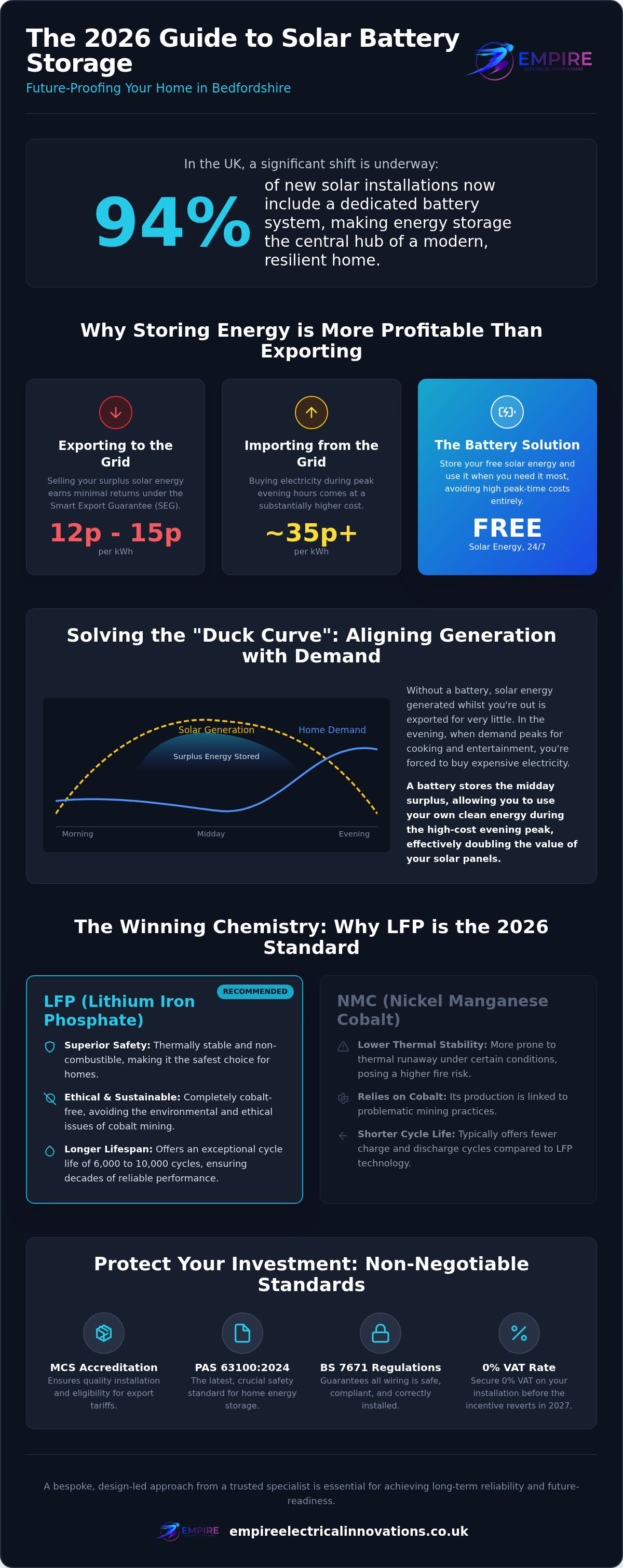
Did you know that 94% of new solar installations in the UK now include a dedicated battery system? In 2026, energy storage is no longer a luxury add-on. It is the central hub of a future-proofed home. If you are searching for reliable solar battery installers Bedfordshire offers, you likely want to stop watching your hard-earned solar energy disappear into the grid for pennies. High electricity prices during evening peaks and frustratingly low Smart Export Guarantee (SEG) rates have made self-sufficiency a necessity rather than a choice.
You have probably felt the frustration of seeing your solar panels produce plenty of power whilst you are at work, only to pay premium rates when you return home. This 2026 buyer's guide provides the clarity you need to navigate new safety standards like PAS 63100:2024 and the latest BS 7671 wiring regulations. We will show you how to secure the 0% VAT rate before it reverts in 2027 and how to integrate storage with EV charging for maximum ROI. This guide outlines the essential steps to select a certified specialist to ensure your property remains powered, protected, and prepared for the years ahead.
Table of Contents
The Strategic Importance of Solar Battery Storage in Bedfordshire
Solar panels generate power during the day, but household demand often peaks after sunset. A battery energy storage system acts as the critical bridge, capturing surplus energy for later use. This technology transforms a simple generation setup into a complete energy ecosystem. For residents working with solar battery installers Bedfordshire specialists recommend, the goal is to maximise every kilowatt generated on-site rather than letting it go to waste.
Bedfordshire receives sufficient solar yield to make storage a high-performing investment. Whilst the county isn't known for constant sunshine, modern PV cells are highly efficient even in diffused light. Storage ensures that energy generated across the Ouse Valley is utilised locally rather than being sent back to the National Grid for a fraction of its market value. It represents a shift from being a passive consumer to an active energy manager.
Why Exporting Energy is No Longer Enough
Relying solely on the Smart Export Guarantee (SEG) is no longer a viable financial strategy. In 2026, export rates often sit between 12p and 15p per kWh, whilst peak-time import costs are substantially higher. This disparity creates a financial leak that only a battery can plug. By storing your own power, you avoid the need to buy back electricity at a premium just because the sun has gone down.
Most households suffer from the "Duck Curve" energy pattern. Production peaks at midday when the house is often empty, but demand spikes in the evening for cooking, laundry, and heating. Without storage, you are forced to buy expensive electricity at night whilst your daytime surplus is exported for little gain. A battery allows for 24/7 self-consumption, letting you use your own power when you actually need it most. It effectively doubles the utility of your solar array.
Local Energy Trends in Bedford, Luton, and Dunstable
The regional landscape is shifting toward resilience. Business parks in Luton and Dunstable are adopting large-scale storage to meet corporate sustainability targets and protect against price volatility. These systems provide a vital buffer against unstable commercial energy markets. In rural Bedfordshire, the benefits are even more practical. Many properties in outlying villages experience unstable grid connections; a robust battery system offers essential protection against local power cuts.
Local authorities are driving a push for carbon neutrality by 2030. Achieving this requires more than just installing panels. It requires the intelligent management of that power. By consulting solar battery installers Bedfordshire businesses trust, you contribute to a more resilient local grid whilst securing your own energy independence. This methodical approach to energy ensures your property is future-ready and shielded from external market shocks.
Selecting the Right Battery Technology: Capacity and Chemistry
When evaluating storage options, it's vital to distinguish between usable capacity (measured in kWh) and power output (measured in kW). Capacity dictates how long your battery lasts. Power output determines what appliances you can run simultaneously. If you want to boil a kettle whilst running a dishwasher, you need high power output, not just high capacity. Expert solar battery installers Bedfordshire specialists recommend will perform a load profile analysis to ensure your system matches your peak demand.
Depth of Discharge (DoD) is another critical metric for long-term reliability. It indicates the percentage of the battery that can be used relative to its total capacity. Modern systems often offer 100% DoD, meaning you can use the entire 'tank' without affecting the unit's lifespan. Choosing between these technologies is a complex task. Qualified solar battery installers Bedfordshire residents trust will always recommend LFP for its inherent fire safety. For more technical details on how these metrics impact your savings, consult this Energy Saving Trust guide to battery storage.
LFP vs. NMC: Which Chemistry Wins in 2026?
In 2026, Lithium Iron Phosphate (LFP) has become the gold standard for residential safety. Unlike Nickel Manganese Cobalt (NMC), LFP batteries are cobalt-free and significantly more stable under high temperatures. This makes them ideal for installation in garages or lofts where thermal fluctuations occur. They also boast a superior cycle life, often lasting 6,000 to 10,000 cycles before performance degrades. Empire Electrical Innovations prioritises LFP chemistry for its combination of safety and longevity.
AC-Coupled vs. DC-Coupled Systems
AC-coupled systems are the preferred choice for retrofitting storage to an existing solar array. They sit on the AC side of your electrics, making installation straightforward and non-disruptive. Conversely, DC-coupled systems are more efficient for entirely new installations as they require fewer conversion steps between the panels and the battery. A DC-coupled setup often yields 1-3% higher efficiency, which compounds over a decade of use. Homeowners in Bedford should consider their existing infrastructure before choosing a path.
Sizing a battery correctly requires a deep understanding of your household's daily energy patterns. You can request a bespoke energy assessment to determine the exact capacity your property requires.
Maximising ROI through Smart Tariffs and EV Integration
In 2026, the financial viability of battery storage is driven by intelligence, not just capacity. Modern battery management systems utilise Artificial Intelligence to predict weather patterns and household energy usage. This allows your system to decide whether to save solar power for the evening or export it during high-demand windows. For those consulting solar battery installers Bedfordshire businesses rely on, this automated optimisation is the key to shortening payback periods. The Smart Export Guarantee (SEG) has evolved into a dynamic market where rates are no longer static, rewarding those who can provide power to the grid when it is most strained.
A sophisticated installation must adhere to Microgeneration Certification Scheme (MCS) standards to ensure you remain eligible for the best financial incentives. This certification is the foundation for accessing high-value export tariffs and the current 0% VAT incentive on installations. By choosing a specialist who understands these regulatory frameworks, you ensure your hardware is fully optimised for the 2026 energy landscape.
The Power of Smart Export and Time-of-Use Tariffs
Energy arbitrage is now a standard feature for Bedfordshire homeowners. This process involves "top-up" charging your battery from the grid during off-peak hours when prices are lowest, then using that cheap energy during expensive peak periods. Some providers, such as Octopus Energy, offer rates as high as 27p per kWh for customers with specific battery setups, whilst others like E.ON Next and British Gas provide competitive fixed rates around 12p to 16.5p per kWh. This ability to buy cheap and sell high transforms your battery into a revenue generator.
Peak Shaving: Businesses can reduce their "red zone" charges by using battery power during maximum demand periods.
Dynamic Export: Selling surplus energy when grid demand peaks for maximum profit.
Grid Balancing: Supporting local infrastructure whilst earning credits from energy suppliers.
Integrating Storage with Electric Vehicle Charging
Pairing battery storage with commercial EV charger installation or residential points creates a closed-loop green energy system. A battery acts as a buffer, preventing a high-power EV charger from tripping the property's main fuse during periods of high domestic use. It also enables "Solar Diversion," a process where the system ensures your vehicle is charged using 100% free, green energy generated on-site rather than pulling from the grid.
This seamless integration is a cornerstone of any future-ready energy strategy. If you are starting from scratch, it is helpful to review our 2026 buyer’s guide for solar panels to understand how generation and storage work in tandem. By coordinating these technologies, you protect your property against future energy price hikes whilst achieving genuine energy self-sufficiency.
The Professional Installation Process: Standards and Compliance
Professional standards are the foundation of a high-performance energy system. It's not just about bolting a unit to a wall. Certified solar battery installers Bedfordshire residents choose must hold MCS accreditation. This certification is mandatory for accessing the 0% VAT rate and the Smart Export Guarantee. Our approach is defined by quiet authority. We remain methodical, disciplined, and highly organised throughout the project lifecycle. Before any hardware arrives, we conduct a comprehensive structural survey. This ensures your property can safely support the combined weight and electrical load of a modern solar and storage array.
Grid Applications: Navigating G98 and G99 in Bedfordshire
Navigating Distribution Network Operator (DNO) requirements is a critical technical step. Most small systems fall under the G98 "notify-and-connect" process. However, larger battery systems, specifically those above 3.68kW per phase, require a full G99 application. This involves obtaining formal grid approval before any work begins. In Bedfordshire, timelines for these applications depend on local grid capacity. As specialist solar battery installers Bedfordshire businesses trust, we handle all technical paperwork and liaison with the DNO. This ensures a seamless experience without administrative delays.
Compliance with Part L and Fire Safety Regulations
Safety standards have tightened significantly in 2026. All new domestic installations must comply with the Part L building regulations for solar and storage. The PAS 63100:2024 fire-safety specification now dictates safe locations for battery units. For instance, batteries are strictly prohibited from lofts, bedrooms, or escape routes like hallways and stairs. We utilise fire-rated enclosures and ensure units are sited in ventilated, accessible areas. Every project concludes with certified electrical testing and commissioning under BS 7671 Amendment 4 and Part P regulations.
The process doesn't end when the last cable is clipped. A thorough handover is essential for long-term value. We provide comprehensive training on your battery management app. This allows you to monitor generation, storage levels, and household consumption in real time. Understanding these metrics is vital for maximising your ROI. To ensure your system meets these rigorous standards, you can book a technical site survey with our specialists.
Why Choose Empire Electrical Innovations for Your Bedfordshire Project?
Selecting the right partner for your energy transition is an investment in your property's future. Empire Electrical Innovations brings a unique perspective to the region. We are not high-volume installers focused on rapid turnover. Instead, we act as a bespoke specialist, providing design-led solutions that account for every technical nuance. As established solar battery installers Bedfordshire homeowners and businesses trust, we prioritise precision over speed. Our methodical approach ensures that your system is sized correctly and installed to the highest professional standards.
Our background in commercial telecoms and EV infrastructure gives us a significant technical advantage. We understand complex infrastructure. This expertise ensures your battery system isn't just an isolated unit; it is a core component of a wider, integrated energy strategy. Whether we are working on a residential project or a large-scale commercial site, our focus remains on future-readiness. We build systems that are prepared for the energy demands of 2026 and beyond, positioning us as the preferred solar battery installers Bedfordshire organisations choose for complex projects.
Bespoke Design for Residential and Commercial Clients
We utilise sector-specific framing to meet the unique needs of every client. Schools, warehouses, and business parks require a different technical approach compared to a standard domestic home. For commercial clients in Bedfordshire business parks, we focus on load management and peak shaving to reduce operational costs. We only utilise premium components, such as GivEnergy battery storage systems, known for their reliability and advanced monitoring capabilities. This commitment to quality ensures long-term value and a better return on your investment. A high-quality installation today prevents costly remedial work in the future.
A Partnership-First Approach to Energy
We frame every project as a collaborative start. Our partnership-first approach means we value clear communication and workmanship over empty promises. We guide you through the entire process, from the initial grid application to the final commissioning and app training. You will always have a clear point of contact who understands the specifics of your project. We don't believe in high-pressure sales; we believe in providing the technical data you need to make an informed decision.
Taking the next step is straightforward and transparent. We provide free site surveys and comprehensive quotations to ensure you have a full understanding of the project scope and benefits. This is a no-nonsense business attitude focused on delivery and performance. We invite you to book a professional site survey with our specialists to discover how a bespoke battery storage system can transform your energy profile.
Future-Proofing Your Bedfordshire Energy Strategy
Transitioning to a battery storage system is a decisive step toward full energy self-sufficiency. You have seen how the right chemistry and smart grid integration transform a standard solar array into a high-performing financial asset. By prioritising safety standards and technical compliance, you ensure your investment delivers reliable power for decades. It's about moving beyond simple generation to active energy management.
As you evaluate the solar battery installers Bedfordshire offers, look for a partner that values technical precision over high-volume sales. Empire Electrical Innovations provides the quiet authority needed for complex infrastructure projects. Our team handles every detail, including MCS certified installations, bespoke system design, and full DNO application management. We ensure your transition is seamless and fully compliant with 2026 regulations.
Book your free Bedfordshire solar battery survey today to begin your journey toward lasting energy independence. We look forward to helping you secure a more resilient future.
Frequently Asked Questions
Do I need solar panels to install a battery storage system in Bedfordshire?
You don't strictly need solar panels to benefit from a battery storage system. Whilst most residents use them to store free solar energy, you can also "top up" your battery using cheap off-peak electricity from the grid. This strategy is particularly effective on time-of-use tariffs. Leading solar battery installers Bedfordshire homeowners consult will design a system that works for your specific energy import patterns, even if you haven't yet installed a PV array.
How long does a typical solar battery last before it needs replacing?
Most modern lithium-ion batteries are designed to last between 10 and 15 years. This lifespan is typically measured in cycles, which refers to one full charge and discharge. Lithium Iron Phosphate (LFP) units generally offer a higher cycle life compared to older chemistries. Your battery won't suddenly stop working after this period; it will simply retain less charge over time. High-quality components and professional installation ensure the unit remains efficient for the longest possible duration.
Can a solar battery provide power during a grid outage or blackout?
A solar battery can provide backup power during a blackout, but only if the system is specifically configured for "island mode" or includes an Emergency Power Supply (EPS) function. Standard grid-tied systems are designed to shut down during power cuts for safety reasons to prevent energy from feeding back into the grid. If protection against outages is a priority, your installer must include additional switching and earth electrodes to ensure your home remains powered safely when the grid fails.
Will I need planning permission for a battery installation in Bedford?
Planning permission is rarely required for domestic battery storage as most installations fall under Permitted Development rights. This applies to both internal and external units, provided they meet certain size and safety criteria. However, if your property is a listed building or located within one of Bedfordshire's conservation areas, you should consult the local planning authority. We recommend checking with Bedford Borough Council or Central Bedfordshire Council if you have any doubts about your property’s specific status.
How much space is required for a domestic battery storage unit?
A typical domestic battery is roughly the size of a small suitcase or a slim wall-mounted radiator. Most units measure approximately 60cm to 80cm in height and 15cm to 25cm in depth. Whilst they are compact, they require adequate clearance for ventilation and must be sited according to PAS 63100:2024 fire safety standards. Professional solar battery installers Bedfordshire residents trust will identify the most efficient location, such as a garage or a dedicated utility area, to ensure compliance and performance.
What is the typical payback period for a solar battery in 2026?
Payback periods for combined solar and battery systems currently range between 6 and 9 years for a typical UK household. This duration depends on several factors, including your daily energy consumption, the specific tariff you use, and the current Smart Export Guarantee (SEG) rates. By storing your own energy and avoiding peak-time grid prices, you significantly accelerate the return on your investment. Smart energy management and dynamic charging from the grid further improve these financial outcomes for local property owners.
Are there any government grants or incentives for batteries in the UK currently?
The primary financial incentive currently available is a 0% VAT rate on the installation of energy-saving materials, which includes battery storage. This incentive is set to remain in place until 31st March 2027, after which it is expected to revert to 5%. Additionally, whilst not a direct grant, the Smart Export Guarantee (SEG) allows you to earn money by exporting stored energy back to the grid during peak demand periods, provided your system is MCS certified and installed by a qualified specialist.
Can I add a battery to my existing solar panel system (retrofitting)?
You can easily add a battery to an existing solar panel array through a process known as retrofitting. This is typically achieved using an AC-coupled system, which integrates with your current setup without needing to replace your existing solar inverter. It is a highly effective way to upgrade an older installation and increase your energy independence. Our specialists ensure that the new storage unit communicates naturally with your existing hardware to maximise overall system performance and long-term reliability.


Comments