
Commercial Battery Storage: 2026 UK Business Guide

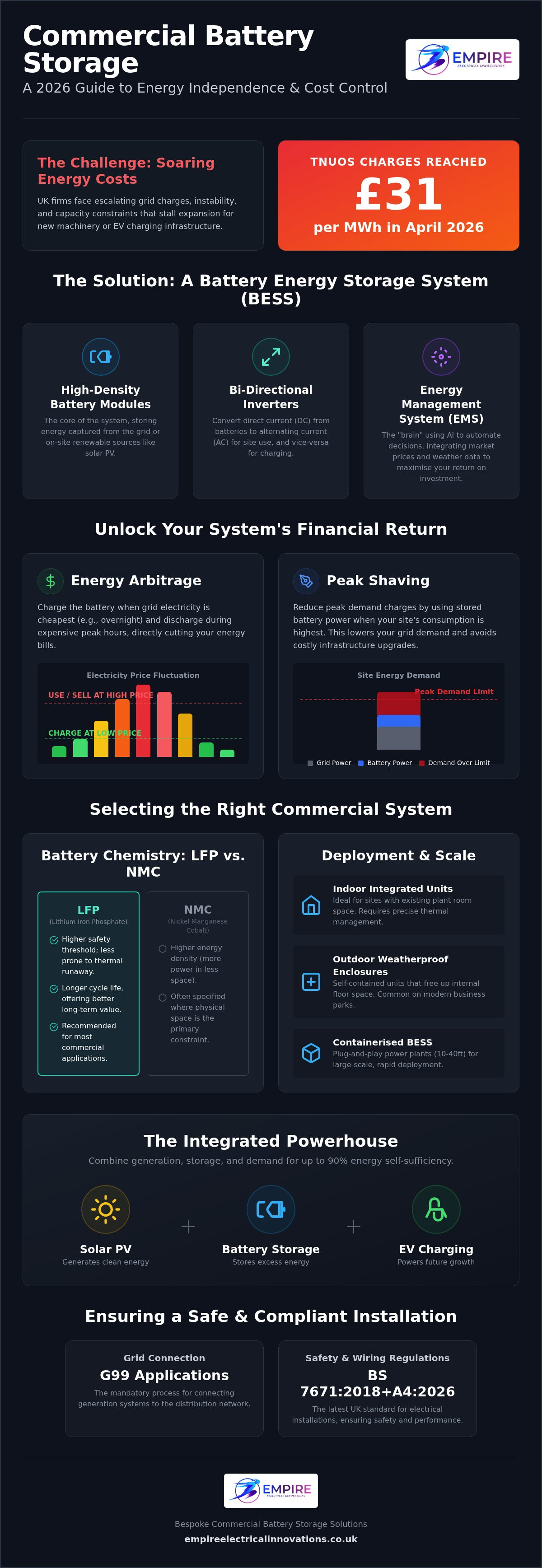
In 2026, energy arbitrage is no longer a peripheral green accessory. It's a critical financial tool for any firm facing Transmission Network Use of System (TNUoS) charges that climbed to £31 per MWh this April. You've likely felt the pressure of unpredictable price spikes during peak hours or found your growth stalled by local grid capacity constraints. It's a common frustration. Expansion plans for EV charging or new machinery shouldn't be held hostage by an unstable local grid.
This guide demonstrates how bespoke commercial battery storage solutions can bypass these bottlenecks, slash your operational overheads, and provide the reliable backup power your critical infrastructure demands. We've designed this resource to help you navigate the transition with confidence. You'll discover the practicalities of the new BS 7671:2018+A4:2026 compliance standards and the realities of G99 applications. We also examine how integrated systems future-proof your business against a volatile energy market. This ensures your site remains resilient, compliant, and cost-effective for years to come.
Table of Contents
What are Commercial Battery Storage Solutions?
Understanding what is a battery energy storage system (BESS) is the first step toward true energy autonomy. At its core, a BESS is a modular technology that captures electricity from either the national grid or on-site renewable sources, such as solar PV, to be discharged when it's most beneficial. In 2026, these systems have evolved into sophisticated financial assets. They comprise three primary pillars: high-density battery modules, bi-directional inverters for power conversion, and an Energy Management System (EMS) to oversee the entire operation.
This year represents a definitive turning point for UK firms. With TNUoS charges rising to £31 per MWh in April 2026, the financial argument for commercial battery storage solutions is undeniable. Scale is no longer a barrier. You can deploy anything from a 10kWh wall-mounted unit for a small retail unit to multi-megawatt containerised solutions for heavy industrial applications. The technology is flexible, secure, and built for longevity.
Behind-the-Meter vs. Front-of-the-Meter
Configuration determines how you'll interact with the energy market. Behind-the-meter (BTM) systems sit on your side of the electric meter. They're designed for on-site consumption, allowing you to store solar energy or cheap overnight power to lower your bills. This is the standard choice for manufacturing plants or data centres with high daytime demand. Front-of-the-meter (FTM) systems connect directly to the distribution network. These are typically used by developers to provide grid services like frequency response. For most businesses, a BTM setup offers the most direct path to reducing operational overheads.
The Role of the Energy Management System (EMS)
The EMS acts as the system's brain. It doesn't just store power; it makes intelligent, real-time decisions. Modern EMS platforms use AI-driven algorithms to integrate weather forecasting and market pricing data. If the system predicts a cloudy afternoon, it might hold onto stored energy longer. If it sees a price spike on the horizon, it prepares to discharge. The EMS maximises ROI by autonomously selecting the most cost-effective energy source at any given second. This level of precision ensures your infrastructure isn't just a battery, but a proactive financial tool that protects your bottom line whilst you focus on core operations.
Types of Industrial Battery Systems for Business Parks
Selecting the correct hardware is a balance between site geography and operational demand. Most commercial battery storage solutions fall into two categories: indoor integrated units or outdoor weatherproof enclosures. Indoor systems are ideal for businesses with vacant plant room space, though they require precise thermal management to ensure longevity. Outdoor systems are more common on modern business parks. These units are self-contained, freeing up valuable internal floor space whilst providing robust protection against the elements.
The chemistry inside the module is just as vital as the enclosure. We typically recommend Lithium Iron Phosphate (LFP) for commercial applications. It offers a higher safety threshold and a longer cycle life than Nickel Manganese Cobalt (NMC) alternatives. Modular systems are particularly effective for growing firms. They allow you to scale your capacity in increments, meaning your infrastructure evolves alongside your business needs without requiring a complete system overhaul.
Containerised BESS for Large-Scale Operations
For warehousing, data centres, and heavy manufacturing, containerised BESS units offer a rapid deployment path. Available in standard 10ft, 20ft, and 40ft formats, these are essentially portable power plants. They feature pre-installed HVAC systems and automated fire suppression, making them a "plug and play" solution for sites with high energy intensity. This standardised approach reduces installation timelines and ensures your site remains compliant with the latest safety protocols.
The Triple-Threat: Solar, Storage, and EV Integration
A truly resilient energy strategy combines generation, storage, and demand. Whilst solar PV for commercial buildings provides the primary driver of cost savings, it requires a battery buffer to achieve 90% or higher self-sufficiency. This integration is essential when deploying commercial EV charging infrastructure. High-speed chargers can easily exceed a site's grid capacity, leading to expensive upgrade fees. By using a battery to manage these spikes, you protect your infrastructure and your budget.
Recent government proposals for community batteries underscore the importance of this balancing act for local grid stability. In one instance, a Hertfordshire business park recently avoided a £100,000 grid connection fee by using a BESS to buffer their EV charging hub. It's a practical example of how intelligent design beats brute-force infrastructure spending. If you're planning a site expansion, our bespoke energy design services can help you identify similar savings before you commit to costly grid upgrades.
Calculating ROI: Financial Benefits and Energy Arbitrage
Investing in commercial battery storage solutions is a strategic financial decision rather than a simple utility purchase. In the 2026 energy market, the return on investment (ROI) is driven by a combination of immediate bill reductions and long-term tax efficiencies. By deploying a BESS, firms can move from being passive consumers to active participants in the energy market. This shift allows you to control your exposure to volatile wholesale prices whilst creating new revenue streams through grid services.
The financial framework for a commercial installation rests on four primary pillars:
Peak Shaving: Lowering your 'Maximum Demand' charges by discharging stored energy during peak periods.
Load Shifting: Buying electricity when rates are lowest and using it when prices spike.
Revenue Generation: Earning payments by providing Frequency Response and grid balancing services back to the National Grid.
Capital Allowances: Utilising the UK government's 'Full Expensing' relief to deduct 100% of the investment cost from taxable profits in the first year.
This financial viability is supported by the UK's official battery strategy, which outlines the national commitment to a sustainable and competitive energy infrastructure. These frameworks provide the stability needed for long-term corporate planning.
Understanding Energy Arbitrage
Energy arbitrage is the practice of exploiting price differences in the electricity market. In 2026, time-of-use tariffs have become increasingly granular. It's now possible to buy off-peak energy for as little as 10p/kWh and avoid paying 45p/kWh or more during expensive "Red Zone" peak hours. For high-intensity operations, this 35p margin represents a massive improvement in operating margins. A well-optimised BESS typically achieves a full return on investment within five to eight years, depending on the site's specific load profile and solar integration. This ensures the technology pays for itself well within its operational lifespan.
Operational Resilience and UPS Capabilities
ROI isn't solely about the monthly bill; it's also about risk mitigation. There's a fundamental difference between standard storage and systems with Uninterruptible Power Supply (UPS) functionality. A standard battery might take a few seconds to kick in. A UPS-capable system provides a seamless transition, protecting critical data centres and medical facilities from brownouts or local grid instability. When you quantify the cost of a single hour of downtime against the cost of installation, the "insurance" value of a battery often outweighs the direct energy savings. It's a secure foundation for any business where power continuity is non-negotiable.
Compliance, G99 Applications, and Planning Permission
Compliance is the foundation of any reliable energy installation. In 2026, the regulatory landscape for commercial battery storage solutions has matured significantly. Amendment 4 to the 18th Edition Wiring Regulations, published in April 2026, introduces Chapter 57 specifically for stationary secondary battery installations. Compliance becomes mandatory after 15 October 2026. These rules aren't optional. They're essential for securing commercial property insurance and ensuring long-term grid stability.
For developers and landlords, meeting Part L building regulations is a critical milestone. Integrating battery storage helps modern sites meet carbon reduction targets that would otherwise be unattainable through fabric improvements alone. Regarding planning permission, many BESS installations on business parks fall under "Permitted Development" if they meet specific size and noise criteria. Larger containerised units or those in sensitive locations usually require a formal application to the local authority.
Navigating the G99 Grid Connection
Connecting to the grid in London or Hertfordshire requires a methodical approach. DNO approval timelines currently range from 8 to 16 weeks, so early application is vital. We manage the entire G99 and G100 process to prevent project delays. The sequence is clear:
Step 1: Initial site capacity study and DNO enquiry. We determine if the local substation can handle your required charge and discharge rates.
Step 2: Formal G99 application and technical design submission. We provide the comprehensive diagrams and fault-level calculations the DNO requires.
Step 3: Witness testing and final commissioning. We facilitate the final on-site checks with the DNO to verify the system's behaviour before it goes live.
Health and Safety for Commercial Storage
Safety is a core pillar of our identity as specialist installers. By prioritising Lithium Iron Phosphate (LFP) chemistry, we provide systems with a much higher safety threshold than older Nickel Manganese Cobalt (NMC) alternatives. LFP is inherently more stable, significantly reducing the risk of thermal runaway. Installations must also maintain safe distances from existing buildings and feature dedicated ventilation to manage heat. A structured maintenance schedule is non-negotiable. It ensures that sensors, cooling fans, and fire suppression systems remain fully operational throughout the system's life.
If you're unsure about your site's grid capacity or planning status, we'll handle the technical legwork for you. Contact us for a bespoke site survey and G99 feasibility report to start your project correctly.
Bespoke Commercial Battery Storage from Empire Electrical Innovations
Empire Electrical Innovations operates as a Trusted Specialist in the energy sector. We don't just supply hardware; we deliver fully commissioned infrastructure. Our turnkey approach covers every stage of the project lifecycle. We manage the process from the first site survey through to final grid commissioning. Our local expertise in Hertfordshire and London is a distinct advantage for site logistics. It allows us to manage complex deliveries and installations whilst maintaining strict project timelines across the Home Counties.
We believe bespoke design is the only way to achieve maximum efficiency. One-size-fits-all hardware often leads to oversized costs or undersized performance. We partner with leading brands such as GivEnergy battery storage to ensure your system is robust and reliable. By using commercial battery storage solutions tailored to your specific site, we guarantee that your investment is future-proofed against the evolving UK energy market. Our designs are methodical, disciplined, and focused on your long-term value.
The Site Survey and Feasibility Study
Our process begins with a rigorous load profile analysis. We don't rely on estimates. We examine your half-hourly data to ensure your BESS is sized correctly for your operational demand. We also evaluate your existing solar PV and EV charging infrastructure to facilitate a seamless integration. This methodical approach allows us to provide transparent ROI projections. These figures are based on your current energy tariff and projected 2026 market trends, giving you a clear financial roadmap before you break ground.
Ongoing Support and Asset Management
Installation is just the start of our partnership. We offer remote monitoring services to maintain 24/7 system health. This proactive oversight means we can address anomalies before they affect your power resilience. Our asset management includes annual performance reviews and firmware optimisations to keep your hardware running at peak efficiency. We ensure your system remains compliant with the latest grid standards as they evolve. This provides a sense of security and competence that only a seasoned partner can offer.
Ready to secure your energy independence? Book your free commercial site survey today and let our specialists design a solution that fits your business.
Future-Proof Your Energy Infrastructure
The transition to commercial battery storage solutions is a strategic move toward financial stability and operational resilience. By mastering energy arbitrage and securing your site against grid instability, you transform a utility cost into a high-performance asset. We've explored how proper G99 compliance and bespoke system design are the foundations of a successful installation. These elements ensure your business remains competitive in a volatile energy market whilst meeting the latest safety standards established in 2026.
Empire Electrical Innovations provides the expertise needed to navigate this complex landscape. Our Hertfordshire-based technical support team specialises in the seamless integration of solar, battery, and EV infrastructure. We deliver fully G99 and G100 compliant installations that prioritise your long-term value and corporate sustainability goals. Don't leave your energy future to chance. Request a Bespoke Commercial Energy Survey today to begin your journey toward energy independence. We look forward to helping you build a more resilient, efficient, and cost-effective business.
Frequently Asked Questions
How much space does a commercial battery storage system require?
Space requirements depend on your required capacity and the choice of enclosure. Small-scale indoor systems typically occupy a footprint similar to a standard server cabinet, making them suitable for plant rooms or warehouses. Larger installations require external space for 10ft, 20ft, or 40ft containers. We identify the most efficient location during our site survey, ensuring adequate ventilation and clearance for maintenance access whilst minimising the impact on your operational floor space in Hertfordshire or London.
Can my business operate entirely off-grid with a BESS?
Most businesses use these systems for grid-tied resilience rather than total independence. Operating entirely off-grid requires an immense battery capacity and a significant renewable generation source to handle winter demand. It's technically feasible but often cost-prohibitive for high-intensity commercial sites. We focus on designing systems that provide reliable backup power and peak-shaving capabilities, allowing you to maintain operations during local grid outages whilst remaining connected to the distribution network.
What is the typical lifespan of an industrial-scale battery?
Industrial-scale batteries typically offer a service life of 10 to 15 years. This longevity is measured in charge and discharge cycles, with modern Lithium Iron Phosphate (LFP) modules often rated for 6,000 to 10,000 cycles at 80% depth of discharge. System health is preserved through intelligent Energy Management Systems that prevent overcharging and manage thermal levels. We provide annual performance reviews to ensure your hardware continues to meet its projected efficiency targets throughout its lifespan.
Are there government grants for commercial battery storage in 2026?
Direct government grants for commercial battery storage solutions are limited in 2026, but significant tax incentives remain available. The 'Full Expensing' capital allowance allows UK firms to deduct 100% of the investment cost from taxable profits in the year of purchase. Additionally, businesses in Hertfordshire and Buckinghamshire may access regional decarbonisation funds or low-interest green loans. We recommend consulting with your financial advisor to maximise these tax-efficient investment routes for your energy infrastructure.
How does a battery system improve our ESG and sustainability reporting?
Battery systems directly improve your ESG ratings by increasing your site's renewable energy self-consumption. Storing solar power for use during peak hours reduces your reliance on carbon-intensive grid electricity, lowering your reported Scope 2 emissions. This data is easily quantifiable through our monitoring software, providing transparent evidence for corporate sustainability reports. It demonstrates a proactive commitment to the UK's net-zero transition to investors, clients, and local stakeholders across the Home Counties.
What happens to the battery if our business moves premises?
Relocating a battery system is possible, but it involves significant decommissioning and re-commissioning costs. Most businesses find that the system adds substantial value to the property, making it more profitable to include the infrastructure in the building's lease or sale price. If you do choose to move the hardware, a new G99 application is required for the new site. We can assist with the technical assessment to determine if relocation is financially viable for your organisation.
How long does the G99 application process usually take?
The approval process generally spans eight to sixteen weeks, though this varies by the Distribution Network Operator (DNO). We manage the entire application in-house to ensure all technical designs and fault-level calculations meet the specific requirements of operators like UK Power Networks. Starting this process early is essential for project timelines. We provide regular updates as your application progresses through the mandatory assessment stages to final witness testing and commissioning.
Can we add battery storage to our existing commercial solar array?
You can easily integrate commercial battery storage solutions with your existing solar PV array through an AC-coupled configuration. This method allows the battery to sit alongside your current solar inverters without requiring a complete overhaul of your existing setup. It's an efficient way to capture excess generation that would otherwise be exported to the grid for minimal return. Our team specialises in these retrofits across Hertfordshire and London, ensuring seamless communication between your old and new energy assets.


Comments