
Commercial Battery Storage Buckinghamshire: 2026 Industrial Trends & ROI Guide

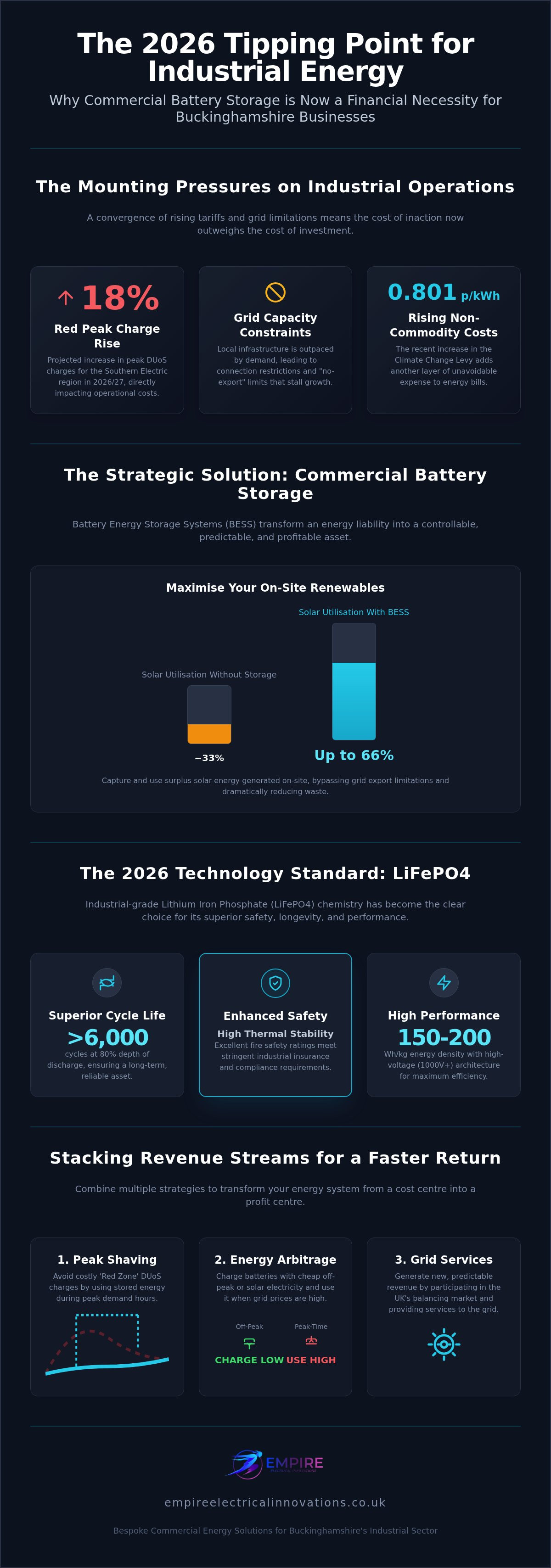
With red peak electricity charges in the Southern Electric region rising by 18 per cent for the 2026/27 period, the cost of doing nothing has officially surpassed the cost of investment. For industrial operators, commercial battery storage Buckinghamshire is no longer a luxury for the eco-conscious. It is a vital hedge against a volatile energy market. You are likely feeling the pressure of rising tariffs and the specific grid capacity constraints that often stall growth in local business parks. The increase in the Climate Change Levy to 0.801p/kWh this April only adds to the urgency of finding a more efficient way to manage power.
We understand that evaluating battery chemistry and G99 regulations can feel complex. This guide promises to simplify that process, showing you exactly how industrial battery systems turn energy liabilities into predictable assets. We will explore the latest 2026 ROI trends, including how to reduce peak-demand charges and generate new revenue through grid-balancing services. By the end, you will have a clear roadmap for integrating storage with your existing commercial solar PV to secure long-term energy independence.
Table of Contents
The Evolving Energy Landscape for Buckinghamshire Businesses in 2026
Buckinghamshire's industrial sector is currently navigating a period of profound structural change. The push for Net Zero 2026 has shifted from a corporate social responsibility goal to a core operational requirement. High-growth industrial hubs in Aylesbury and High Wycombe are leading this transition, yet they face a significant hurdle. The local infrastructure is struggling to keep pace with the rapid electrification of heat and transport. For many firms, 2026 represents the tipping point where traditional energy procurement is no longer sufficient to protect industrial margins.
The Buckinghamshire Local Enterprise Partnership (LEP) continues to champion sustainable growth, but policy alone cannot solve grid limitations. As businesses install larger solar arrays and EV charging fleets, the demand on the local network has reached critical levels. This environment has made commercial battery storage Buckinghamshire a strategic necessity. It provides the flexibility required to operate within a constrained network whilst maintaining ambitious production schedules. Modern businesses are moving away from passive consumption toward active energy management.
Grid Capacity Challenges in Buckinghamshire
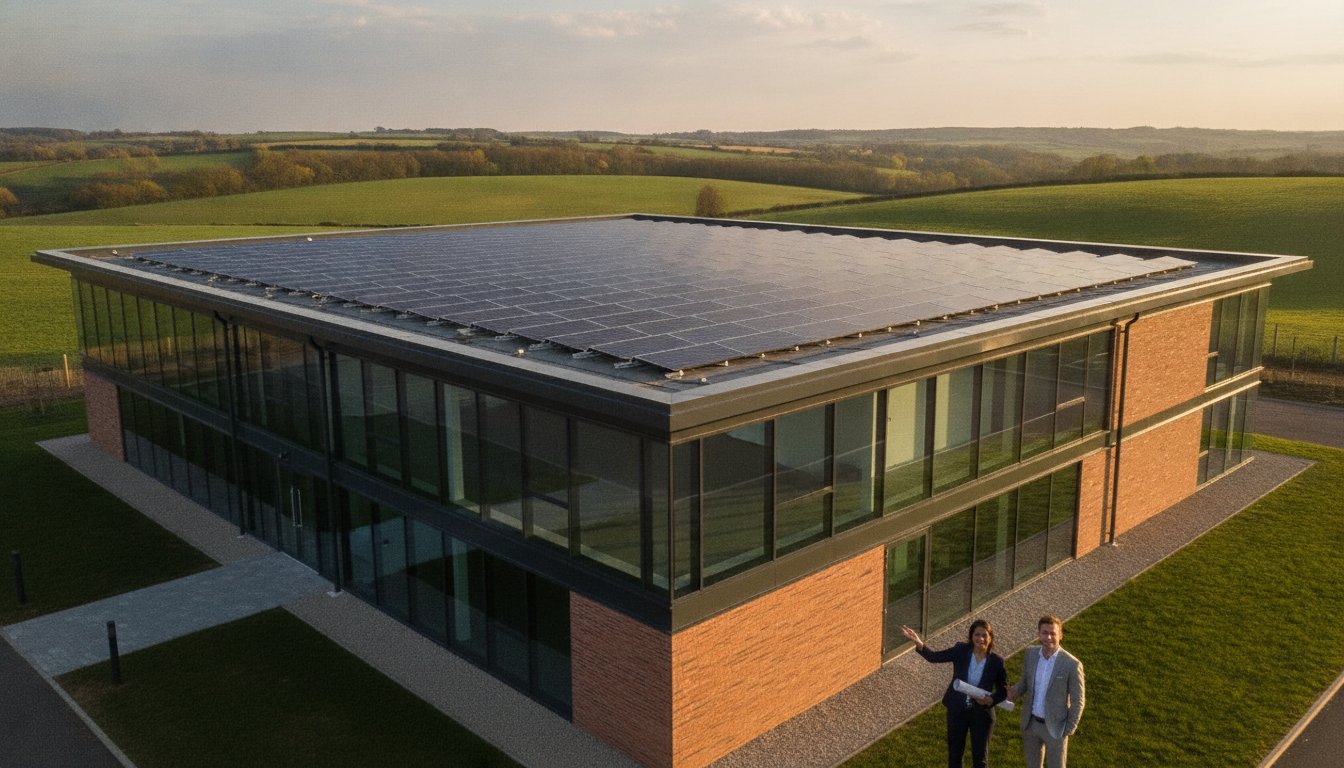
Industrial expansion in the South East is currently outpacing local substation upgrades. In many Buckinghamshire business parks, the Distribution Network Operator (DNO) may restrict new connections or impose "no-export" constraints. This prevents businesses from sending surplus solar power back to the grid. A battery energy storage system (BESS) solves this by capturing that energy on-site. Public sector projects have already validated this approach. Local libraries and family centres across the county have demonstrated that integrated storage allows sites to utilise up to 66 per cent of their generated renewable energy. This model is now being scaled for heavy industrial use to bypass grid queues.
Energy Price Volatility and the 2026 Outlook
Fixed-price energy contracts are no longer the safety net they once were. While wholesale costs fluctuate, non-commodity charges are rising steadily. In the Southern Electric Power Distribution (SEPD) region, red peak DUoS charges are expected to grow by 18 per cent during the 2026/27 period. Additionally, the Climate Change Levy increased to 0.801p/kWh in April 2026. These rising costs make load-shifting essential.
The transition to Market-wide Half-Hourly Settlement (MHHS) will be complete by May 2027, meaning prices will be tied directly to the time of use. Businesses that don't adapt will face significant penalties during peak hours. Integrating storage with solar PV for commercial buildings allows firms to buy electricity when it is cheapest and use it when the grid is most expensive. This strategy protects industrial margins from the volatility of the 2026 energy market.
Industrial Battery Storage Systems: 2026 Technology Trends
In 2026, an industrial-grade battery energy storage system (BESS) is defined as a high-capacity infrastructure asset typically achieving energy densities of 150 to 200 Wh/kg at the pack level. This technical specification distinguishes these units from light commercial wallboxes, which are designed for lower cycle depths and smaller loads. Industrial systems are built to withstand the rigours of heavy manufacturing, often operating at high-voltage architectures of 1000V or more to reduce conversion losses and improve thermal management.
Lithium Iron Phosphate (LiFePO4) has emerged as the dominant chemistry for commercial battery storage Buckinghamshire projects this year. While other chemistries exist, LiFePO4 offers the thermal stability and fire safety ratings required for insurance compliance in industrial settings. It also provides a superior cycle life, often exceeding 6,000 cycles at 80 per cent depth of discharge. This longevity aligns with the UK's national battery strategy, which focuses on developing a secure and sustainable supply chain for high-performance storage solutions.
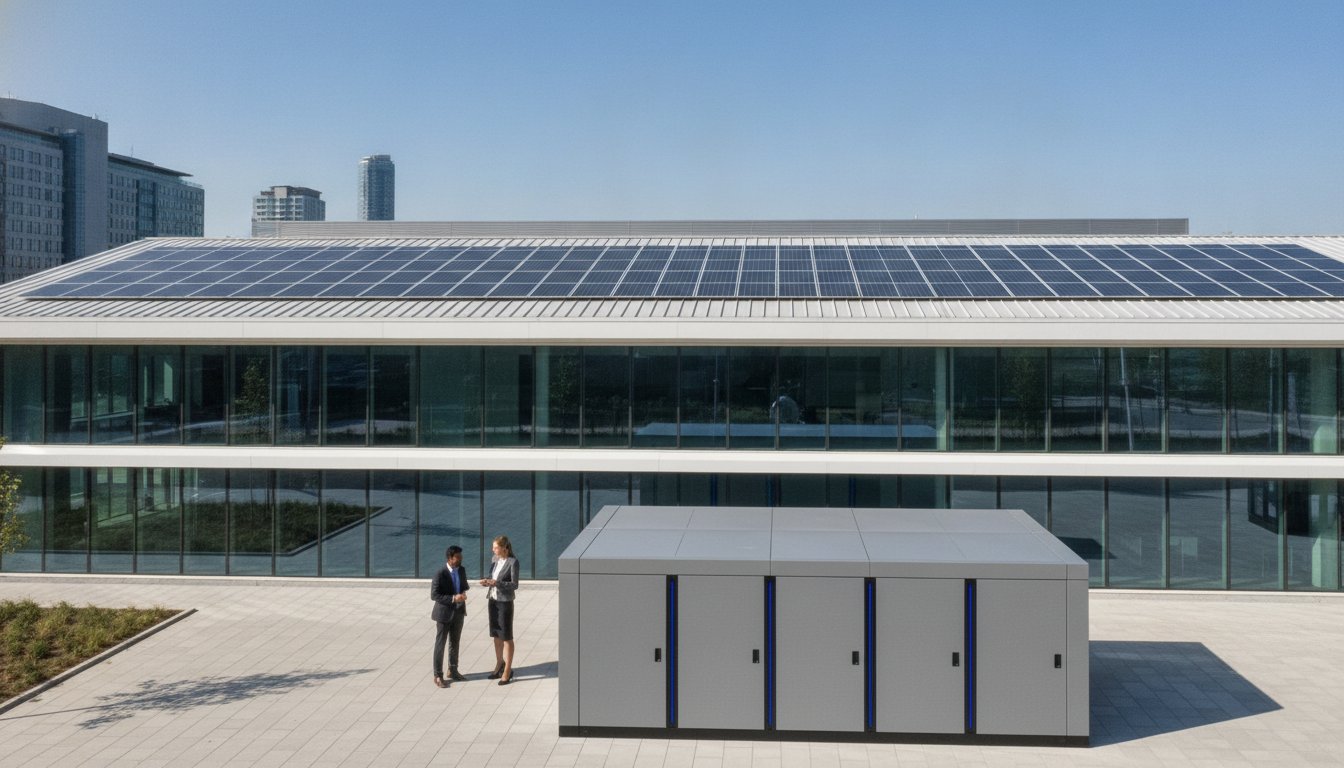
Choosing the right physical format is equally critical for Buckinghamshire facilities. Modular systems are increasingly popular for businesses with available internal plant room space, as they allow for incremental capacity increases. Conversely, containerised systems housed in 20ft or 40ft ISO enclosures provide a "plug-and-play" solution for sites where internal space is at a premium. These outdoor units come pre-integrated with cooling, fire suppression, and power conversion systems, making them ideal for rapid deployment in busy industrial parks. To ensure your facility selects the most efficient configuration, it is advisable to consult with a specialist designer during the early planning stages.
AI-Driven Energy Management Systems (EMS)
Machine learning has transformed how industrial batteries interact with the grid. Modern EMS platforms now predict peak demand by analysing historical plant load data alongside real-time weather patterns. This allows the system to optimise discharge cycles, ensuring power is available exactly when it is needed most. These algorithms are a cornerstone of advanced commercial solar battery storage London deployments, where they manage complex multi-site energy flows to maximise financial returns whilst protecting the physical health of the battery cells.
Hybrid Inverter Advances for Industrial Use
The latest multi-string high-voltage inverters have pushed round-trip efficiency levels beyond 90 per cent. For industrial processes where even a momentary power dip can cause costly production delays, these inverters offer seamless switching with 0ms latency. This provides a level of power quality that traditional backup generators cannot match. Furthermore, these systems are designed for future-readiness, featuring bi-directional charging capabilities that will allow businesses to integrate vehicle-to-grid (V2G) technology as their commercial fleets transition to electric power.
Strategic ROI: Peak Shaving, Arbitrage, and Grid Services
Financial performance for industrial energy assets has moved beyond simple cost-cutting. In 2026, commercial battery storage Buckinghamshire functions as a high-yield financial tool. The primary driver for many manufacturers is peak shaving. By discharging stored energy during the SEPD "Red Zone" periods, businesses avoid the 18 per cent increase in peak DUoS charges scheduled for the 2026/27 period. This targeted discharge prevents expensive spikes in demand charges that often cripple industrial margins during high-output shifts.
Energy arbitrage provides a secondary layer of value. Systems can be programmed to purchase power during off-peak windows when rates are at their lowest. This stored energy is then utilised during expensive daytime peaks or sold back to the grid. With Smart Export Guarantee (SEG) rates reaching as high as 29p/kWh during peak hours, the spread between off-peak purchase prices and peak export revenue has never been more attractive. This active participation in the energy market aligns with the UK's national battery strategy, which encourages industrial sites to act as flexible grid assets.
Sustainability reporting also sees a measurable boost. Industrial BESS allows for precise tracking of carbon displacement. This data is vital for ESG reporting and stakeholder transparency. It transforms a technical installation into a powerful statement of corporate responsibility, proving that the business is future-ready and resilient.
Calculating the ROI of Industrial Storage
Professional investors now prioritise Internal Rate of Return (IRR) over simple payback periods. Whilst a typical standalone system might see a return in four to ten years, this timeline accelerates significantly when paired with on-site generation. Integrating storage with solar battery installation Hertfordshire models creates a self-sustaining energy loop. By combining peak shaving, arbitrage, and grid service payments, "stacked benefits" can effectively halve the payback time of industrial BESS compared to single-use applications.
Grid Services and Demand Side Response (DSR)
Buckinghamshire businesses can now generate direct revenue by supporting the National Grid through Dynamic Containment and Frequency Response services. Most industrial sites partner with an "Aggregator" to manage this process. These specialists bundle multiple battery fleets together to meet the minimum capacity requirements for grid auctions. Legislative changes in 2026 have streamlined this process, making it easier for medium-sized enterprises to access markets that were previously reserved for utility-scale providers. This ensures your battery is earning money even when your factory is idle.
Planning Your Installation: Compliance, Capacity, and Location
Successful implementation of commercial battery storage Buckinghamshire depends on a methodical, five-step planning process. We begin with a detailed half-hourly (HH) data load profile analysis. This ensures the system is sized to your actual consumption patterns rather than theoretical estimates. Following this, the DNO G99 application process is initiated. For industrial sites in Buckinghamshire, this involves navigating either SSEN or UKPN requirements under the Engineering Recommendation G99 Issue 1 Amendment 9 (2026). Securing export capacity is essential for the revenue-stacking strategies discussed in previous sections.
The physical installation requires rigorous structural and environmental assessments, particularly for containerised solutions. These units must be placed on reinforced foundations that account for both weight and local drainage. Once the hardware is in place, we focus on commissioning and seamless integration with your existing Building Management System (BMS). This allows for real-time monitoring and automated control of your energy flows. To begin this process for your facility, you can book a professional site survey to assess your specific infrastructure needs.
DNO and Planning Permission in Buckinghamshire
Navigating the grid in Aylesbury or High Wycombe requires early engagement with the relevant DNO. Most industrial projects fall under SSEN or UKPN jurisdiction. Whilst many battery installations are considered permitted development, large-scale containerised systems often require formal planning permission from Buckinghamshire Council. We also prioritise the telecoms infrastructure during this stage. High-spec monitoring requires reliable fibre or 4G/5G connectivity to ensure the system communicates effectively with grid aggregators and provides the data required for ESG reporting.
Safety Standards and Insurance Considerations
Compliance with the latest IET wiring regulations is the baseline for every project. Industrial units must feature dedicated thermal management and fire suppression systems to meet the high standards of commercial insurers. We focus on bespoke safety designs that include automated shutdown protocols and specific spacing requirements for indoor installations. Providing your insurer with a comprehensive compliance pack, including details on the LiFePO4 chemistry and fire-rated enclosures, is the best way to secure coverage for your new energy assets.
Bespoke Energy Solutions: Partnering with Empire Electrical Innovations
Empire Electrical Innovations operates with a quiet authority in the high-end industrial energy sector. We don't rely on flashy marketing. We rely on methodical engineering and proven results. Our team handles every phase of your project, starting with free site surveys and moving through bespoke system design to final commissioning. This comprehensive approach ensures that your commercial battery storage Buckinghamshire installation is tailored to your specific load profile and operational goals. We understand that industrial infrastructure is a long-term investment, so we prioritise precision at every stage.
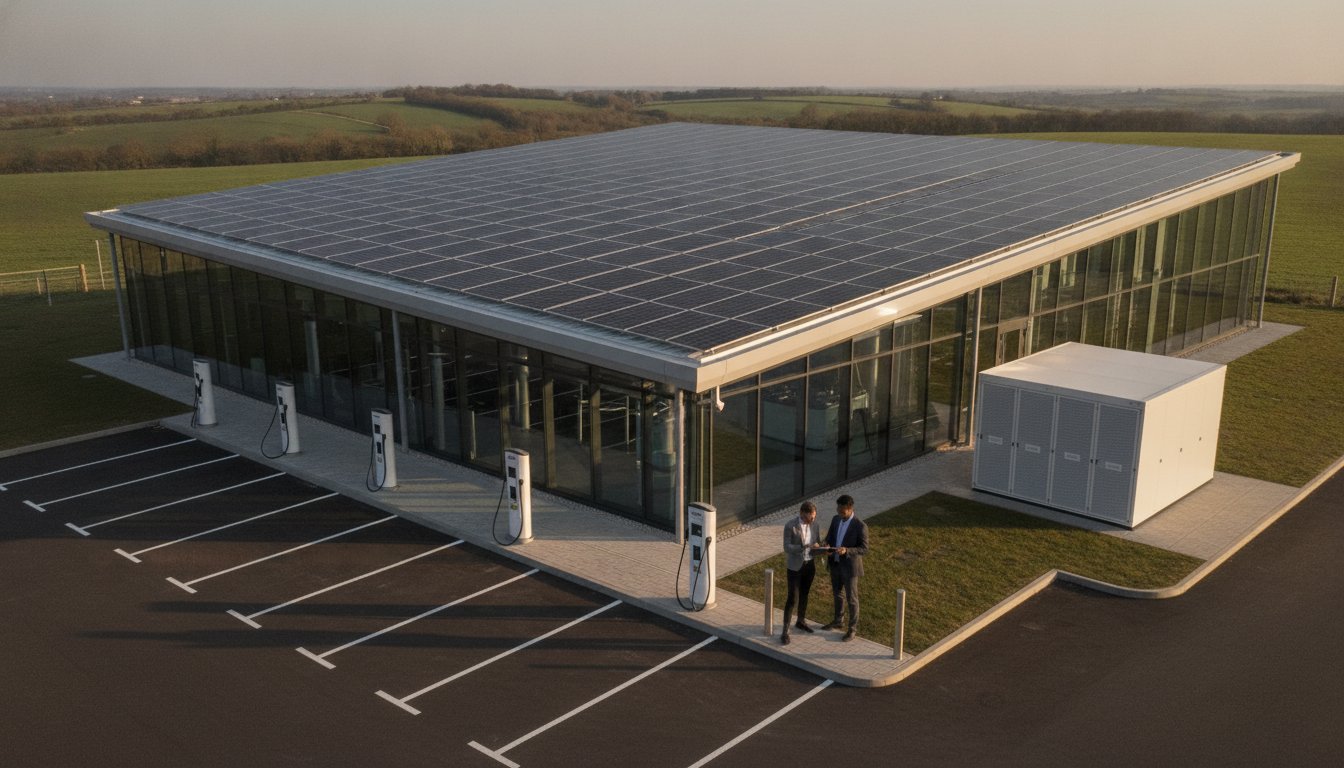
Longevity and reliability are the cornerstones of our service. We provide ongoing performance monitoring to ensure your assets deliver the ROI discussed earlier in this guide. For businesses looking to electrify their fleet, we specialise in the seamless integration of storage with commercial EV charger installation Hertfordshire. This creates a unified energy ecosystem where your battery manages the significant power demands of high-speed charging without exceeding your grid capacity. This synergy is essential for maintaining operational efficiency whilst transitioning to a zero-emission fleet.
Why Buckinghamshire Businesses Trust Empire
Industrial energy projects require more than just technical skill. They require a deep understanding of local infrastructure. We possess extensive knowledge of Buckinghamshire's business parks, from the industrial estates of Aylesbury to the commercial hubs in High Wycombe. This local expertise allows us to navigate DNO requirements and planning constraints with precision. Our commitment to compliance and industry-leading standards ensures that every installation is future-ready and fully insurable. We view every project as a long-term partnership. We focus on clear communication and technical excellence to ensure your project is delivered on time and within specification.
Start Your Energy Transition Today
Preparing your facility for the 2026 energy market requires forward-thinking design. The transition to half-hourly settlement and the rise in peak-time tariffs make "wait-and-see" strategies increasingly expensive. By booking a professional solar and battery survey now, you can identify the exact capacity needed to protect your margins. Our specialist team is ready to provide a bespoke commercial battery storage quotation that reflects your specific site requirements and financial objectives. Secure your energy independence today and turn your power infrastructure into a strategic asset for the decade ahead.
Future-Proof Your Industrial Energy Strategy
The 2026 energy market demands a shift from passive consumption to strategic asset management. As discussed throughout this guide, the combination of rising "Red Zone" charges and the transition to half-hourly settlement makes commercial battery storage Buckinghamshire a critical investment for industrial resilience. By integrating high-capacity LiFePO4 systems with existing infrastructure, your facility can bypass grid constraints whilst generating new revenue through frequency response services. This transition turns a standard operational cost into a high-performance financial asset.
Success in this landscape requires a partner who understands the technical nuances of industrial business parks. As a NICEIC Approved Contractor and specialists in DNO G99 applications, Empire Electrical Innovations provides the bespoke design and methodical installation standards necessary for long-term reliability. We ensure your system is compliant, secure, and optimised for maximum return on investment. Our partnership-first approach guarantees that your energy transition is handled with the precision your business deserves.
Take the first step toward energy independence and secure your margins against future volatility. Book a Free Commercial Energy Survey for your Buckinghamshire Business today. We look forward to helping you build a more profitable and sustainable future.
Frequently Asked Questions
What is the typical lifespan of an industrial battery storage system in 2026?
Industrial battery systems in 2026 typically offer an operational lifespan of 10 to 15 years. This longevity is largely dependent on the depth of discharge and the frequency of use. Modern Lithium Iron Phosphate (LiFePO4) cells are often rated for over 6,000 cycles at 80 per cent depth of discharge. Regular maintenance and advanced thermal management systems help preserve cell health and ensure the system remains a reliable asset.
How much space is required for a commercial battery storage installation in Buckinghamshire?
Space requirements for commercial battery storage Buckinghamshire installations vary significantly based on the chosen system's capacity. A small modular rack system might only require a few square metres in a dedicated plant room. In contrast, large-scale industrial projects often utilise 20ft or 40ft containerised units placed externally. We conduct structural assessments to ensure the chosen location can support the weight of the enclosures and provide adequate ventilation.
Can battery storage help my business bypass grid capacity limits for EV charging?
Battery storage is an effective solution for bypassing grid capacity limits when installing EV charging infrastructure. By discharging stored power during high-demand charging periods, you can support rapid chargers without exceeding your site's agreed supply capacity. This "buffer" strategy prevents the need for expensive and time-consuming substation upgrades. It allows your business to scale its electric fleet whilst maintaining operational continuity.
What are the fire safety requirements for installing large batteries in a warehouse?
Installing large batteries in a warehouse requires compliance with the latest IET wiring regulations and specific fire safety standards. Key requirements include automated thermal management systems and dedicated fire suppression, such as aerosol or specialised gas systems. Insurance providers typically demand that units are housed in fire-rated enclosures. We recommend using LiFePO4 chemistry due to its superior thermal stability and lower risk of thermal runaway.
Is planning permission always required for outdoor containerised battery systems?
Planning permission is frequently required for outdoor containerised battery systems, though some smaller installations may fall under permitted development rights. Buckinghamshire Council considers factors such as the unit's size, proximity to boundaries, and visual impact. It's essential to consult with local planning officers early in the project. Our team supports this process by providing technical drawings and environmental impact assessments to ensure a smooth application.
How does energy arbitrage work for a Buckinghamshire manufacturer?
Energy arbitrage allows a Buckinghamshire manufacturer to purchase electricity when wholesale prices are lowest, typically during off-peak night hours. This stored energy is then utilised during expensive daytime peaks to avoid high tariffs. If your site generates a surplus, you can also sell power back to the grid when demand and prices are at their highest. This active market participation maximises your financial return and stabilises costs.
Can I integrate a new battery system with my existing commercial solar PV array?
You can seamlessly integrate a new battery system with an existing commercial solar PV array. Most industrial projects utilise an AC-coupled configuration, which allows the battery to be added without modifying the existing solar inverters. This setup enables your facility to capture surplus solar energy that would otherwise be exported for a lower rate. It ensures that your renewable generation is used on-site to reduce grid reliance during peak hours.
What financial incentives or grants are available for Buckinghamshire businesses in 2026?
In 2026, Buckinghamshire businesses can benefit from several financial incentives, including the government's full expensing capital allowance. This allows companies to deduct the cost of qualifying plant and machinery, such as commercial battery storage Buckinghamshire, from their taxable profits. Additionally, revenue can be generated through the Smart Export Guarantee (SEG) and participation in grid-balancing services. These mechanisms significantly improve the project's internal rate of return and overall value.
Comments