
Commercial Battery Storage Hertfordshire: 2026 Strategic Infrastructure Guide

What if your business could bypass the rising costs of the grid entirely during peak hours? Most Hertfordshire directors already recognise that volatile energy tariffs and grid capacity constraints in local business parks are no longer just an inconvenience; they are a direct threat to operational stability. As we move through 2026, relying solely on the national infrastructure is becoming a costly gamble for those facing strict Net Zero mandates. Implementing commercial battery storage Hertfordshire allows your business to capture and deploy energy on your own terms, turning a variable cost into a predictable, strategic resource.
You likely want to secure long-term price certainty whilst ensuring your critical operations remain resilient against power outages. This guide explains how bespoke storage solutions maximise your solar ROI and provide a measurable reduction in your carbon footprint. We will examine the latest BS 7671:2018+A4:2026 compliance requirements, current grid connection timelines for UK Power Networks, and how to leverage 100% first-year capital allowances to shorten your payback period.
Table of Contents
The Strategic Case for Commercial Battery Storage
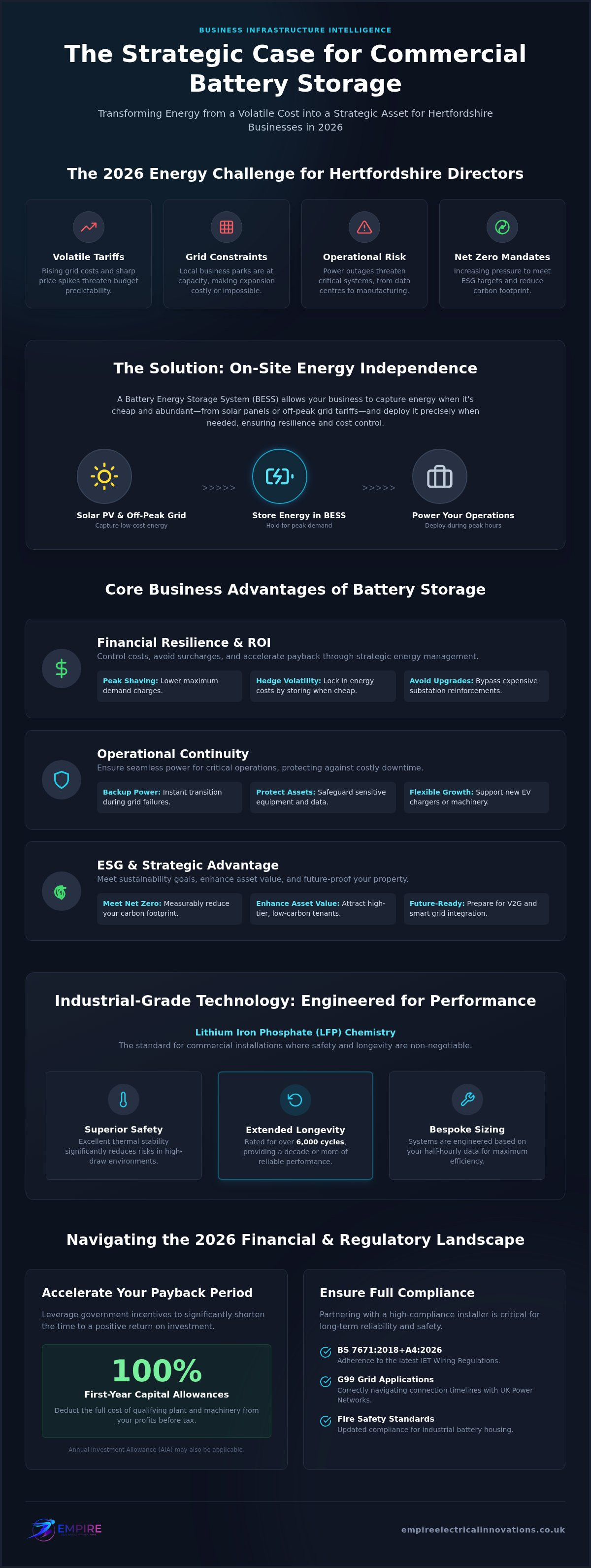
In the current economic climate, energy is no longer a passive utility. It's a strategic variable. For Hertfordshire businesses, investing in a battery energy storage system (BESS) represents more than just a sustainability choice; it's a fundamental infrastructure upgrade. By decoupling consumption from immediate grid availability, organisations can protect themselves against the sharp price spikes that have characterised the 2026 energy market. This technology allows for the purchase of electricity during off-peak windows for use when demand, and cost, is at its highest.
Beyond immediate cost savings, commercial battery storage Hertfordshire plays a pivotal role in meeting Environmental, Social, and Governance (ESG) mandates. Local authorities across the South East are increasingly prioritising Net Zero targets. For property developers and commercial landlords, on-site storage enhances asset value. It makes a building more attractive to high-tier tenants who require energy independence and low-carbon credentials. It transforms a property from a simple shell into a self-sustaining energy hub.
Energy Security. Fiscal Resilience.
Congested zones in Hertfordshire often face higher surcharges during peak hours. Storage mitigates this. For manufacturing plants, data centres, and refrigerated logistics hubs, a power failure is catastrophic. A bespoke storage solution provides a seamless transition to backup power, ensuring operational continuity without the need for carbon-heavy diesel generators. Commercial battery storage acts as the bridge between intermittent generation and 24/7 operational demand.
Grid Constraints and Local Capacity
Many business parks in Hertfordshire are nearing their maximum capacity. Securing additional power from the grid is often prohibitively expensive or physically impossible without major works. Battery storage provides a technical workaround. It allows sites to expand their operations or integrate commercial EV charging infrastructure without overloading existing distribution boards.
This approach offers several practical benefits for site managers:
Avoided Upgrades: Bypass the need for expensive substation reinforcements.
Peak Shaving: Lower the site's overall maximum demand charges.
Operational Flexibility: Support new machinery or high-draw equipment with stored energy.
By managing local capacity on-site, businesses gain the freedom to grow. They don't have to wait for the distribution network operator to catch up with their ambitions. It's a proactive stance that ensures your infrastructure is ready for the demands of the next decade.
Technical Excellence: Scaling Storage for Industrial Needs
Scaling infrastructure for industrial applications requires a move away from standard domestic hardware. In 2026, the priority for commercial battery storage Hertfordshire installations is Lithium Iron Phosphate (LFP) chemistry. It's safer. It lasts longer. It offers superior thermal stability. These characteristics are essential for high-draw environments like manufacturing or telecoms hubs where reliability is non-negotiable. LFP cells typically offer over 6,000 cycles, providing a decade or more of consistent performance in demanding commercial settings.
System sizing is another critical factor. We use half-hourly settlement data to map your specific energy profile precisely. This ensures your system isn't just a generic installation but a bespoke solution tailored to your demand peaks. For those looking to integrate storage with solar PV for commercial buildings, this data-led approach ensures that every kilowatt-hour of generated power is either utilised or stored, rather than being wasted. Large-scale energy projects may also qualify for support through the Industrial Energy Transformation Fund (IETF), which targets industrial processes and energy efficiency improvements.
Future-proofing is built into our designs. Modern systems must support Vehicle-to-Grid (V2G) capabilities and interact with smart tariffs that reward flexible demand. We ensure your hardware is ready for these transitions, allowing your business to act as a prosumer in the evolving UK energy market.
Peak Shaving and Load Shifting
The primary fiscal driver for industrial storage is the mitigation of Red Band periods. These peak Distribution Use of System (DUoS) charges can significantly inflate operational costs during the late afternoon and early evening. By automatically discharging stored energy during these windows, businesses can drastically lower their average cost per kWh. One Hertfordshire warehouse recently reduced its peak grid demand by 40% through a strategic load-shifting programme. It's a simple, automated way to protect your margins without changing your operational workflow.
Integration with Building Management Systems
Modern infrastructure requires seamless connectivity. We integrate energy storage directly with existing Building Management Systems (BMS). This allows for real-time monitoring through professional-grade dashboards, giving facility managers total visibility over energy flows. It also ensures compliance with Part L building regulations for new developments, which now place a heavy emphasis on energy efficiency and on-site generation. If you're ready to explore how these technical standards apply to your site, you can request a technical site survey to begin the project planning phase.
Financial ROI and 2026 Commercial Incentives
Investing in commercial battery storage Hertfordshire is no longer just a hedge against rising costs; it's a high-yield financial strategy. For a 100kWh+ system, the primary driver of ROI is the ability to shift consumption from expensive peak windows to low-cost off-peak periods. Whilst energy prices remain volatile in 2026, businesses that control their own dispatchable power are seeing significantly shortened payback periods. When integrated with on-site generation, a storage system acts as a force multiplier, capturing excess solar energy that would otherwise be exported for minimal gain and deploying it when grid prices are highest.
Beyond immediate operational savings, storage assets improve commercial EPC ratings and property yields. High-quality infrastructure makes industrial units more attractive to institutional investors and premium tenants who prioritising ESG compliance. This shift in asset value is supported by the UK Government's National Battery Strategy, which aims to create a robust ecosystem for energy storage. By installing these systems now, Hertfordshire businesses are positioning their physical assets at the forefront of the green transition.
Capital Allowances and Tax Efficiency
Tax incentives are a critical component of the 2026 financial case. Businesses can currently leverage the Annual Investment Allowance (AIA) to claim 100% first-year deductions on qualifying green infrastructure, up to a limit of £1 million. This allows for the full cost of the battery hardware to be offset against taxable profits in the year of purchase. In 2026, qualifying battery storage hardware is treated as plant and machinery, allowing for immediate tax relief through full expensing or the AIA. Some local authorities in Hertfordshire also offer discretionary business rate exemptions for buildings that undergo significant energy efficiency upgrades, further improving the project's net present value.
Revenue Generation through Grid Services
A well-managed battery system can transform from a cost centre into a revenue generator. By participating in Demand Side Response (DSR) programmes, businesses can earn payments for discharging power to the grid during periods of national stress. Additionally, the Smart Export Guarantee (SEG) provides a route for selling surplus stored energy back to providers, with 2026 rates from companies like OVO reaching up to 20p/kWh for certain commercial contracts. Professional battery storage installation ensures your system is configured to toggle between self-consumption and grid export automatically, ensuring you always capture the highest possible value for every kilowatt-hour.
Navigating Installation: Compliance and Grid Integration
Grid integration is the most significant technical hurdle for commercial battery storage Hertfordshire projects. It requires precise coordination with UK Power Networks (UKPN). For systems exceeding 50kW, a G99 application is mandatory. In 2026, typical timelines for these applications range from 8 to 16 weeks. If the local network requires reinforcement, this period can extend to 32 weeks. Managing these expectations early prevents project delays and ensures your site is ready for commissioning as soon as the hardware arrives. We handle the entire DNO liaison process to ensure your connection agreement is secured without unnecessary friction.
Siting the battery units requires balancing operational efficiency with strict safety standards. Outdoor containerised systems are often preferred for industrial sites. They offer natural ventilation and easier access for maintenance. Indoor installations must comply with BS 7671:2018+A4:2026, specifically Chapter 57, which covers stationary secondary batteries. Compliance with these standards becomes mandatory for all new installs by 15 October 2026. Proper housing protects your investment and ensures your facility remains fully insured.
Complex sites often require significant groundworks to connect storage units to main distribution boards. This is where the expertise of telecoms ducting contractors becomes invaluable. They ensure that sub-surface cabling is protected and compliant, facilitating a seamless link between your energy assets and your operational centre. This integrated approach to infrastructure minimises the risk of service interruptions during the physical installation phase.
The Professional Survey and Design Phase
A professional solar survey is the foundation of any storage project. We conduct a full electrical audit to assess your current board capacity and harmonics. This data allows us to design a bespoke system that matches your specific operational load profile. We don't guess. We measure. This ensures the system is sized correctly to handle your peak demand without over-investing in unnecessary capacity.
Compliance, Testing, and Commissioning
Every installation must meet IET wiring regulations and MCS standards to ensure long-term reliability. During the commissioning phase, we perform rigorous testing to verify system response times and safety shutdowns. Once complete, we provide full Operation & Maintenance (O&M) manuals. These documents are vital for insurance compliance and ongoing system health. Regular maintenance ensures the system continues to perform at peak efficiency throughout its lifecycle. To ensure your project meets these rigorous technical standards, book a professional site audit with our engineering team today.
Partnering with Empire Electrical Innovations
Empire Electrical Innovations operates as a technical partner rather than a generic installer. We understand that commercial battery storage Hertfordshire projects are not standalone electrical tasks; they are integral components of a wider infrastructure strategy. Our approach is defined by quiet authority and a commitment to precision. We don't rely on flashy marketing. We rely on high-compliance workmanship that stands the test of time. This focus on standards ensures your energy assets remain resilient, safe, and fully optimised for the long term.
Our expertise spans the full spectrum of modern power and data infrastructure. As a GivEnergy battery storage specialist, we possess the technical depth required for industrial-scale environments. From large-scale solar PV and battery storage systems to workplace EV charging and commercial telecoms infrastructure, we provide a unified service. We serve Hertfordshire, London, and the Home Counties with a methodical discipline. This ensures every project is delivered to the highest professional standards, meeting both Part L building regulations and specific industrial safety requirements.
Infrastructure. Integration. Integrity.
Complex multi-service projects require a single-source contractor to maintain coherence. By managing the integration of energy storage with existing telecoms or fibre blowing requirements, we eliminate the friction of coordinating multiple vendors. This is particularly valuable for property developers and industrial site managers who require future-ready sites. We provide transparent communication and methodical management from the initial survey through to the final switch-on. Whether we are supporting schools in reducing their carbon footprint or helping factories secure energy independence, our strategies are always bespoke.
Start Your Commercial Energy Project
The first step towards energy independence is a free professional site survey. We don't provide generic estimates. Instead, we deliver customised yield projections and detailed financial modelling based on your site's specific half-hourly data. This allows you to see the tangible impact on your bottom line before any hardware is ordered. Our engineering team also verifies current G99 application lead times with UK Power Networks to provide a realistic and honest project timeline. We believe in clear communication over empty promises, ensuring your investment is grounded in practical reality.
Secure Your Energy Future
Implementing commercial battery storage Hertfordshire is a decisive step towards long-term operational resilience. It transforms energy from a volatile overhead into a managed strategic asset. By integrating storage with existing solar PV and EV charging, you maximise on-site generation and protect your business from peak-time grid surcharges. This approach doesn't just lower costs; it builds a foundation for growth in an increasingly constrained grid environment.
Compliance and precision remain at the heart of our delivery. As GivEnergy Certified Installers with specialist commercial infrastructure expertise, we ensure your project meets every regulatory standard from the outset. We provide free site surveys and bespoke yield projections to give you total confidence in your ROI. Our team handles the technical complexities, from UK Power Networks liaison to full commissioning, so you can focus on your core operations.
Take the first step towards energy independence today. Book your professional commercial energy storage survey to receive a customised financial model for your site. We look forward to helping your business thrive in the new energy landscape.
Frequently Asked Questions
Do Hertfordshire businesses need planning permission for commercial battery storage?
Standalone, ground-mounted, or containerised battery energy storage systems (BESS) in Hertfordshire require planning permission from the local authority. If the system is installed as ancillary equipment to an existing solar array, it might fall under permitted development, but this is at the discretion of the council. You should always seek a Lawful Development Certificate to ensure full legal compliance before commencing work.
What is the typical ROI for a commercial battery system in 2026?
The typical payback period for a commercial system currently ranges between four and six years. This ROI is often accelerated to three to five years when businesses utilise the 100% first-year capital allowances or the Annual Investment Allowance (AIA). These tax incentives allow firms to offset the entire hardware cost against taxable profits in the year of purchase.
How long does it take to get a G99 grid connection in Hertfordshire?
For commercial battery storage Hertfordshire projects, a standard G99 application with UK Power Networks typically takes between 8 and 16 weeks. If your site requires network reinforcement to handle the load, these timelines can extend to 32 weeks. It's vital to start the DNO application process early to avoid delaying the final commissioning of your infrastructure.
Can battery storage be retrofitted to an existing commercial solar PV system?
Yes, battery storage can be successfully retrofitted to existing solar PV arrays using an AC-coupled configuration. This method allows the battery to function independently of the solar inverter, making it a flexible option for businesses with older generation assets. It ensures that excess solar energy is captured for use during peak evening periods rather than being exported.
What is the lifespan of an industrial-grade battery storage system?
Industrial-grade Lithium Iron Phosphate (LFP) batteries generally have an operational lifespan of 10 to 15 years. These systems are designed to handle over 6,000 cycles while maintaining roughly 80% of their original capacity. Longevity depends heavily on the depth of discharge and the efficiency of the on-site thermal management systems.
How does battery storage help with peak shaving for businesses?
Peak shaving involves discharging stored energy during high-cost windows, such as the Red Band DUoS periods, to reduce grid demand. By using the battery to "shave" the top off your demand profile, you avoid expensive peak-time surcharges and lower your overall maximum demand charges. This strategy is particularly effective for high-draw industrial sites in Hertfordshire.
Is battery storage safe for installation inside commercial buildings?
Indoor installation is safe as long as the system adheres to BS 7671:2018+A4:2026 and the IET Code of Practice. These regulations mandate specific requirements for fire separation, ventilation, and emergency shutdown procedures. Professional installers will conduct a thorough risk assessment to determine if your building's internal environment is suitable for high-capacity storage.
What maintenance is required for commercial energy storage assets?
Commercial systems require minimal manual intervention but benefit from annual physical inspections and 24/7 remote monitoring. The Battery Management System (BMS) constantly tracks cell temperatures and voltages to ensure optimal performance. Regular software updates and thermal filter cleaning are usually the only recurring maintenance tasks needed to protect your energy assets.
Comments