
Commercial EV Charger Installation Buckinghamshire: The 2026 Workplace Checklist

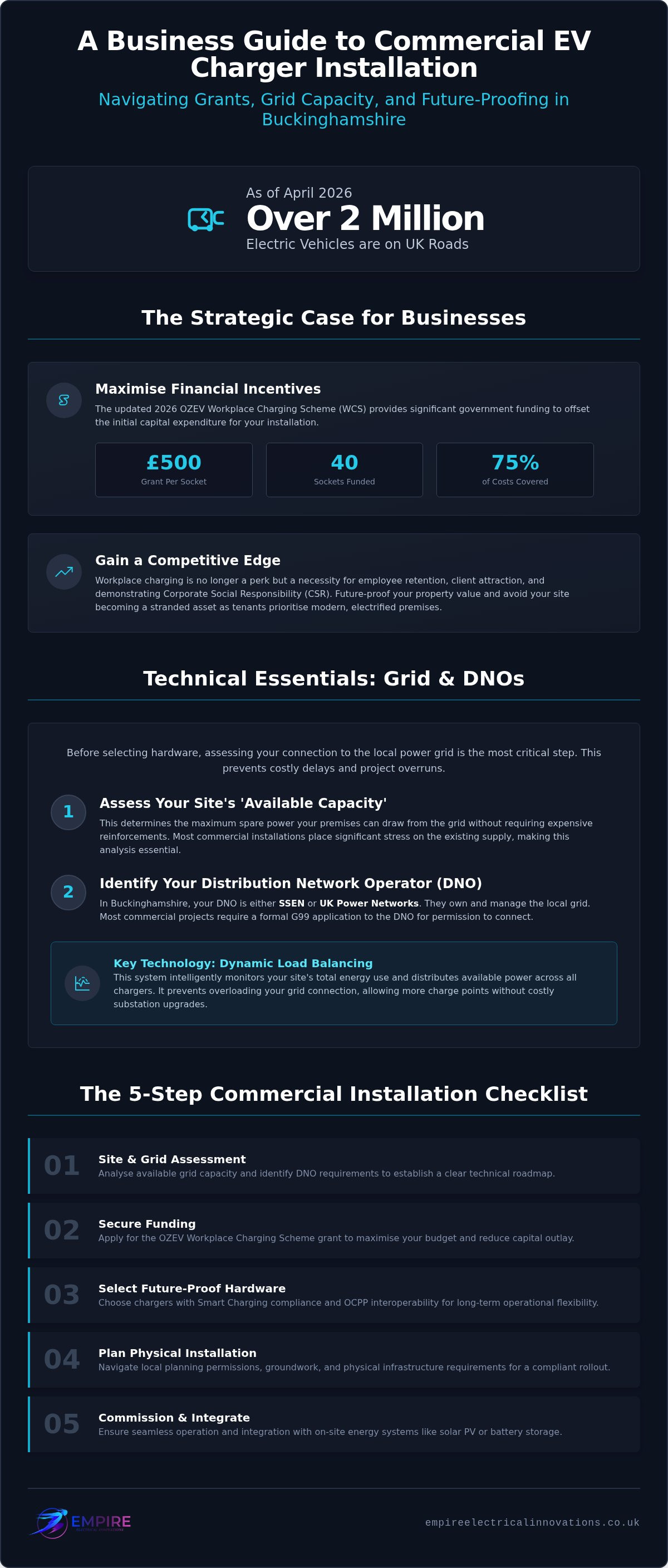
With over 2 million electric vehicles now navigating UK roads as of April 2026, the pressure on Buckinghamshire businesses to provide reliable power has reached a critical tipping point. You likely recognise that providing charging facilities is now a baseline expectation for both employees and fleet operations. However, the technical landscape has changed significantly. From the recent increase in OZEV Workplace Charging Scheme grants to £500 per socket to the complexities of local grid capacity, a commercial EV charger installation Buckinghamshire project requires more than just hardware. It demands a strategic energy plan.
We understand the frustration of navigating shifting regulations and the fear of investing in infrastructure that might be obsolete in just two years. This article provides a definitive, professional checklist to help you secure maximum funding and ensure seamless integration with your existing electrical systems. We will examine the latest smart charging mandates, DNO notification requirements, and the essential steps to future-proof your site against rising energy demands. This is your roadmap to a compliant, resilient, and high-performance charging network.
Table of Contents
The Strategic Case for Commercial EV Charger Installation in Buckinghamshire
Buckinghamshire's commercial geography is undergoing a profound transformation. From the data-driven tech hubs of Milton Keynes to the sprawling industrial estates across High Wycombe and Aylesbury, the demand for high-capacity power is rising. A professional commercial EV charger installation Buckinghamshire provides more than just a place to plug in. It serves as a vital tool for employee retention and a magnet for high-value clients who have already transitioned to electric transport. Businesses that fail to adapt risk falling behind in a market where sustainability is a core metric of professional competence.
By 2026, workplace charging has moved from a luxury perk to a logistical necessity. This demand is driven by the rapid pace of UK plug-in vehicle adoption, which reached over 2 million vehicles in early 2026. For commercial landlords, this infrastructure is essential for maintaining property value. A site without charging capabilities risks becoming a stranded asset as tenants prioritise modern, electrified premises. Electrifying your fleet also demonstrates a tangible commitment to Corporate Social Responsibility (CSR), aligning your brand with the UK's 2050 net-zero targets and reducing your scope 2 emissions profile.
Buckinghamshire's Local Low Emission Zones and Policies
Buckinghamshire Council's EV Action Plan continues to shape regional transport policies. The council aims to reach 1,000 public charge points by the end of 2027, but the private sector must bridge the gap for workplace needs. Early adoption is critical. Business parks in areas like Marlow and Beaconsfield often face limited grid capacity. Securing your connection now prevents being 'locked out' when local substations reach their maximum load due to neighbouring installations. Proactive planning ensures your business remains operational as regional transport plans increasingly favour low-emission commercial vehicles.
Financial Incentives: The 2026 OZEV Workplace Charging Scheme
The financial argument for electrification is stronger than ever. Under the 2026 OZEV Workplace Charging Scheme (WCS), the grant value increased to £500 per socket for installations completed after 1 April 2026. This allows Buckinghamshire businesses to claim for up to 40 sockets across multiple sites, covering 75% of the total purchase and installation costs. Additionally, the tax landscape remains favourable. Businesses can utilise 100% first-year capital allowances on charging equipment, whilst employees enjoy reduced Benefit-in-Kind (BiK) rates, making company EVs a highly tax-efficient recruitment tool in a competitive labour market.
Technical Requirements: Grid Capacity and DNO Notifications
Hardware selection is often the second step in a professional commercial EV charger installation Buckinghamshire. The primary consideration is always the local grid infrastructure. Unlike domestic installations, commercial arrays place significant stress on the building's electrical supply. Before any cable is laid, we must establish your site's 'Available Capacity'. This is the amount of spare power your premises can draw from the local substation without triggering a blackout or requiring expensive grid reinforcements. Ignoring this step is the most common cause of project delays and budget overruns.
Dynamic load balancing is a critical management protocol that monitors total site energy consumption and automatically distributes available power across all active chargers to prevent exceeding the supply limit. This technology allows businesses to install more sockets than their raw capacity would normally allow, effectively future-proofing the site without immediate substation upgrades.
Navigating the Distribution Network Operator (DNO) in Buckinghamshire
In Buckinghamshire, your site will be managed by one of two Distribution Network Operators: SSEN (Scottish and Southern Electricity Networks) or UK Power Networks. Identifying your DNO is essential because they own the cables and substations serving your business. For smaller installations, we use a 'Connect and Notify' procedure, where the DNO is informed after the work is complete. However, most commercial projects require an 'Apply and Plan' approach. This involves a formal G99 application to the DNO to request permission to connect a large-scale array. We manage this entire technical dialogue, ensuring your application is compliant and processed efficiently.
Three-Phase vs Single-Phase Commercial Charging
The distinction between single-phase and three-phase power is the difference between slow charging and business efficiency. While single-phase supplies are common in smaller offices, they generally limit charging speeds to 7kW. For commercial fleets and high-turnover visitor parking, 22kW three-phase charging is the gold standard. It delivers power up to three times faster, significantly reducing the time vehicles are tethered to the ground. Assessing your existing distribution board is the first step in determining if your electrical centre can support these higher loads. If your current supply is insufficient, we provide bespoke site surveys to map out the most cost-effective upgrade path, ensuring your infrastructure is ready for the next generation of high-capacity electric vehicles.
Hardware and Software: Selecting Future-Proofed Infrastructure
Selecting hardware for a commercial EV charger installation Buckinghamshire involves balancing physical durability with technical flexibility. Socketed units are the preferred choice for visitor car parks because they allow users to bring their own cables, ensuring universal compatibility across all vehicle makes. Conversely, tethered units provide a more efficient experience for dedicated fleet depots where drivers need to plug in quickly at the end of a shift. However, the most critical specification is the Open Charge Point Protocol (OCPP). This industry standard ensures your hardware can communicate with any back-office software. It prevents "vendor lock-in," allowing you to switch management platforms in the future without the capital expense of replacing physical chargers.
Effective infrastructure management requires a robust back-office system. These platforms enable businesses to track energy usage per employee, generate automated billing reports, and set different pricing tiers for staff versus guests. By integrating these systems with commercial solar PV for buildings, your organisation can significantly lower the operational costs of your fleet. This transforms your car park into a strategic energy asset that provides long-term financial returns.
Smart Charging and Load Management
Modern commercial infrastructure relies on Dynamic Load Management (DLM) to protect the site's primary fuse. If your building's power demand spikes due to heavy machinery or HVAC systems, the DLM protocol automatically throttles the EV chargers to prevent a total power outage. This intelligent distribution allows you to prioritise essential fleet vehicles that require a full charge for early departures whilst limiting power to guest chargers. By utilising scheduled charging, your system can also take advantage of off-peak commercial energy tariffs, ensuring vehicles are charged when electricity prices are at their lowest.
Energy Synergies: Solar and Battery Storage
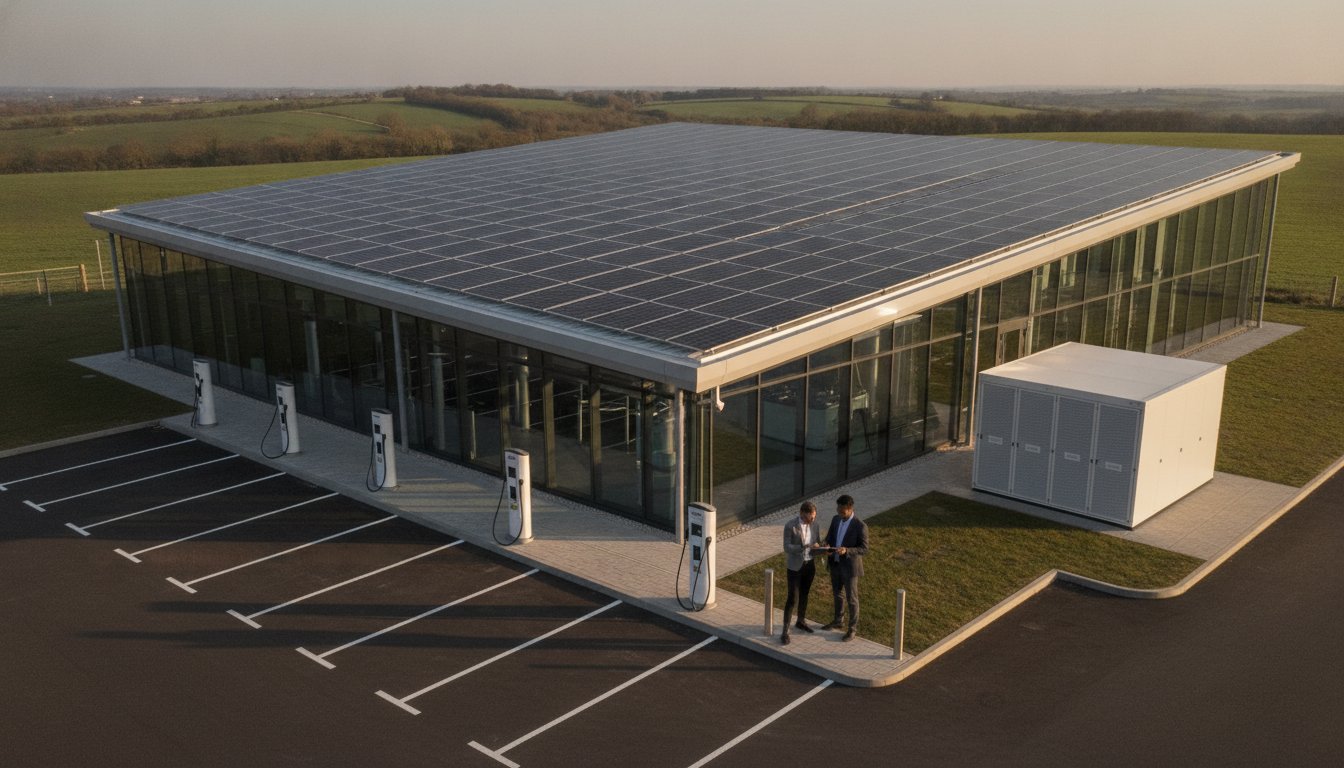
A truly future-ready installation leverages solar battery installation in Hertfordshire and Buckinghamshire to buffer peak demand. Battery storage allows you to "shave" the peaks off your energy consumption by discharging stored renewable power during high-usage periods. This reduces the reliance on the grid capacity discussed in the previous section and can prevent costly infrastructure reinforcement charges. By creating a closed-loop sustainable energy ecosystem at your Buckinghamshire headquarters, you insulate your business from volatile energy markets whilst maintaining a high-performance charging network.
The Buckinghamshire Commercial EV Installation Checklist
A successful commercial EV charger installation Buckinghamshire follows a methodical, five-step commissioning process. This ensures that technical compliance matches your specific operational needs. We don't just install hardware; we build resilient energy infrastructure that supports your business goals.
Step 1: Professional Site Survey. We conduct a physical and electrical assessment. This validates the available capacity identified in our earlier grid analysis and determines the most efficient cable routes.
Step 2: DNO and Planning Approvals. We secure formal approval from SSEN or UK Power Networks. We also verify local planning constraints, particularly for sites in sensitive locations like Aylesbury Old Town.
Step 3: Infrastructure Design. Our engineers map cable routes with future expansion in mind. We design for 2028 fleet needs, not just your 2026 requirements, to avoid redundant costs later.
Step 4: Certified Installation. NICEIC-certified engineers execute the work. We adhere strictly to BS 7671 wiring regulations and Part S building mandates.
Step 5: Commissioning and Handover. We activate the back-office software and test every socket. Your team receives full training on energy tracking and billing management.
Planning Permission and Conservation Constraints
Buckinghamshire's landscape varies from the modern grid layouts of Milton Keynes to the historic streets of Aylesbury and Marlow. Whilst most projects proceed under 'Permitted Development' rights, heritage sites require a more nuanced approach. If your business operates within a conservation area or a listed building, formal planning permission is often mandatory. Buckinghamshire Council requires specific aesthetic considerations for charging units to ensure they don't detract from the local character. We also ensure that all bay markings and signage comply with the latest accessibility standards, providing clear guidance for both staff and visitors.
Groundworks and Infrastructure Preparation
The longevity of your installation depends on the quality of the underground infrastructure. High-quality ducting is essential for protecting cables from environmental damage and physical stress. We utilise our internal telecoms ducting expertise to streamline complex outdoor runs across large industrial estates or corporate campuses. This methodical approach minimises disruption to your car park and pedestrian walkways during the civil phase. By installing oversized ducting now, we eliminate the need for costly re-digging when you decide to add more sockets in the future.
If you are ready to begin your site assessment, you can book a professional site survey with our technical team today.
Expert Commissioning with Empire Electrical Innovations
Empire Electrical Innovations operates with a partnership-first philosophy. We recognise that a commercial EV charger installation Buckinghamshire is a long-term investment in your site's operational capacity. Our approach moves beyond simple hardware fitting; we act as technical consultants who ensure your infrastructure grows alongside your business. As OZEV-approved installers, we possess the verified credentials required to secure your grant funding whilst maintaining the highest UK safety standards. Our NICEIC and MCS accreditations provide the assurance of methodical, compliant workmanship on every project.
Precision is the hallmark of our service. We leverage our extensive background in commercial EV charging infrastructure to design systems that are both resilient and efficient. Reliability is maintained through bespoke maintenance packages, ensuring your charge points achieve 99.9% uptime. For a business in 2026, a non-functional charger is a reputational risk. We mitigate this through proactive monitoring and rapid response protocols, keeping your fleet moving and your visitors powered without interruption.
The Empire Site Survey: More Than a Quote
Our site survey is a comprehensive technical audit of your facility's energy profile. We provide a detailed analysis of your existing electrical load, identifying exactly how many sockets your current supply can support without expensive grid upgrades. You receive a no-nonsense breakdown of hardware options tailored to your specific sector, whether you manage a retail park in Milton Keynes or a distribution hub in High Wycombe. We also provide clear, actionable advice on integrating renewable technologies like solar PV to reduce your long-term operational costs and maximise your return on investment.
Start Your Buckinghamshire EV Project Today
Initiating your transition to electric transport is a streamlined process. You can book a professional site survey across Buckinghamshire, from Aylesbury to Marlow, by contacting our technical team. Following the survey, we provide a bespoke quotation and a project timeline. Whilst every site is unique, the journey from your initial enquiry to the first successful vehicle charge typically spans six to eight weeks. This schedule accounts for the DNO application process and any necessary groundworks. Contact Empire Electrical Innovations for your bespoke EV survey to secure your business's energy future.
Securing Your Business Energy Infrastructure
Transitioning your premises to support electric transport is no longer a peripheral facility upgrade; it's a strategic investment in your organisation's operational resilience. Success depends on a methodical approach to grid capacity, DNO notifications, and smart software integration. By securing the updated £500 per socket OZEV grant and choosing future-proofed, OCPP-compliant hardware, you insulate your business against shifting regulatory demands and rising energy costs. A professional commercial EV charger installation Buckinghamshire transforms your car park into a high-performance energy asset.
Empire Electrical Innovations brings quiet authority to every project. As a NICEIC Approved Contractor and OZEV Approved Workplace Installer, we're specialists in renewable integration, connecting your charging points with solar PV and battery storage for maximum efficiency. We don't just fit hardware; we commission bespoke energy ecosystems designed for longevity. Our team ensures your infrastructure is compliant, scalable, and ready to meet the demands of a fully electrified fleet.
Book Your Professional Commercial EV Site Survey today to ensure your Buckinghamshire headquarters is ready for the road ahead. We look forward to powering your transition with precision and expertise.
Frequently Asked Questions
Do I need planning permission for commercial EV chargers in Buckinghamshire?
Planning permission is typically not required for standard installations under Permitted Development rights. Exceptions apply if your business is located in a conservation area or a listed building, such as those in historic parts of Aylesbury or Marlow. In these cases, you must consult Buckinghamshire Council before starting your commercial EV charger installation Buckinghamshire project. We handle the technical drawings and compliance checks to ensure your application meets local heritage standards.
How much can my business save with the OZEV Workplace Charging Scheme in 2026?
Businesses can save up to £500 per socket through the OZEV Workplace Charging Scheme as of April 2026. This grant covers 75% of the total purchase and installation costs for up to 40 sockets across your sites. It's a significant capital injection that makes large-scale electrification much more accessible. We manage the entire application process on your behalf to ensure you receive the maximum funding available under current 2026 regulations.
What happens if my site does not have enough electrical capacity for multiple chargers?
If your site lacks capacity, we implement Dynamic Load Management to distribute power intelligently without exceeding your supply limit. This technology monitors the building's total load and throttles charging speeds during peak usage periods. If a physical upgrade is still necessary, we manage the G99 application with SSEN or UK Power Networks to increase your site's available capacity. This ensures your infrastructure remains safe and functional without causing site-wide power outages.
Can I charge employees and visitors for using the EV points?
You can absolutely charge employees and visitors for their energy usage. By using OCPP-compliant hardware and a robust back-office management platform, you can set different pricing tiers for staff, fleet drivers, and guests. These systems automate the billing process and provide detailed energy reports for tax purposes. This functionality transforms your charging points from a business expense into a potential revenue stream or a cost-neutral employee benefit.
How long does a typical commercial EV charger installation take?
A standard commercial installation typically takes six to eight weeks from the initial enquiry to the final commissioning. While the physical installation of the units may only take a few days, the timeline is influenced by the DNO notification and approval process. We coordinate all technical dialogues with the network operator to keep the project on schedule. Our methodical approach ensures every regulatory hurdle is cleared before our engineers arrive on-site.
Is it possible to integrate my existing solar panels with the new EV chargers?
Integration with existing solar PV systems is not only possible but highly recommended for long-term ROI. We specialise in connecting EV infrastructure with renewable energy and battery storage to create a closed-loop system. This allows your vehicles to charge using free, on-site electricity during daylight hours. It significantly reduces your reliance on the grid and protects your business from the volatility of commercial energy tariffs.
What is the difference between AC and DC charging for a workplace setting?
AC charging is the standard for workplaces where vehicles are parked for several hours, offering speeds up to 22kW. DC charging is "rapid" and typically used for short-stay commercial hubs or fleet depots requiring fast turnarounds. For most Buckinghamshire offices and industrial units, AC charging is the most cost-effective and grid-friendly solution. It provides sufficient power for a full charge over a standard working day without requiring massive substation upgrades.
Do you provide ongoing maintenance for the charging infrastructure?
We provide bespoke maintenance packages designed to ensure 99.9% uptime for your charging network. Ongoing support is essential for a commercial EV charger installation Buckinghamshire, as it prevents reputational damage from non-functional units. Our services include annual safety inspections, firmware updates, and remote diagnostic support. This proactive care ensures your investment remains operational and compliant with the latest UK wiring and smart charging regulations throughout its lifespan.

Comments