
Commercial EV Charging Infrastructure: The 2026 Strategic Guide

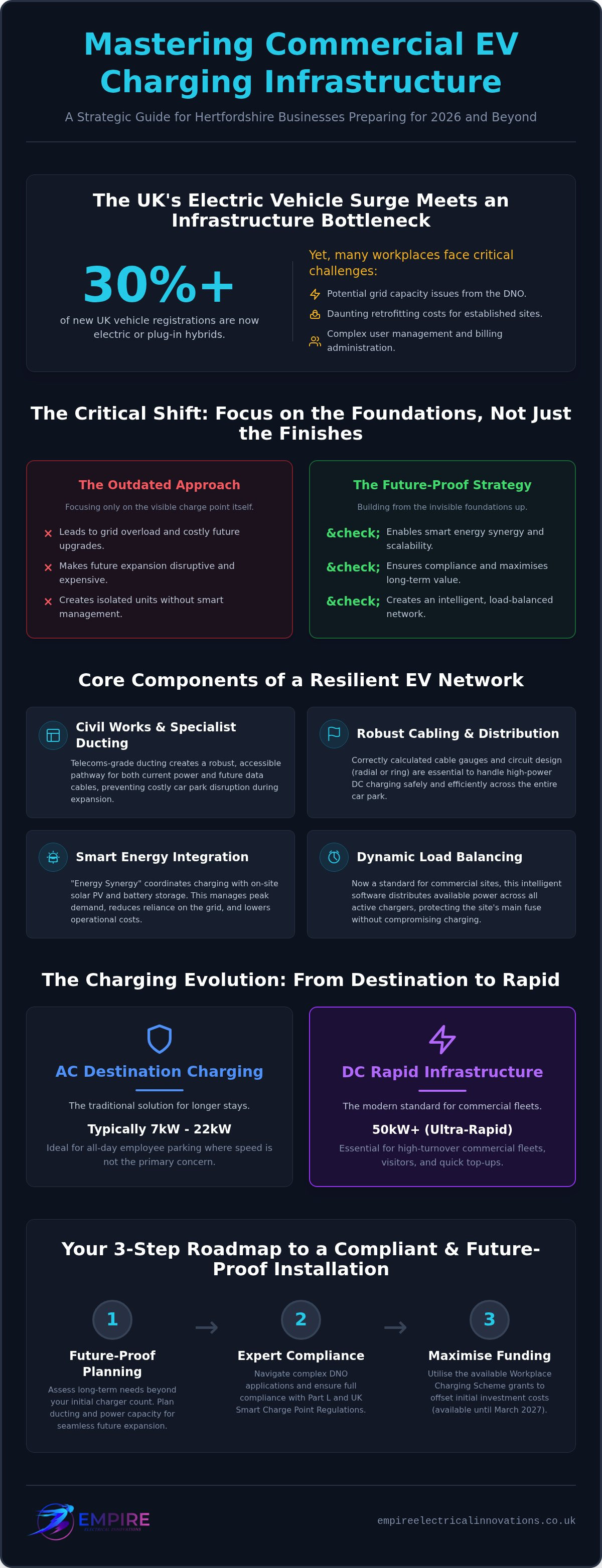
Over 30% of new vehicle registrations in the UK are now electric or plug-in hybrids, yet many workplace car parks remain tethered to the power constraints of the last decade. You likely recognise the pressure to adapt. It's frustrating to face potential grid capacity issues from the DNO or the daunting prospect of high retrofitting costs for established sites. Managing multiple users and complex billing only adds to the administrative burden.
This strategic guide helps you master the complexities of commercial EV charging infrastructure Hertfordshire businesses require for long-term success. Infrastructure dictates performance. We promise to move beyond the charge point itself to focus on the invisible foundations: ducting, cabling, and smart energy synergy. You'll learn how to achieve a future-proofed network that meets the latest Part L building regulations whilst remaining cost-effective.
We'll examine the technical requirements for robust installations, from civil works to seamless integration with existing solar or battery systems. By the end of this guide, you'll have a clear, compliant plan for workplace electrification that avoids common pitfalls and maximises the current Workplace Charging Scheme grants available until March 2027.
Table of Contents
Commercial EV Charging Infrastructure: The 2026 Landscape
Commercial EV infrastructure is far more than a simple socket on a wall. It represents a total system of power supply, civil ducting, and intelligent management software. In 2026, the industry has transitioned away from basic hardware towards integrated energy ecosystems. For those managing commercial EV charging infrastructure Hertfordshire sites, the focus has shifted to ultra-rapid charging hubs capable of supporting high-intensity commercial fleets and visitor demands.
Future-proofing is now the non-negotiable requirement for businesses across the Home Counties. With grid capacity becoming a premium commodity, installing a system without a long-term power strategy is a significant risk. We advocate for Energy Synergy. This concept describes the seamless coordination between your charging assets and on-site renewable generation. A well-designed Electric Vehicle Charging Infrastructure Overview highlights that the most successful projects are those that anticipate future power needs today.
Shifting from Basic Points to Intelligent Networks
Standalone chargers are largely obsolete for commercial applications in 2026. These isolated units lack the communication capabilities needed to protect your site’s main fuse during peak demand. Dynamic load balancing has become the standard solution. It ensures that power is distributed across the network based on real-time vehicle requirements and building load. Intelligent infrastructure is a system that balances grid demand with site-wide energy consumption.
Meeting ESG and Sustainability Mandates
Effective EV infrastructure is a primary driver for corporate net-zero targets and ESG reporting. It provides tangible evidence of a company's commitment to decarbonisation. Beyond compliance, charging availability is a powerful tool for talent acquisition and employee retention. Staff members who've transitioned to electric vehicles now view workplace charging as a vital benefit. For developers, this integration is often mandated by Part L building regulations and solar panels, making early infrastructure planning essential for new commercial builds.
Essential Infrastructure Components: Beyond the Charge Point
Successful installation of commercial EV charging infrastructure Hertfordshire depends on what lies beneath the surface. Whilst the charge point unit is the visible interface, the underlying civil engineering determines the system’s lifespan. We are seeing a decisive shift from standard AC destination chargers towards high-power DC rapid infrastructure. DC units require more robust electrical architecture but offer the turnaround times essential for modern commercial fleets. Every installation must align with the UK Smart Charge Point Regulations to ensure grid stability and data security.
Specialist telecoms-grade ducting is a core component of this architecture. This isn't merely about housing power cables; it's about creating a pathway for future data integration and smart management. Our team utilises Test Rod and Rope (TRR) to prepare existing sites for new cables without unnecessary digging. This methodical approach identifies blockages early and ensures that new fibre or power lines can be pulled through seamlessly, saving time and reducing project costs.
Civil Works and Specialist Ducting
High-quality ducting prevents future car park disruption during fleet expansion. If you intend to add more chargers in the coming years, your initial civil works must reflect that ambition. There is a deep synergy between telecoms infrastructure and smart EV charging networks. Both require high-capacity, accessible conduits that allow for easy maintenance. Our background as telecoms ducting contractors Hertfordshire allows us to apply these rigorous standards to every EV project we undertake.
Cabling and Power Distribution
Selecting the right cable gauges is essential for 2026 power demands. We carefully calculate the requirements for radial or ring circuits based on your specific car park layout. Radial circuits provide direct paths for individual units, while ring circuits can offer increased reliability for larger arrays. We ensure longevity by using high-spec electrical components and weather-resistant housings designed for the long term. If you're unsure about your site's current capacity, we can assess your existing electrical infrastructure to determine the most efficient path forward.
Smart Integration: Solar, Storage, and Grid Management
Relying solely on the grid for commercial EV charging infrastructure Hertfordshire projects is often a costly oversight. A "Grid Only" model leaves your business vulnerable to fluctuating energy prices and strict capacity limits set by the Distribution Network Operator (DNO). In contrast, an Integrated Energy approach provides a more resilient and cost-effective foundation. This strategy aligns with the UK Government's EV Infrastructure Strategy, which emphasises the need for smart, localised energy management to reduce the burden on national power networks. By generating and storing your own power, you gain independence from volatile commercial energy markets.
Bespoke energy design is particularly beneficial for warehouses and large offices where roof space is abundant but grid capacity is capped. We analyse your site's specific energy profile to ensure that your charging network doesn't just draw power, but manages it intelligently. This integrated methodology prevents the need for expensive grid reinforcements that can often delay projects by months or even years.
Solar PV and EV Synergy
Commercial buildings often possess vast roof spaces that remain underutilised. By installing solar PV for commercial buildings, you can direct clean energy straight into your vehicle fleet. This synergy creates an immediate return on investment. Charging from the sun avoids the high peak-time commercial rates that typically apply during business hours. It transforms your building from a passive shelter into a primary power source for your logistics, ensuring your fleet is powered by the most inexpensive energy available.
Battery Storage as an Infrastructure Buffer
Battery storage serves as the vital buffer for sites with limited grid supply. Utilising solar battery installation Hertfordshire allows you to store energy during low-demand periods and discharge it when multiple vehicles plug in simultaneously. This process, known as peak shaving, prevents your site from exceeding its agreed capacity and incurring heavy DNO penalties. Battery storage acts as a digital substation for your EV network. For warehouses and large offices, this allows for rapid charging capabilities even when the local grid cannot provide the required instantaneous load.
Planning and Compliance: Navigating DNOs and Regulations
Navigating the regulatory framework for commercial EV charging infrastructure Hertfordshire requires a methodical approach to avoid project delays. The primary hurdle for businesses in the South East is securing capacity from UK Power Networks (UKPN). Without a formal application, you risk overstressing local substations, which can lead to significant fines or forced disconnection. Compliance isn't just about the hardware; it involves a deep understanding of BS 7671:2018+A4:2026 and the latest IET Wiring Regulations to ensure every component is fit for purpose.
Planning must account for the specific safety standards required for public-facing or employee-facing charging points. These environments demand high levels of physical and electrical protection. We focus on ensuring that your infrastructure design is robust enough to handle high-traffic use whilst remaining fully compliant with the Electric Vehicles (Smart Charge Points) Regulations 2021. This dual focus on safety and smart functionality is what separates a standard installation from a professional, future-proofed network.
The DNO Application Roadmap
Securing grid capacity is a structured process that begins long before the first hole is dug. We follow a three-step roadmap to ensure your site has the power it needs:
Step 1: Initial site load assessment. We create a demand profile that accounts for your existing building load and the anticipated peak draw of the new charging units.
Step 2: Formal application. We submit G99 or G100 applications to UK Power Networks to secure the necessary capacity. G99 is essential for sites integrating generation like solar, whilst G100 manages export limitations.
Step 3: Managing grid reinforcement. If the local network is constrained, we negotiate with the DNO to manage reinforcement costs or implement smart load management to bypass expensive upgrades.
Safety Standards and Commissioning
Rigorous testing and commissioning are vital before any charge point is opened for public use. This includes verifying PEN conductor fault protection to prevent electric shocks in the event of a neutral failure. Every installation must undergo strict testing to ensure that all protection devices operate within the required timescales. We provide a comprehensive Compliance Pack for every project. This documentation is essential for your insurance providers and health and safety audits, proving that your infrastructure meets every current legal requirement. If you're concerned about your site's power limits, we can manage the entire DNO application process to secure the capacity you need.
Bespoke Design and Commissioning: The Empire Approach
Empire Electrical Innovations operates as a Trusted Specialist. We bridge the gap between heavy electrical engineering and digital data management. For commercial EV charging infrastructure Hertfordshire projects, this dual expertise is vital. A successful installation requires more than just a connection to the grid; it demands a bespoke design that accounts for site-specific constraints and long-term operational goals. We position ourselves as the partner for complex, multi-site energy infrastructure, ensuring that your network remains resilient as technology evolves.
Our approach is methodical and disciplined. We don't just install hardware; we design energy systems. By understanding both the high-voltage requirements and the low-voltage data needs, we ensure your charging network is fully integrated into your building's ecosystem. This foresight prevents the common technical bottlenecks that occur when power and data are treated as separate entities.
Tailored Solutions for Your Sector
A one-size-fits-all charger box is insufficient for professional environments. Every sector has unique requirements. Schools often prioritise secure, timed access for staff, whilst business parks require high-density arrays with sophisticated user billing. Residential developers must focus on seamless integration to meet stringent Part S building regulations. Our design process for Hertfordshire and London workplaces starts with these specific sector needs. We invite you to view our commercial EV charger installation Hertfordshire project examples to see how we adapt our infrastructure to different commercial environments.
Expert Commissioning and Support
Professional commissioning is the final, critical step in ensuring system uptime. This phase involves more than just powering up the units. We manage the software handshake between the physical hardware and the management platform, ensuring that load balancing, payment gateways, and data reporting are perfectly synced. Our support doesn't end at the handover. Ongoing maintenance is essential to prevent charger anxiety amongst your team and visitors. We start every project with a professional site survey and electrical audit. This methodical beginning identifies potential capacity issues early and allows us to design a robust commercial EV charging infrastructure Hertfordshire system that works from day one. We ensure your infrastructure is an asset, not a liability.
Future-Proof Your Workplace
Building a successful EV network requires looking beneath the surface. We've explored how the shift toward ultra-rapid charging and smart energy integration defines the 2026 landscape. Success depends on robust ducting. It requires methodical grid capacity management rather than just the hardware units themselves. By combining solar PV and battery storage, businesses can bypass grid constraints whilst securing long-term operational efficiency.
Our team brings specialist expertise to every stage of commercial EV charging infrastructure Hertfordshire projects. We provide integrated solar, battery, and EV solutions across Hertfordshire, Bedfordshire, and London. From initial DNO applications to final commissioning, we ensure your system is compliant and future-ready. We value precision and clear communication throughout the design process to deliver a bespoke network tailored to your specific sector needs.
The transition to electric transport offers a significant opportunity for corporate growth and sustainability. It's time to move beyond temporary fixes and invest in a high-performance network that supports your fleet for years to come. Begin your infrastructure project with a professional site survey today. We look forward to helping you power the future of your business.
Frequently Asked Questions
Do I need to upgrade my commercial electricity supply for EV charging?
Not necessarily, but a site load assessment is required first. We evaluate your existing demand profile against the proposed charger load. If capacity is limited, we implement dynamic load management or integrate battery storage. This avoids expensive and time-consuming grid reinforcements from the DNO. Our methodical approach ensures your current supply is utilised efficiently before recommending any physical upgrades to the local substation or incoming mains.
What is the difference between AC and DC charging for businesses?
AC charging is typically used for long-stay destination charging, such as employee car parks where vehicles remain for several hours. DC rapid charging provides much higher power levels for quick turnarounds, making it essential for commercial fleets and visitor hubs. DC infrastructure requires more complex electrical architecture and robust civil works. We design bespoke systems that often combine both types to balance installation costs with the operational needs of your business.
Can I install EV chargers if my office has limited grid capacity?
Yes, limited capacity doesn't prevent installation if you use an integrated energy approach. We specialise in bypassing grid constraints by installing battery storage systems and solar PV arrays. These components act as a buffer, storing energy during low-demand periods to discharge during peak charging times. This strategy allows you to deploy the high-power commercial EV charging infrastructure Hertfordshire sites need without waiting for the DNO to upgrade the local network.
Are there grants available for commercial EV infrastructure in 2026?
The Workplace Charging Scheme (WCS) remains available until 31 March 2027. This grant covers up to 75% of the purchase and installation costs, capped at £500 per socket. Businesses can apply for up to 40 sockets across multiple sites. We help you navigate the application process to ensure your project meets all OZEV eligibility criteria. This funding significantly reduces the initial capital expenditure for expanding your workplace charging network.
How does smart load management work in a workplace car park?
Smart load management uses intelligent software to distribute available power across all active charging points in real-time. It monitors the building's total energy consumption and adjusts the charger output to ensure the site's main fuse isn't exceeded. If several vehicles plug in simultaneously, the system throttles the power delivery to each unit. This prevents outages and allows for more charging points to be installed on a standard electrical supply.
What is the role of ducting in a commercial EV installation?
Ducting provides the protected underground pathway for your power and data cables. High-quality, telecoms-grade ducting is essential for long-term reliability and future-proofing. It allows for the easy addition of more cables as your fleet grows without the need to excavate your car park again. We use Test Rod and Rope (TRR) techniques to ensure existing ducts are clear and viable, reducing civil works costs and minimising site disruption.
How long does it take to install a commercial charging network?
Installation timelines vary based on the project's complexity and the required civil works. A standard workplace installation might take a few days, but larger projects involving DNO applications and extensive ducting can take several weeks or months. Securing grid capacity from UK Power Networks is often the longest phase. We manage the entire timeline, from the initial site survey and design to the final commissioning and safety testing of your network.
Can I integrate my existing commercial solar panels with new EV points?
Integration is not only possible but highly recommended for maximising your return on investment. We synchronise your existing solar PV array with the new charging points to ensure vehicles are powered by clean energy whenever available. This reduces your reliance on the grid and lowers your operational costs. Our bespoke commissioning process ensures that your commercial EV charging infrastructure Hertfordshire project prioritises self-generated power over expensive peak-time electricity.


Comments