
Commercial Solar Battery Storage London: Maximising Energy Independence in 2026

In 2026, London's commercial energy tariffs remain amongst the highest in the UK, yet many firms still let surplus solar energy leak back to the grid for minimal returns. Achieving true energy independence in the capital requires more than just panels. Investing in commercial solar battery storage London systems allows your business to capture every kilowatt of generated power. You're likely aware that the gap between import costs and export rates is wider than ever. This makes self-consumption a strategic necessity for protecting your bottom line.
We understand that navigating urban planning and fire safety in a dense city centre can feel like a complex hurdle. This article demonstrates how bespoke battery energy storage systems (BESS) bypass these constraints to reduce overheads and secure your infrastructure. You'll discover how to leverage peak shaving to lower electricity bills, ensure energy security for critical systems, and meet the strict compliance standards required for London's unique architectural landscape. We also explore how integrating storage with EV charging creates a unified, future-ready energy ecosystem for the years ahead.
Table of Contents
The Strategic Case for Commercial Solar Battery Storage in London
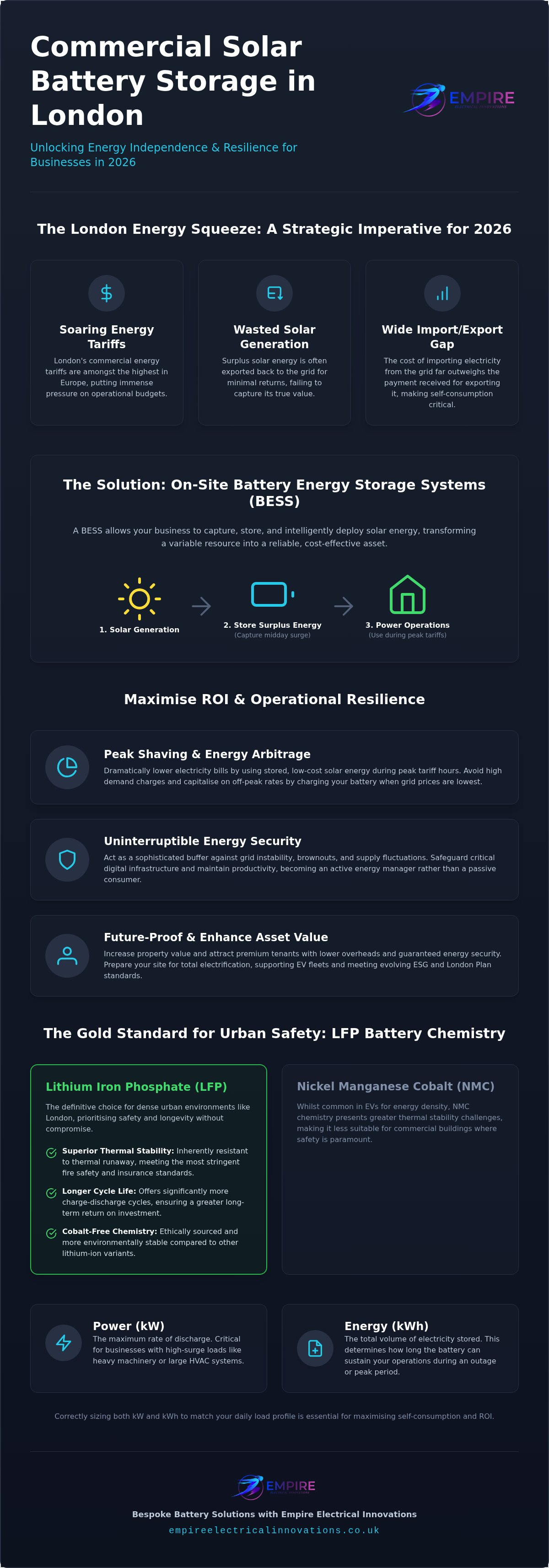
In 2026, the London energy landscape is defined by its complexity. A battery energy storage system (BESS) has moved from a niche technology to a fundamental requirement for commercial resilience. London businesses face a unique set of challenges, including some of the highest peak-time tariffs in Europe. By implementing commercial solar battery storage London firms can effectively decouple their operational costs from the volatility of the wholesale market. It isn't just about saving money. It's about establishing a secure, independent power base in a city where grid demand frequently outstrips supply.
Pairing storage with solar PV for commercial buildings is the most efficient way to maximise self-consumption. Without a battery, your solar array might only meet a fraction of your daily needs because generation doesn't always align with your peak operational hours. A bespoke battery system captures that midday surge for use during high-tariff evening periods. This approach is central to modern Corporate Social Responsibility (CSR) and ESG frameworks. Investors and clients now demand more than just carbon offsets; they want to see tangible on-site carbon reduction and energy efficiency.
Reducing Reliance on the National Grid
London's "energy squeeze" is a practical reality for many facility managers. Grid capacity is often capped in dense urban areas, preventing firms from expanding their operations or adding new machinery. Batteries provide an immediate solution by offering on-site reserves. They act as a sophisticated buffer against brownouts and supply fluctuations that can otherwise cripple critical digital infrastructure. You're no longer a passive consumer at the mercy of the grid's stability. Instead, you're an active energy manager, using stored reserves to smooth out supply issues before they impact your productivity.
Future-Proofing Commercial Property Assets
Installing high-spec renewable hardware is a proven method for increasing the long-term value of commercial property. In a competitive market, buildings that offer energy security and lower overheads command higher rents and better resale values. This strategy also prepares your site for the inevitable shift toward total electrification. Whether it's supporting a growing fleet of electric vehicles or transitioning to electric heating, commercial solar battery storage London systems provide the necessary infrastructure to handle increased demand. This forward-looking approach ensures your assets remain compliant with the London Plan and evolving sustainable development goals.
Understanding Commercial BESS Technology and Capacity
Selecting the right hardware for commercial solar battery storage London installations begins with chemistry. Lithium Iron Phosphate (LFP) has emerged as the industry gold standard for urban commercial sites. Unlike Nickel Manganese Cobalt (NMC), LFP offers superior thermal stability and a significantly longer cycle life. This makes it a safer choice for buildings where fire safety is a non-negotiable priority. This commitment to robust, safe technology is a core pillar of the UK's national battery strategy, which aims to secure a reliable supply chain for high-performance storage across the country.
Space is often the most significant constraint for businesses in the capital. Modular systems are designed for flexibility; they can be installed in internal plant rooms, basements, or even secure cupboards. For industrial sites with external yard space, containerised systems offer a "plug-and-play" solution that scales up to several megawatt-hours. High-performance inverters are equally vital. They ensure that the conversion from DC stored energy to AC usable power is both efficient and rapid. For a tailored assessment of your site's specific technical requirements, you can speak with our specialist team to explore bespoke options.
Power vs. Energy: kW and kWh Explained
You must distinguish between power (kW) and energy (kWh) when designing your system. Power represents the maximum rate at which the battery can discharge; energy is the total volume of electricity stored. For businesses with high surge loads, such as those running heavy machinery or large HVAC systems, the "C-rating" is a crucial metric. A higher C-rating means the battery can discharge its full capacity more quickly to meet sudden spikes in demand. Precise sizing is essential to maximise self-consumption and ensure the fastest possible payback period.
Typical System Sizes by Sector:
Small Office: 30 - 60 kWh (Primary use: Peak shaving and UPS backup)
Retail Centre: 50 - 150 kWh (Primary use: Load shifting and EV charging support)
Light Industrial: 200 - 500+ kWh (Primary use: Grid constraint mitigation and machinery support)
Smart Energy Management Systems (EMS)
The Energy Management System (EMS) acts as the brain of the installation. It uses sophisticated algorithms to decide when to store solar energy, when to draw from the grid, and when to discharge to the building based on real-time tariff data. Modern EMS units integrate seamlessly with existing Building Management Systems (BMS). This provides a single, unified point of control for facility managers. Real-time monitoring also ensures you have the accurate data required for ESG reporting and financial auditing. This level of precision is what defines commercial solar battery storage London solutions in 2026. It's no longer just a battery; it's a strategic financial asset.
Navigating London-Specific Installation Challenges and Regulations
Installing commercial solar battery storage London systems requires more than technical skill. It demands a thorough understanding of the capital's unique regulatory landscape. The London Plan sets the bar high for sustainability in commercial developments. It mandates an energy hierarchy that prioritises on-site renewables and storage to reduce carbon footprints. For businesses, this means battery systems are often the deciding factor in securing planning approval for new builds or major refurbishments. You're not just installing hardware; you're ensuring your property remains a compliant, high-value asset.
UK Power Networks (UKPN) oversees the grid across London. Navigating their G99 and G100 application processes is a critical step in any project. In many parts of central London, the grid is already operating near capacity. We use G100 compliant export limitation technology to manage how much power your system sends back to the grid. This allows you to install a larger, more capable battery without requiring expensive and time-consuming grid upgrades. It's a strategic way to bypass infrastructure bottlenecks whilst still enjoying the full benefits of on-site energy reserves.
Compliance and Safety Standards
Working with established renewable energy contractors in the South East ensures your project meets every legal and safety benchmark. London's built-up nature makes fire safety a primary concern for insurers and local authorities. We design installations that strictly follow IET wiring regulations and specific fire authority guidance. This methodical approach gives you the confidence that your system is both high-performing and fully insured.
Safety protocols we implement include:
Thermal Management: Sophisticated cooling systems to maintain optimal operating temperatures in restricted plant rooms.
Fire Suppression: Automated systems designed specifically for high-density lithium storage environments.
Access Routes: Strategic positioning to ensure safe maintenance access whilst maximising usable floor space.
Urban Planning and Grid Constraints
Planning permission requirements vary depending on the installation's footprint. Internal modular units are often simpler to approve, but external containerised systems may require full planning applications. This is particularly relevant in London's many conservation areas where visual impact is strictly monitored. Logistics also play a major role. From navigating narrow streets to managing delivery windows on Red Routes, every phase of a London installation requires meticulous planning. We handle the coordination with local councils to ensure a seamless delivery that doesn't disrupt your daily business operations.
Maximising ROI: Peak Shaving and Energy Arbitrage for Businesses
Energy is no longer just a line item on your balance sheet; it's a strategic asset. By installing commercial solar battery storage London businesses can transition from being passive consumers to active participants in the energy market. The most immediate financial benefit comes through two primary strategies: peak shaving and energy arbitrage. These methods don't just save money on bills. They provide a buffer against the extreme price volatility that has characterised the UK market in recent years. This shift allows you to predict your long-term energy costs with far greater precision.
The Financial Impact of Peak Shaving
Peak shaving is the process of using stored energy to avoid grid charges during peak windows. For London firms, this is particularly effective for mitigating "Red Band" Distribution Use of System (DUoS) charges. These fees are highest during periods of maximum grid demand, typically between 16:00 and 19:00 on weekdays. By discharging your battery during these hours, you can significantly reduce your "Maximum Demand" charge. Some industrial sites have successfully reduced their peak grid reliance by up to 30%, leading to substantial annual savings. This methodical approach ensures you're never paying premium rates for power that you could have generated or stored yourself.
Revenue Generation through Grid Services
Beyond saving money, your battery can actually generate income. Participating in Demand Side Response (DSR) programmes allows you to support the National Grid during times of frequency instability. Whilst individual SMEs might find the entry requirements complex, working with "Aggregators" allows smaller businesses to pool their battery capacity. These partners manage the technical dispatch and ensure you receive payments for providing frequency response services. By 2026, the ROI timeline for a commercial BESS has shortened significantly due to these multiple revenue streams. Many systems now reach break-even much faster than traditional solar-only installations.
Integrating storage with your commercial EV charging infrastructure adds another layer of financial protection. High-speed chargers can place immense strain on your local substation, often necessitating expensive grid upgrades. A battery system manages these spikes locally. This allows you to offer rapid charging without the capital expenditure of a new transformer. It's a cohesive way to future-proof your site whilst maintaining operational efficiency. It ensures your infrastructure can grow alongside your fleet requirements.
To see how these financial models apply to your specific facility, you can request a detailed ROI projection from our specialist consultants.
Bespoke Battery Solutions with Empire Electrical Innovations
Implementing commercial solar battery storage London systems requires a partner who understands both technical infrastructure and local urban constraints. Empire Electrical Innovations provides a methodical, end-to-end service designed to deliver long-term value. Our "Trusted Specialist" status is built on a foundation of compliance and precision. We don't offer generic packages. Instead, we develop bespoke energy strategies that align with your specific operational goals. This ensures your investment is protected by the highest UK standards from day one.
The process begins with a professional solar survey. This initial phase is critical for identifying site-specific opportunities and constraints. We evaluate your current energy usage and physical space to design a system that integrates seamlessly with your existing infrastructure. Whether you already have a professional solar panel installation in Hertfordshire or a complex rooftop array in central London, we ensure the battery storage component enhances overall system efficiency. Our commitment to workmanship means every installation is future-ready and fully compliant.
Expert Design and Consultation
Every sector has a unique energy signature. A school's demand peaks during the day, whilst a distribution centre may require high-power discharge for overnight fleet charging. We conduct detailed load analysis to match BESS capacity with these daily profiles. This precision prevents over-sizing and ensures your ROI projections are accurate and achievable. We also handle the entire DNO application process on your behalf. Managing G99 or G100 compliance with UK Power Networks is a standard part of our service. We remove the administrative burden from your facility management team so you can focus on your core business.
Ongoing Support and Maintenance
Energy independence is a long-term commitment. We ensure the longevity of your hardware through regular system health checks and essential firmware updates. Modern commercial solar battery storage London solutions rely on sophisticated software to manage charging cycles and grid interaction. Our team provides remote monitoring to optimise performance and detect potential faults before they impact your operations. This proactive support maintains the high standards of safety and efficiency established during the initial installation. We value clear communication and consistent support over simple transactions.
Contact Empire Electrical Innovations for a bespoke commercial battery storage quote and begin your journey toward energy independence.
Securing Your Energy Independence
Developing a resilient energy strategy is no longer optional for London businesses. You've seen how commercial solar battery storage London systems provide a sophisticated buffer against market volatility whilst ensuring compliance with the London Plan. By utilising peak shaving and energy arbitrage, your facility can lower demand charges and enhance its long-term property value. These systems aren't just hardware. They're the foundation of a modern, sustainable business model.
Empire Electrical Innovations brings the expertise of a NICEIC Approved Contractor to every project. We specialise in navigating complex London urban infrastructure. We provide bespoke energy designs that prioritise your specific ROI. Our methodical approach ensures that every installation is safe, compliant, and seamlessly integrated. We focus on high standards of workmanship to build lasting partnerships with our clients. Our goal is to provide technical infrastructure that supports your business for years to come.
Book your free commercial energy survey with Empire Electrical Innovations today. We look forward to helping you take control of your energy future.
Frequently Asked Questions
How much space does a commercial solar battery storage system require?
The space required depends entirely on your system's capacity and configuration. A standard modular unit for a London office typically occupies a footprint similar to a server rack, roughly 0.6m by 0.8m. Larger industrial systems often require external containerised solutions, ranging from 10ft to 40ft in length. You must also account for mandatory clearances for ventilation and maintenance access. We assess your available space during the initial survey to ensure the chosen footprint complies with all safety standards.
Do we need planning permission for a battery storage installation in London?
Planning permission is generally not required for internal modular installations as they often fall under Permitted Development rights. However, external battery containers or systems installed within London's many conservation areas usually require a full planning application. Visual impact and noise levels are key considerations for local councils. We provide the technical documentation and drawings necessary to support your application if your specific site requires formal approval from the local planning authority.
What is the typical lifespan of a commercial BESS in 2026?
In 2026, a high-quality commercial solar battery storage London system typically offers an operational lifespan of 10 to 15 years. This durability is based on Lithium Iron Phosphate (LFP) chemistry, which usually supports between 6,000 and 10,000 charge cycles. Performance remains high throughout this period, though capacity may slightly decrease over time. Regular firmware updates and professional maintenance are essential for ensuring your system reaches its maximum projected longevity and maintains its financial ROI.
Can battery storage help our business avoid expensive grid connection upgrades for EV chargers?
Batteries act as a powerful buffer between the grid and your EV charging points. They store energy during low-demand periods and discharge it rapidly to meet the high surge loads of rapid chargers. This process prevents your site from exceeding its agreed supply capacity. It's a strategic way to avoid the significant capital expenditure associated with upgrading local substations or transformers when expanding your commercial fleet charging infrastructure in congested urban areas.
How does energy arbitrage work for UK businesses with solar panels?
Energy arbitrage involves charging your battery when electricity prices are at their lowest, typically overnight or during periods of high solar generation. Your system then discharges this stored power when grid prices skyrocket during peak windows. For businesses with solar panels, this maximises the value of every generated kilowatt. It effectively shields your operations from volatile price spikes whilst ensuring you're always using the most cost-effective power available to your facility.
Are lithium-ion batteries safe for indoor installation in London offices?
Modern Lithium Iron Phosphate (LFP) batteries are highly safe for indoor installation when paired with robust thermal management systems. Unlike older chemistries, LFP is inherently stable and resistant to thermal runaway. We ensure all indoor installations meet strict London fire authority guidelines and IET wiring regulations. This includes automated fire suppression and adequate ventilation to maintain a secure environment within your plant room or basement, providing peace of mind for your staff and insurers.
What is the difference between G99 and G100 DNO applications?
A G99 application is the standard requirement for connecting any generation or storage system to the UK distribution network. It focuses on the technical safety and synchronisation of your hardware with the grid. G100 specifically covers Export Limitation schemes. This is crucial in London, as it allows you to install a large battery system whilst guaranteeing the DNO that you won't exceed a specific export limit, often bypassing the need for expensive grid upgrades.
How long does the installation of a commercial battery system usually take?
The physical installation of a commercial battery system typically takes between one and two weeks, depending on the site's complexity. However, the end-to-end project timeline is longer due to the DNO application process. Securing G99 approval from UK Power Networks can take several months in the current landscape. We manage these administrative phases concurrently with the design work to ensure your system is commissioned as efficiently as possible without unnecessary delays to your project.


Comments