
Commercial Solar Panel Grants UK: The 2026 Business Funding Guide

With commercial electricity rates stubbornly fixed between 24p and 27p per kWh in 2026, the average UK business is effectively paying a volatility tax on every hour of operation. You have likely searched for commercial solar panel grants UK only to find a fragmented landscape of regional schemes and expiring funds. It is a common frustration for firms facing high upfront costs whilst trying to secure long-term energy stability.
We're here to help you navigate this complexity. By leveraging tax incentives like the Annual Investment Allowance alongside local decarbonisation grants, you can transform a high capital expense into a strategic asset with a 6 to 10 year payback period. This guide provides a methodical breakdown of the 2026 funding environment, including the UKSPF extensions and the latest Smart Export Guarantee (SEG) opportunities. We will show you how to align technical compliance with financial precision to future-proof your business operations and secure the best possible return on investment.
Table of Contents
Navigating Commercial Solar Panel Grants in 2026
Commercial solar grants are financial mechanisms designed to reduce the capital expenditure (CAPEX) of renewable energy systems. In 2026, the landscape of commercial solar panel grants UK has evolved significantly. Whilst many firms still look for direct cash handouts, the reality is a sophisticated blend of tax write-offs and performance-linked payments. This shift ensures that funding supports high-quality, efficient installations rather than just subsidising equipment. It's a move toward rewarding long-term performance over initial setup.
Securing commercial solar panel grants UK now requires a strategic, methodical approach. Direct cash grants are increasingly regional, often replaced by robust national incentives like Full Expensing and the Annual Investment Allowance. These allow firms to treat solar as a high-performance business asset. It represents a form of quiet authority. It's a disciplined investment that delivers predictable returns without the noise of volatile markets. By focusing on compliance and high-tier workmanship, businesses can access the best funding tiers available this year.
The 2026 Commercial Energy Landscape
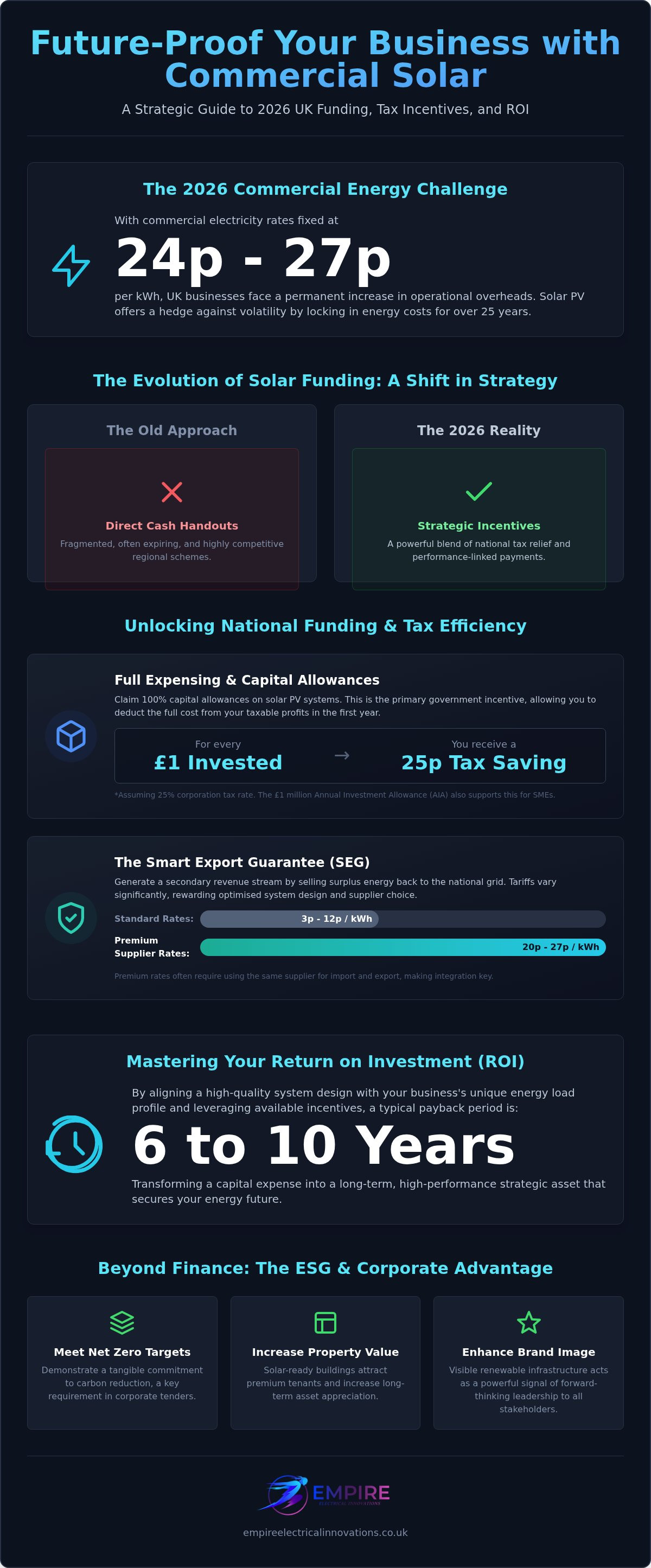
Energy price stability is the primary driver for UK boardrooms. With commercial electricity rates hovering between 24p and 27p per kWh, businesses face a permanent increase in operational overheads. Solar PV provides a fixed-cost hedge. By locking in a low generation cost for the next 25 years, you effectively de-risk your business from future grid price hikes. The history of Solar power in the United Kingdom shows a clear trajectory toward this decentralised model. Energy independence isn't just about sustainability. It's about securing your bottom line against external shocks. It's a pragmatic way to manage cash flow in an unpredictable economy.
ESG and Corporate Social Responsibility
Visible renewable infrastructure is a powerful signal to stakeholders. As we move toward Net Zero 2050, corporate tenders increasingly require proof of carbon reduction. A solar installation transforms an underutilised roof into a badge of compliance and forward-thinking leadership. For property owners, solar-ready buildings attract premium tenants who are eager to lower their own energy bills. This creates a virtuous cycle of value. High standards in workmanship and seamless integration ensure these systems remain reliable assets for decades, supporting both environmental targets and long-term asset appreciation. It's about being future-ready today.
National Funding Streams and Tax Efficiency
While direct commercial solar panel grants UK are often competitive and sector-specific, national tax incentives provide a more universal route to funding. These mechanisms allow businesses to recover a significant portion of their investment through reduced corporation tax liabilities. In 2026, the focus has shifted toward these fiscal levers as the primary way to offset installation costs. It's a methodical approach to financing that rewards profitable, forward-thinking firms.
Full Expensing and Capital Allowances
Full Expensing remains a cornerstone of the UK's green industrial strategy. It allows companies to claim 100% capital allowances on qualifying plant and machinery, including solar PV systems. For every £1 invested in solar technology, businesses can reduce their taxable profits by the full amount, effectively resulting in a 25p tax saving for every pound spent. This is often more lucrative than traditional grants because it's non-competitive and guaranteed for profitable firms. The £1 million Annual Investment Allowance (AIA) also continues to provide a robust framework for SMEs to write off the total cost of their transition in the year of purchase. Selecting high-quality components is essential here. Precision engineering ensures the system remains a performing asset long after the tax benefits are realised.
The Smart Export Guarantee (SEG) in 2026
The Smart Export Guarantee (SEG) provides a secondary revenue stream by paying businesses for the surplus energy they send back to the grid. This is particularly valuable for firms that close over weekends or bank holidays. In 2026, export tariffs vary significantly based on your energy provider and installation standards:
Standard export rates: Typically range from 3p to 12p per kWh for non-integrated customers.
Premium supplier rates: Can reach 20p to 27p per kWh for customers using the same supplier for import and export.
Weekend generation: Provides a consistent revenue stream during periods of zero on-site demand.
However, self-consumption remains the most efficient financial strategy. Using the energy you generate on-site saves you the full 24-27p retail rate, which far outweighs even the best export payments. Maximising this "internal" ROI requires a system designed for your specific load profile.
For high-energy industrial sites, the Industrial Energy Transformation Fund (IETF) provides targeted support for deep decarbonisation. Eligibility in 2026 focuses on sites with high thermal or electrical loads that require complex infrastructure integration. Additionally, solar panels remain exempt from business rates increases in 2026. This prevents your green investment from triggering a higher tax bill for your premises. To understand how these national streams apply to your specific site, a professional bespoke solar PV assessment can clarify your potential savings.
Regional Grants and Sector-Specific Support in the South East
Regional funding provides a critical layer of support for businesses that don't fit the national industrial criteria. In 2026, local authorities across the South East have launched targeted programmes to bridge the gap between national tax breaks and local net-zero goals. These commercial solar panel grants UK are often administered through local enterprise partnerships or county councils. They require a methodical application process but offer direct match-funding that can significantly lower the initial CAPEX for SMEs. It's a disciplined way to secure funding that stays within the local economy.
London and Home Counties Regional Schemes
The Mayor of London’s Energy Efficiency Fund (MEEF) remains a primary vehicle for larger projects in the capital. It provides flexible finance for low-carbon infrastructure, including solar PV and battery storage systems. For businesses in Hertfordshire and Bedfordshire, the Low Carbon Workspaces scheme provides essential match-funding for energy efficiency. This is particularly effective for warehouses and logistics hubs near the M1 and M25 corridors. These sites often have massive roof areas that, when paired with high-capacity solar, turn a building into a power station. You should also ensure your project aligns with Capital allowances for plant and machinery to maximise your fiscal recovery alongside these regional pots.
Solar Energy for Schools and Academies
Educational institutions in Buckinghamshire and the wider South East face unique budget pressures. The Public Sector Decarbonisation Scheme (PSDS) provides a dedicated route for schools to upgrade their infrastructure. Implementing solar energy for schools UK reduces long-term operational pressure by cutting energy bills significantly. This is quiet innovation in action. It provides a visible example of sustainability for students whilst freeing up capital for core educational needs. These projects often require NICEIC and MCS certified installers to meet the rigorous safety and compliance standards of the public sector.
Rural businesses in the Home Counties can also access the Farming in Protected Landscapes (FiPL) programme. This supports farmers and land managers in Areas of Outstanding Natural Beauty (AONB) to invest in renewable technology that respects the local environment. The real multiplier for these grants comes from system integration. Adding battery storage or EV charger installation doesn't just increase your self-consumption; it qualifies for additional funding tiers in many 2026 regional schemes. By storing excess generation and powering a commercial fleet, you accelerate your ROI far beyond what a standalone solar array can achieve.
Maximising Your ROI: A Framework for UK Businesses
Achieving a 6 to 10 year payback period requires more than just securing commercial solar panel grants UK. It demands a methodical framework based on three pillars: bill reduction, tax efficiency, and revenue generation. High-performing systems are designed around your specific operational habits. This ensures that every kilowatt generated is either consumed on-site or stored for high-tariff periods. It's a disciplined approach that treats energy as a controllable variable rather than an unavoidable overhead.
The first step is a Load Profile Analysis. This matches your generation peaks with your daytime demand. If your facility runs heavy machinery at 8:00 AM before the sun is at full strength, you need a strategy to bridge that gap. Integrating battery storage for solar panels allows for "Peak Shaving". This technique uses stored energy to avoid the most expensive grid rates during production starts, significantly lowering your blended energy cost. It's a quiet innovation that protects your margins.
Next, consider commercial EV charging infrastructure as a secondary revenue stream. By offering workplace charging to staff or visitors, you monetise excess solar generation that would otherwise be exported at lower SEG rates. This creates a self-sustaining ecosystem. Finally, model your 25-year financial outlook. This must account for a typical 0.5% annual drop in panel efficiency and scheduled maintenance. A reliable system isn't a "fit and forget" project; it's an investment in longevity and precision.
The Commercial ROI Calculation Formula
The standard formula for assessing your investment is: (Annual Savings + Annual Income) / Net System Cost. Your goal should be a Levelised Cost of Energy (LCOE) that's significantly lower than the current 24-27p grid rates. When you factor in the 100% tax write-offs mentioned earlier, the net cost of the system drops, accelerating your break-even point. Precision in the initial design is what separates a mediocre return from an exceptional one.
Integrating Battery Storage and EV Charging
Batteries and chargers act as ROI multipliers. Whilst a standalone solar array is effective, adding storage allows you to capture energy that would otherwise be lost during weekends or bank holidays. This stored power then offsets your most expensive grid consumption. It's a logical progression for any business park or industrial unit looking to de-risk their infrastructure. To see how these components integrate on your site, you can book a professional site survey to receive a tailored performance forecast.
Future-Proofing Your Infrastructure with Empire Electrical Innovations
Empire Electrical Innovations operates as a Trusted Specialist in the renewable energy sector. We focus on technical precision rather than high-pressure marketing. For businesses pursuing commercial solar panel grants UK, the quality of the initial design often determines the success of the application. Most funding bodies require detailed performance forecasts and technical specifications that only a certified specialist can provide. A professional solar survey and quote serves as the essential foundation for these financial submissions.
Larger commercial sites in London and the South East face unique technical hurdles. Managing G99 grid applications is a core part of our service. This process ensures your system can safely export power without destabilising the local network. We also function as specialist telecoms infrastructure contractors. This expertise allows us to handle complex site cabling and ducting that general installers often overlook. We ensure your solar PV, battery storage, and telecoms work in seamless integration. It's about building infrastructure that lasts.
Navigating DNO and Planning Permissions
Navigating the relationship with Distribution Network Operators (DNO) requires methodical planning. In Hertfordshire and London, grid capacity is often constrained. We manage these negotiations to secure the best possible connection for your site. For developers, adhering to Part L building regulations is now mandatory for new commercial builds. Our bespoke design approach is also critical for listed buildings or those within conservation areas. We balance modern performance with strict planning constraints. It's a disciplined way to modernise heritage assets.
Longevity, Precision, and Partnership
Longevity is built on compliance. We maintain strict MCS and NICEIC standards to ensure your installation meets commercial insurance requirements. This protects your investment and validates your grant eligibility. Our work continues after the final panel is installed. We provide post-installation monitoring to verify that your ROI targets are being met in real-world conditions. This partnership-first approach starts with a collaborative site survey. We work with you to design a system that fits your specific operational environment. We don't just install equipment; we deliver a long-term energy strategy.
Securing Your Energy Independence in 2026
Navigating the landscape of commercial solar panel grants UK in 2026 requires a shift from seeking simple handouts to implementing a disciplined fiscal strategy. Success lies in combining regional match-funding with national tax incentives like the £1 million Annual Investment Allowance. By integrating battery storage and EV charging, you don't just lower bills; you turn your roof into a high-performance business asset.
Precision and compliance remain the foundations of this transition. As certified MCS and NICEIC installers specialising in Hertfordshire and London commercial infrastructure, we ensure your system meets the highest standards for insurance and grant eligibility. Our team provides the technical expertise required for complex solar, battery, and EV charging integration.
Take the first step toward long-term energy stability today. Book your free commercial solar survey with Empire Electrical Innovations to receive a bespoke performance forecast. Secure your business against market volatility and build a resilient, future-ready operation.
Frequently Asked Questions
What is the average payback period for commercial solar panels in 2026?
The average payback period for a commercial system in 2026 is between 6 and 10 years. This timeframe is achieved by combining high self-consumption with tax incentives like Full Expensing. Whilst the initial capital expenditure is significant, the reduction in grid energy reliance provides a rapid return on investment. Precision in system design and matching your load profile are essential to hitting the lower end of this range.
Can my business still claim the 100% Full Expensing tax relief on solar?
Yes, your business can still claim 100% Full Expensing tax relief on solar PV installations throughout 2026. This allows profitable companies to write off the entire cost of the system against their taxable profits in the first year. This mechanism effectively acts as one of the most reliable commercial solar panel grants UK alternatives, providing a 25p tax saving for every £1 invested in renewable technology.
Are there specific grants for SMEs in Hertfordshire or London?
SMEs in London can access the Mayor of London’s Energy Efficiency Fund (MEEF) for flexible project financing. In Hertfordshire and Bedfordshire, the Low Carbon Workspaces scheme offers match-funding for energy efficiency improvements. These regional pots are designed to support smaller firms that might not meet the criteria for larger industrial funds. They often require evidence of carbon reduction and professional installation by certified contractors.
Do I need planning permission for a warehouse solar installation?
Most warehouse solar installations fall under Permitted Development rights, meaning formal planning permission isn't usually required. However, exceptions apply if your building is listed or located in a conservation area. You must also ensure the array doesn't protrude more than 200mm from the roof plane. It's vital to verify these details with your local authority or a specialist consultant before commencing any structural work on site.
How much can a battery storage system reduce my business energy bills?
A battery storage system can reduce your energy bills by a further 20% to 40% compared to a standalone solar array. It achieves this by storing excess generation from sunny periods for use during peak tariff times or morning production starts. This process, known as peak shaving, ensures you use your own low-cost energy instead of drawing from the grid when rates are at their highest.
What is the Smart Export Guarantee (SEG) rate for businesses in 2026?
In 2026, Smart Export Guarantee (SEG) rates for businesses vary between 3p and 27p per kWh. The highest rates are typically reserved for firms that use the same supplier for both energy import and export. Whilst these payments provide a helpful secondary revenue stream, the financial benefit is always lower than self-consuming the energy on-site, which saves you the full retail price of grid electricity.
Can solar panels power my commercial site during a power cut?
Standard solar installations will shut down during a power cut for safety reasons to prevent back-feeding the grid. To maintain power during an outage, your system requires a battery storage unit with an "islanding" or emergency power supply (EPS) function. This allows the system to operate independently from the grid. We can integrate these backup capabilities during the design phase to ensure your critical infrastructure remains operational.
How do I apply for the Industrial Energy Transformation Fund (IETF)?
Applications for the Industrial Energy Transformation Fund (IETF) are processed through the GOV.UK portal during specific funding windows. This fund is specifically for high-energy industrial sites looking to improve efficiency or decarbonise processes. You will need to provide detailed energy audits and a clear technical roadmap. Working with a specialist to document your commercial solar panel grants UK eligibility can significantly improve your chances of a successful application.


Comments