
Future Homes Standard Solar Panels: The 2026 Guide to Compliance and Installation

By March 2027, the traditional British building site will undergo its most significant transformation in a generation as rooftop solar becomes a mandatory fixture for virtually every new home. The publication of the Future Homes Standard on 24 March 2026 has turned renewable energy from a premium upgrade into a non-negotiable regulatory requirement. Integrating Future Homes Standard solar panels is no longer just about meeting environmental targets; it's about securing your legal right to build. While the transition to SAP 10.3 and the upcoming Home Energy Model may feel like a moving target, the mandate is clear. New developments must now function as micro-power stations to achieve the required 75 to 80 per cent reduction in carbon emissions.
We recognise that navigating these shifting Part L regulations whilst managing build costs feels like a high-stakes balancing act for any developer. This guide will help you master the technical specifications and economic advantages of the 2026 mandates to ensure your projects remain both compliant and profitable. We will examine the 40 per cent ground area sizing rules, the critical role of battery storage in future-proofing, and how to achieve seamless grid integration for your next residential or commercial development.
Table of Contents
Understanding the Future Homes Standard and Solar Mandates
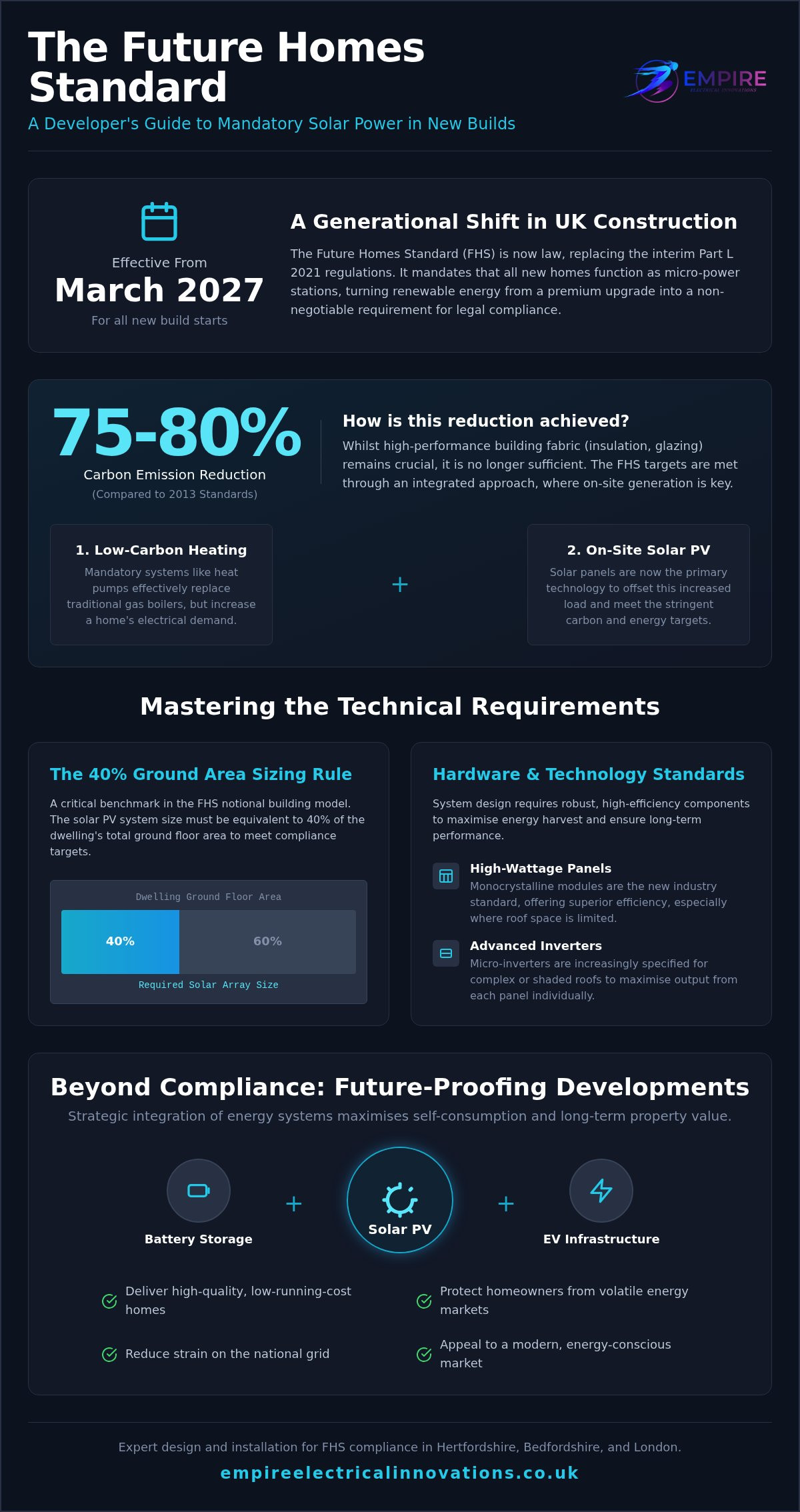
The Future Homes Standard (FHS) represents the most rigorous update to building regulations in recent history. It officially succeeds the interim Part L 2021 standards. The government published the final regulations on 24 March 2026, setting a clear trajectory for the construction industry. These rules become legally enforceable for all new-build starts from 24 March 2027. Precision. Performance. Compliance. These are the pillars of the new framework.
The core objective is clear. New homes must produce 75 to 80 per cent fewer carbon emissions than those built to 2013 standards. Whilst low-carbon heating like heat pumps is a mandatory component, Future Homes Standard solar panels have emerged as the primary technology for achieving these targets. Heat pumps increase a dwelling's electrical demand. Solar PV offsets this load, ensuring the property remains within its primary energy and carbon limits. It's a logical, integrated approach to modern housing.
The Shift from Part L to the Future Homes Standard
Under the previous Part L framework, developers could often rely solely on high-performance insulation and glazing. This 'fabric first' approach remains a vital foundation, but it's no longer sufficient on its own. The 2026 regulations tighten the 'notional building' benchmarks significantly. This means the theoretical model used to set your carbon targets now assumes a high level of on-site renewable generation. To meet these benchmarks, solar PV is effectively a standard requirement for virtually every new home.
Key Policy Drivers for 2026 and Beyond
The shift aligns with the UK’s 2050 Net Zero target and interim housing milestones. Central government's 'rooftop revolution' mandate prioritises energy security through decentralised power. By turning roofs into assets, the FHS reduces the strain on the national grid and protects homeowners from volatile energy markets. This move toward a zero-energy building model is already reflected in local planning trends. Planning authorities across Hertfordshire, Bedfordshire, and London are adopting stricter green policies that often exceed national minimums. We see this through:
Decarbonised heat: The effective elimination of gas boilers from new-build specifications.
On-site generation: A focus on Future Homes Standard solar panels to provide clean, local electricity.
Future-proofing: Designing infrastructure today that can handle the energy demands of tomorrow.
Adopting these standards early isn't just about avoiding penalties. It's about delivering high-quality, low-running-cost homes that appeal to a modern, energy-conscious market. We provide the technical expertise to ensure your developments meet these standards without unnecessary complexity.
Technical Specifications: Solar PV Requirements for New Builds
Compliance with the 2026 building regulations requires a methodical approach to system design. The most critical benchmark for developers is the 40 per cent ground area rule. Under the Future Homes Standard, the solar PV system must be sized to cover approximately 40 per cent of the dwelling's total ground floor area. This calculation is a fundamental part of the notional building model used to determine if a property meets its carbon reduction targets. Precision at the design stage is essential to avoid costly retrofits during the commissioning phase.
Hardware selection has also evolved. High-wattage monocrystalline modules are now the 2026 industry standard due to their superior efficiency and longevity. When roof space is at a premium, these panels allow developers to meet the 40 per cent requirement using fewer units. Inverter technology must be equally robust. Whilst string inverters remain common for simple layouts, micro-inverters are increasingly specified for complex roofs to mitigate shading issues and maximise the performance of Future Homes Standard solar panels across the entire site.
Calculating Array Size and Ground Area Coverage
The 40 per cent calculation provides a clear baseline, but practical application varies by site. For residential rooftops, developers must balance aesthetic integration with maximum solar harvest. The Future Homes Standard consultation documents acknowledge that exceptionally constrained urban sites may require "best endeavours" clauses. If shading from adjacent buildings or unfavourable orientation makes the full 40 per cent target unfeasible, developers must demonstrate that they've maximised the available potential within the constraints of the plot.
Orientation remains a primary driver of performance scores. South-facing arrays are optimal, but East-West configurations are often used to provide a more consistent energy profile throughout the day. Consulting with a specialist in bespoke solar PV design ensures these technical hurdles don't delay your project's approval or lead to compliance failures.
Hardware Standards and Longevity
Longevity and reliability are non-negotiable for FHS-compliant installations. We recommend specifying Tier 1 modules for all property projects to ensure long-term performance and bankability. Minimum hardware standards include:
MCS Certification: Essential for homeowners to access the Smart Export Guarantee (SEG) and for developers to prove installation quality.
Warranty Protection: 2026 standards typically expect 25-year linear power output warranties and at least 12-year product warranties.
High Efficiency: Modules should ideally exceed 21 per cent efficiency to meet the 40 per cent ground area rule on smaller plots.
By focusing on high-specification hardware and precise calculations, developers can future-proof their assets whilst ensuring full regulatory compliance from day one.
The Economic Argument: ROI and SAP 10.3 Compliance
Whilst compliance with Future Homes Standard solar panels is a regulatory necessity, the economic logic is equally compelling. The transition to SAP 10.3 ensures that developers are rewarded for high-performance electrical design. This methodology provides a more accurate reflection of a building's energy balance by accounting for on-site generation and its impact on the grid. It effectively bridges the performance gap between theoretical design and post-occupancy reality. Homes that generate their own power are simply more resilient in a volatile market.
In the Hertfordshire and London markets, energy efficiency has become a primary differentiator for savvy buyers. Homes with integrated solar aren't just compliant; they're more valuable assets. Smart Export Tariffs allow owners to turn their roofs into revenue streams, with 2026 export rates ranging from 3p to 27p per kWh depending on the provider. This transforms the property from a passive shelter into an active power station. It's a strategic shift that enhances the long-term bankability of any new development.
Optimising SAP Scores with Solar PV
The Environmental Impact Rating (EIR) is directly influenced by the installed PV capacity. Under the Future Homes Standard solar panel requirements, a larger array directly lowers the dwelling's CO2 emission rate. Whilst battery storage isn't a mandatory requirement under the current FHS draft, it significantly improves SAP performance by increasing the proportion of solar energy used on-site. SAP 10.3 rewards solar export by applying a carbon credit to the dwelling's overall emissions profile, though it prioritises self-consumption over grid feedback.
Long-term Financial Benefits for Homeowners
Households in homes built to the new standard could save approximately £1,000 a year on energy bills. This figure is significant given the Ofgem price caps seen in early 2026. Beyond bill savings, the "Green Premium" is a tangible reality in the South East. Energy-efficient homes often sell faster and at higher price points as buyers seek protection from future energy price volatility. You can explore a detailed breakdown of the ROI for Hertfordshire homeowners to see how these systems pay for themselves through reduced overheads and enhanced resale value.
By integrating solar early in the design phase, developers can market their projects as "future-proofed." This appeals to a demographic that values sustainability and financial predictability. We provide the technical data needed to support these claims, ensuring your sales team can communicate the value of renewable integration effectively.
Strategic Implementation: Integrating Solar with Battery and EV Infrastructure
The 2026 mandates push new developments toward an "all-electric" model. This shift creates a substantial increase in peak electrical demand. Relying on Future Homes Standard solar panels alone can lead to inefficiencies where generation and demand don't align. Strategic integration is the solution. By linking solar arrays to heat pumps and water cylinders, developers can create a cohesive ecosystem that manages load intelligently. It's about building homes that don't just generate power but use it effectively.
Managing the electrical load of a modern home requires a methodical approach. When a heat pump, an electric oven, and a car charger operate simultaneously, the demand on the local network is significant. Integrated systems allow for "solar diversion," where excess energy is automatically sent to heat water or charge a vehicle before it's exported. This reduces the home's reliance on the grid during expensive peak periods and ensures every kilowatt generated provides maximum value to the occupant.
The Role of Battery Storage in FHS Homes
Whilst the current FHS framework doesn't mandate battery storage, including it is a logical step for any future-ready development. It allows owners to store daytime solar harvest for evening use. This is crucial for maximising efficiency with solar battery installation. We specialise in GivEnergy and other leading residential systems that provide the reliability property owners expect. These batteries stabilise the home's energy profile, protecting users from high evening peak rates and ensuring renewable energy isn't wasted.
EV Charger Integration and Load Balancing
Co-ordinating solar PV with commercial EV charging infrastructure is another priority for 2026. High-density developments face the risk of tripping main fuses if multiple vehicles charge whilst heat pumps and appliances are running. Dynamic load management is essential here. These systems monitor the total building load in real-time, prioritising solar generation for EV charging when available and throttling chargers when total demand nears capacity. This prevents infrastructure failure without requiring expensive grid upgrades.
Using a single-contractor approach for solar and EV infrastructure ensures seamless communication between systems. This reduces technical friction and simplifies the commissioning process for developers. We specialise in these integrated designs across Hertfordshire, Bedfordshire, and London. Contact our specialist team to discuss a bespoke energy strategy for your next project.
Expert Solar Installation for FHS Compliance in the South East
Empire Electrical Innovations operates as a methodical partner for property developers across Hertfordshire, Bedfordshire, and Buckinghamshire. Achieving compliance with Future Homes Standard solar panels requires more than just mounting hardware. It demands a disciplined approach to project management that begins at the pre-planning stage and continues through to the final handover. We specialise in high-standard commercial and residential projects, providing the technical certainty required for complex electrical infrastructure.
Our "no-nonsense" approach removes the friction from large-scale renewable projects. We handle the technical burden of compliance, ensuring that every installation meets the rigorous benchmarks set out in the 2026 regulations. By managing the commissioning and handover process, we allow property managers to focus on their core delivery whilst we secure the renewable energy credentials of the development. Reliability is our foundation. Precision is our standard.
Why a Local Specialist Matters
Navigating the South East and London energy markets requires specific regional expertise. Local grid constraints often dictate the feasibility of a solar array, and managing District Network Operator (DNO) applications is a critical path for any project. We provide fast-response support and detailed site surveys across the Home Counties to identify these hurdles early. This proactive stance prevents delays during the construction phase.
Working with a local specialist ensures your project remains on schedule despite the complexities of regional planning variations. You can find more detailed insights in our guide to professional solar panel installation in Hertfordshire. This proximity allows us to maintain the high standards of workmanship and clear communication that define our brand as a trusted partner for the construction sector.
Our Process: From SAP Analysis to Commissioning
Success starts during the early design phase. We collaborate with architects and developers to ensure that Future Homes Standard solar panels are integrated into the building's fabric from the outset. This early-stage involvement prevents design conflicts and ensures the system is optimised for the specific orientation and shading profile of the site. We treat the building as an integrated system rather than a collection of separate components.
Our expertise extends beyond solar. We ensure seamless integration with commercial telecoms and fibre infrastructure, providing a holistic approach to a development's connectivity and power. Our commissioning process includes:
Performance Validation: Rigorous final testing to ensure the system meets the design-stage carbon reduction targets.
Network Readiness: Specialised Test Rod and Rope (TRR) services to ensure site infrastructure is ready for fibre blowing and telecoms integration.
Compliance Documentation: Comprehensive handover packs for building control, property managers, and end-users.
This structured flow ensures that every development we touch is fully compliant, future-proofed, and ready for immediate occupation. We provide the technical backbone that allows your developments to thrive in a zero-carbon future.
Future-Proofing Your Next Development
The transition to the 2027 building mandates represents a strategic opportunity to redefine property value. By mastering the 40 per cent ground area rule and integrating complementary technologies like battery storage, you ensure your projects aren't just compliant but market-leading. Future Homes Standard solar panels are the cornerstone of this new era. They provide the necessary carbon reductions whilst offering homeowners significant long-term energy savings in an all-electric landscape.
Navigating these complex Part L updates requires a partner who understands the technical nuances of the South East grid. As MCS Certified Installers and GivEnergy Approved Partners, we specialise in bespoke energy solutions for Hertfordshire and London property developments. Our methodical approach ensures every installation is high-performing, fully commissioned, and ready for handover. Begin your FHS compliance project with a professional solar survey to ensure your next development meets the highest standards of efficiency and reliability. We look forward to helping you build a cleaner, more secure future.
Frequently Asked Questions
Is solar mandatory for all new builds under the Future Homes Standard?
Yes, rooftop solar is a mandatory requirement for virtually every new home built in England from 24 March 2027. While the standard uses a "notional building" approach rather than a rigid prescription, the carbon reduction targets of 75 to 80 per cent make solar PV the only viable primary technology for most developments. Some minor exceptions exist for specific site constraints, but it's now the default requirement for regulatory compliance.
How much solar PV is required to meet FHS 2026 standards?
The solar PV system must be sized to cover approximately 40 per cent of the dwelling's total ground floor area. This calculation is a key metric within the SAP 10.3 methodology used to demonstrate compliance. For a typical residential property, this usually equates to a 4kWp to 6kWp array depending on the footprint. High-efficiency monocrystalline modules are recommended to meet this target on smaller or more complex roof spaces.
Does the Future Homes Standard require battery storage for residential properties?
No, battery storage is not currently a mandatory requirement under the Future Homes Standard. However, many developers choose to include it because it significantly improves SAP performance scores by increasing self-consumption of generated energy. Storing power for evening use reduces the home's reliance on the grid during peak times, providing a better energy profile for the end-user whilst protecting them from volatile price caps and energy market shifts.
Can I still use a gas boiler in a home built to the Future Homes Standard?
No, gas boilers are effectively eliminated from new-build specifications under the 2026 regulations. The standard requires low-carbon heating systems, with electric heat pumps being the predominant technology. Because heat pumps increase the property's electrical load, Future Homes Standard solar panels are essential to offset this demand and meet the strict carbon emission limits. This shift ensures all new homes are fit for a decarbonised national grid.
How does the Future Homes Standard affect the cost of building a new home?
Building to these standards does increase initial capital expenditure due to the requirement for high-performance fabric, heat pumps, and solar arrays. However, these costs are balanced by the long-term value added to the property asset. Homes built to the FHS are estimated to save occupants around £1,000 per year on energy bills. This makes them significantly more attractive to buyers who prioritise low running costs and energy independence.
What happens if a development started before the 2026 mandate?
Transitional arrangements usually apply based on when the initial building notice or full plans were submitted to local authorities. If work on a specific plot commenced before the March 2027 enforcement date, it might still fall under interim standards. However, developers are increasingly adopting FHS levels of Future Homes Standard solar panels and insulation now to avoid building obsolete stock that is harder to sell in a green-conscious market.
Are there exemptions for solar panels on shaded or north-facing roofs?
There are "best endeavours" clauses for exceptionally constrained sites where solar harvest is severely limited by external factors. If a roof is heavily shaded by adjacent structures or lacks suitable orientation, developers must demonstrate they've maximised the available potential. In these cases, other compensatory measures in the building's fabric or heating system may be required to meet the overall carbon reduction target of 75 to 80 per cent.
How do I ensure my solar installation is compliant with Part L and FHS?
Compliance is secured by using MCS-certified installers and ensuring the system design matches the SAP 10.3 calculation for the specific plot. It's vital to provide a comprehensive handover pack, including commissioning certificates and performance data, to building control. Working with a specialist who understands the integration of renewables, battery storage, and EV charging ensures that the final installation meets all regulatory standards without technical friction or delays.


Comments