
Solar for Hertfordshire Farms: 2026 Strategic Guide

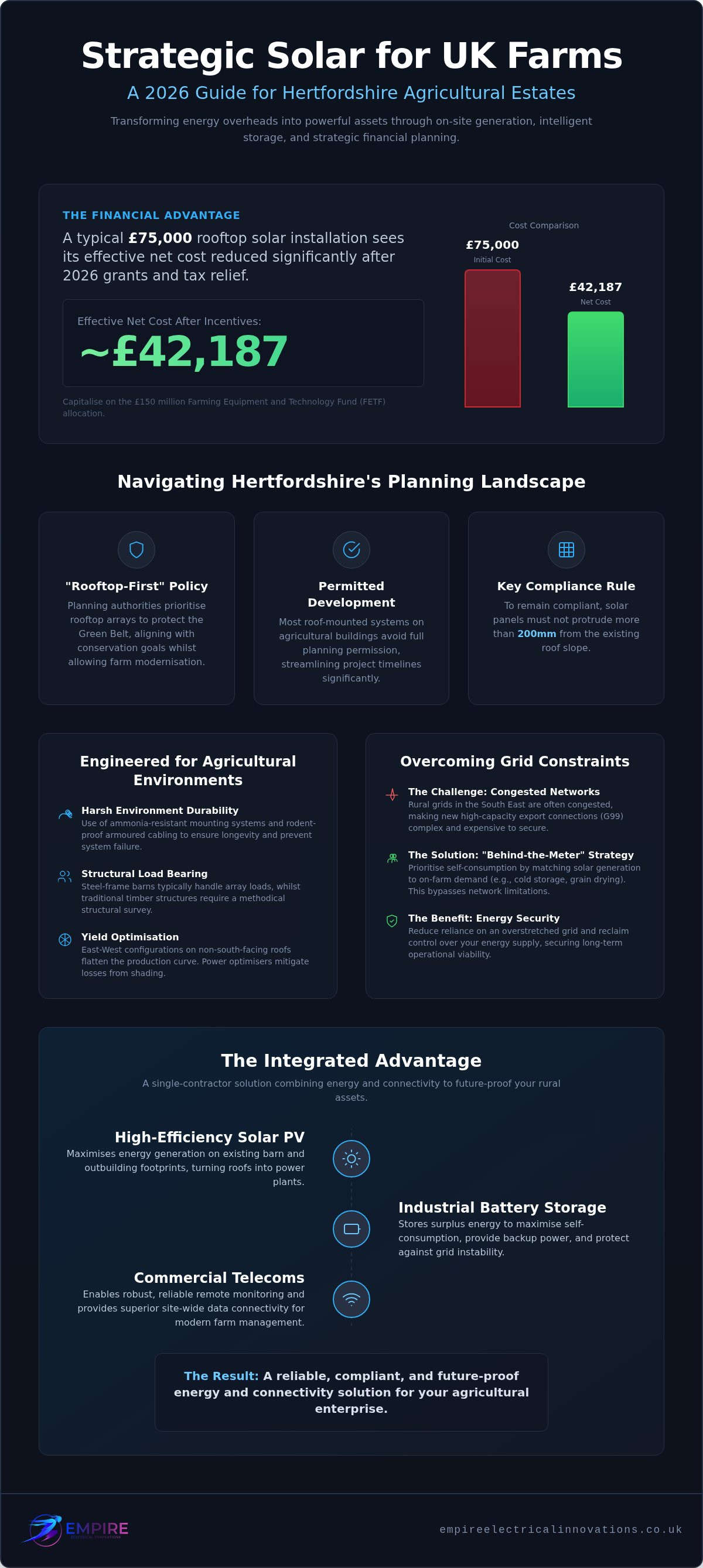
A typical £75,000 rooftop solar installation on a UK farm can now see its effective net cost reduced to approximately £42,187 after 2026 grants and tax relief. You likely recognise that energy price volatility is no longer a temporary hurdle but a permanent threat to your margins. This is particularly true when powering energy-intensive grain drying or cold storage facilities. In a county defined by the Chilterns and strict Green Belt policies, installing solar panels for agricultural buildings Hertfordshire requires more than just technical skill. It demands a strategic, compliant, and methodical approach.
We understand the pressure to reduce overheads whilst maintaining high operational standards. You can transform your estate into a self-sustaining, future-ready enterprise that generates diversified revenue through the Smart Export Guarantee. This 2026 strategic guide outlines how to navigate the local planning landscape and secure your share of the £150 million FETF allocation. We will detail the integration of high-efficiency PV with industrial battery storage and robust telecoms infrastructure. This represents the Empire Advantage: a single-contractor solution for energy and connectivity that overcomes remote monitoring challenges. Reliable. Compliant. Future-proof.
Table of Contents
Navigating the 2026 Agricultural Energy Landscape in Hertfordshire
The agricultural sector in South East England has reached a pivotal juncture in 2026. Energy costs for intensive operations, such as grain drying and livestock climate control, have shifted from manageable overheads to significant business risks. Hertfordshire farms face a unique set of challenges. High land values and a dense population mean that large-scale ground-mount projects often face local opposition. Consequently, the focus has shifted toward high-efficiency rooftop arrays. Agricultural energy resilience for a Hertfordshire estate in 2026 is the strategic decoupling of operational costs from grid volatility through onsite generation and intelligent storage. By installing solar panels for agricultural buildings Hertfordshire, landowners are reclaiming control over their energy security.
The Green Belt and Local Planning Sensitivities
Hertfordshire planning authorities maintain a strict "rooftop-first" policy to protect the Green Belt. This approach aligns with local conservation goals while allowing farms to modernise without encroaching on productive land. Under 2026 Permitted Development Rights (PDR), most roof-mounted systems on agricultural buildings don't require full planning permission. The panels must not protrude more than 200mm from the roof slope to stay compliant. These installations also support Environmental, Social, and Governance (ESG) targets. While some estates explore agrivoltaics for biodiversity gains on marginal land, the most efficient route to approval remains the utilisation of existing barn footprints. It's a methodical way to upgrade infrastructure while respecting the landscape.
Grid Capacity Challenges in the South East
The rural networks across Bedfordshire and Hertfordshire are increasingly congested. Securing a G99 connection for systems exceeding 50kW has become a complex technical exercise. National grid constraints mean that simple export-led models are often rejected or require expensive infrastructure upgrades. Onsite generation offers a practical workaround. By matching solar output to the high-demand cycles of cold storage or automated feeding systems, you can bypass local network limitations. This "behind-the-meter" strategy ensures that power is used where it's generated. It reduces reliance on an overstretched grid and secures the long-term viability of your agricultural assets. We focus on these technical nuances to ensure your system is both compliant and performant from day one.
Engineering Solar PV for Barns and Farm Outbuildings
Modern agricultural buildings in Hertfordshire offer expansive, unobstructed roof spaces. Steel-frame barns typically handle the additional dead load of solar arrays without reinforcement. Traditional timber structures require a more methodical structural survey to ensure longevity. We prioritise Tier 1 high-efficiency panels to maximise yield on every square metre. This approach is central to integrating solar PV for commercial buildings into a broader estate management strategy. When designing solar panels for agricultural buildings Hertfordshire farms rely on, we must account for structural load-bearing and orientation optimisation simultaneously.
Bespoke Design for Agricultural Environments
Agricultural environments are uniquely demanding. Ammonia from livestock housing can corrode standard mounting systems, so we specify components designed for these conditions. Bird-nesting and dust accumulation are managed through specific mounting heights and panel choices. Rodent damage to cabling is a frequent cause of system failure in rural outbuildings. Using galvanised steel conduit or specialist armoured cabling ensures your investment remains secure. We select inverters with high ingress protection ratings to withstand the rigours of farm-based plant rooms. It's about building for the next twenty years, not just the next five.
Maximising Yield on North-Facing or Shaded Roofs
Not every barn has a perfect southern aspect. Permitted development rights for agricultural buildings allow for significant installations, but performance depends on technical precision. East-West configurations are often superior for farms with high morning and evening demand. These systems flatten the production curve, providing more usable power during milking or feeding times. Power optimisers are essential when silos or neighbouring trees cast shadows. This technology allows each panel to operate independently, preventing a single shaded cell from compromising the entire string.
Tracking performance across multiple outbuildings requires integrated monitoring software. It provides real-time data on generation and self-consumption, which is vital for calculating your exact ROI. For those ready to begin, our solar panel installation Hertfordshire team specialises in these complex rural environments, ensuring every kilowatt is accounted for.
Industrial Battery Storage: ROI and Financial Incentives
Generating power is only half the equation for a modern Hertfordshire estate. The true value of solar panels for agricultural buildings Hertfordshire farms utilise is realised through industrial battery storage. Without storage, your generation is tethered to daylight hours, often peaking when demand is lowest. Integrating a battery system transforms your solar PV from a supplemental daytime source into a 24/7 power solution. It allows you to capture surplus energy during the sunniest periods and deploy it during high-tariff evening windows or overnight operations.
Peak shaving represents a significant financial advantage for arable and livestock units. Energy-intensive processes, such as grain drying or automated climate control, create massive spikes in demand. Utility providers often levy heavy surcharges for these peaks. A battery system acts as a buffer, discharging stored energy to meet these spikes and keeping your grid draw below the surcharge threshold. This strategy alone can shave thousands off annual operational costs beyond the basic reduction in unit price.
50kW Array Performance Comparison:
Standalone Solar: Typically achieves 30% to 40% self-consumption. High volumes of surplus energy are exported to the grid at Smart Export Guarantee (SEG) rates, which are often lower than the cost of purchasing power.
Solar-plus-Storage: Can increase self-consumption to 80% or higher. By displacing expensive grid purchases with your own stored energy, the system significantly accelerates the payback period.
Full Expensing and AIA: The 2026 Tax Outlook
The 2026 fiscal landscape provides substantial support for Hertfordshire farm businesses investing in green technology. The Annual Investment Allowance (AIA) remains a cornerstone, allowing you to deduct 100% of the cost of qualifying plant and machinery, including solar and storage, from your taxable profits up to a £1 million limit. Additionally, "Full Expensing" rules in 2026 offer a permanent tax break for companies investing in new equipment. This means for every pound you invest, you can reduce your tax bill by up to 25p. Combined with SEG rates reaching as high as 25p/kWh from providers like Good Energy, the long-term payback is more secure than ever.
Battery Storage for Emergency Backup and UPS
Rural power outages shouldn't compromise sensitive livestock systems or automated infrastructure. In 2026, the transition from traditional lead-acid to high-density lithium-ion storage has set a new standard for reliability. These systems function as an Uninterruptible Power Supply (UPS), providing seamless backup for ventilation, feeding lines, and cooling systems. Our solutions are fully scalable. You can start with a capacity that meets your current emergency needs and expand the stack as your agricultural production grows. It's a methodical approach to future-proofing that ensures your estate remains operational regardless of local grid stability.
The Empire Advantage: Integrating Energy and Telecoms
Smart farming in 2026 demands more than just raw power. It requires a seamless flow of data across the entire estate. High-speed connectivity is the backbone of modern agricultural operations, from automated grain moisture sensors to real-time energy market trading. Many providers treat energy and data as separate entities, but we understand they're inextricably linked. This is the Empire Advantage. We provide a single-contractor solution that manages both electrical and telecoms infrastructure simultaneously. It's a methodical approach that eliminates the need for multiple subcontractors and reduces project timelines.
Preparation is the first step in any multi-utility upgrade. Our Test Rod and Rope (TRR) services allow us to assess existing underground ducts for viability before any cables are pulled. If existing infrastructure is blocked or insufficient, we operate as telecoms ducting contractors Hertfordshire estates trust for new, compliant installations. This ensures that when you install solar panels for agricultural buildings Hertfordshire, your site is also ready for the data demands of the next decade. We don't just install panels; we build the underlying network that makes them intelligent.
Connecting Remote Agricultural Buildings
Remote barns often suffer from poor wireless signals, making real-time monitoring difficult or impossible. We use fibre blowing services to bring high-speed data directly to your most isolated buildings. By combining energy and data cabling in shared trenches, we significantly reduce site disruption and civil engineering costs. This robust infrastructure is essential for participation in flexible energy markets. It allows your system to respond instantly to price fluctuations, maximising the value of every generated kilowatt through precise, automated control. It's about creating a secure, hard-wired foundation for your estate's digital future.
Diversifying with EV Charging and Farm Shops
Farm shops and rural tourism sites are perfectly positioned to benefit from the synergy between solar generation and EV charging hubs. We specialise in commercial EV charger installation Hertfordshire, designing systems that manage the load between chargers, solar arrays, and heavy farm machinery. This avoids expensive grid upgrades by using onsite generation and battery storage to power visitor vehicles. Integrated renewable hubs future-proof your estate, creating new revenue streams whilst supporting your commitment to sustainable land management. It's a logical expansion that turns your rooftops into a high-performance asset.
If you're looking to integrate energy and connectivity on your estate, contact our specialist team today to discuss your bespoke infrastructure requirements.
Partnering with Empire Electrical Innovations for Agricultural Success
Choosing a partner for your estate's energy transition is a decision rooted in trust and technical competence. We position ourselves as the "Trusted Specialist" for rural developers and landowners across the region. Our expertise in solar panel installation Hertfordshire is built on a foundation of methodical planning and high standards. We don't just supply equipment. We deliver integrated infrastructure that stands the test of time. Our approach is disciplined, organised, and focused on your specific operational needs, ensuring that every project delivers long-term value.
From Site Survey to Final Commissioning
Assessments of structural integrity and electrical capacity are the first steps in our process. We conduct detailed surveys to evaluate how solar panels for agricultural buildings Hertfordshire farms use will interact with existing roof loads. Our team manages the entire DNO application process from start to finish. We ensure your connection is compliant and secure. Communication remains transparent throughout the installation phase, providing you with a clear timeline and regular updates. Once commissioned, our ongoing O&M support protects your agricultural assets. We ensure peak performance year after year, allowing you to focus on your core farming operations whilst we manage the energy infrastructure.
Serving the South East Rural Community
Our local expertise spans Hertfordshire, Bedfordshire, and Buckinghamshire. We are deeply committed to the highest industry standards and maintain active certifications with MCS, NICEIC, and RECC. This compliance is particularly critical when navigating Part L building regulations solar panels requirements for new agricultural builds. We ensure every project aligns with Hertfordshire County Council 2026 renewable targets. Our specialists design systems that create long-term value for the next generation of farmers. It's an investment in legacy and energy autonomy. We prioritise workmanship and clear communication over empty promises, embodying the persona of a reliable consultant who gets the job done right.
Every estate has unique requirements. We provide bespoke agricultural energy surveys that account for your specific building types and operational demands. This methodical assessment forms the basis of a precise quotation tailored to your business goals. Choosing to install solar panels for agricultural buildings Hertfordshire landowners can trust is a strategic move for any commercial estate. Secure your energy future today by starting a professional partnership focused on excellence and reliability.
Securing Your Estate’s Energy Independence
The landscape of agricultural energy in 2026 is defined by those who take a methodical approach to infrastructure. Integrating high-efficiency solar panels for agricultural buildings Hertfordshire estates rely on is the first step toward decoupling your business from grid volatility. By combining onsite generation with industrial storage and robust telecoms, you create a resilient operation ready for the next generation. This strategy ensures that your grain drying, cold storage, and automated systems remain performant regardless of external market shifts. It's an investment in both autonomy and asset value.
Choosing a partner that understands the intersection of energy and connectivity is essential for long-term success. Empire Electrical Innovations brings quiet authority to every project as a NICEIC Approved Contractor and OZEV Authorised Installer. Our Hertfordshire-based specialist team focuses on precision delivery and support. We don't just install equipment; we build the foundations for modern, smart farming. Every installation is a commitment to longevity, compliance, and workmanship.
Book your free agricultural energy survey with Empire Electrical Innovations to begin your transition. It's time to transform your outbuildings into high-performing assets that secure your estate's future. We look forward to building a productive partnership with you.
Frequently Asked Questions
Do I need planning permission for solar panels on agricultural buildings in Hertfordshire?
Most roof-mounted solar panels for agricultural buildings Hertfordshire owners install fall under permitted development rights. This means you don't usually require full planning permission provided the panels don't protrude more than 200mm from the roof plane. However, ground-mounted arrays always require a full application. We recommend a "rooftop-first" strategy to simplify the process. Always verify with Hertfordshire local planning authorities before starting works to ensure compliance with current Green Belt sensitivities.
How much can a Hertfordshire farm save on energy bills with solar PV in 2026?
A Hertfordshire farm can achieve significant savings by matching generation to high-demand cycles like grain drying. A typical 100kWp rooftop system can have an effective net cost of around £42,187 after 2026 grants and tax relief. Standalone systems usually reach 30% to 40% self-consumption. Integrating battery storage can push this above 80%, drastically reducing grid reliance. Exact savings depend on your specific tariff and how much generated power you use onsite versus exporting.
Can I install solar panels on a listed barn or within the Chilterns AONB?
Installing solar within the Chilterns AONB or on listed structures requires a more methodical approach. While permitted development exists, stricter rules apply in protected landscapes to preserve visual amenity. Listed buildings almost always require Listed Building Consent alongside planning permission. We specialise in bespoke designs that respect heritage requirements whilst delivering modern performance. It's about finding a balance between renewable energy goals and the conservation of Hertfordshire's unique architectural legacy.
What is the typical ROI for agricultural solar and battery storage systems?
The typical payback period for a farm rooftop solar system in 2026 is between 2 and 4 years. This rapid ROI is driven by the combination of high electricity prices and generous capital allowances like the Annual Investment Allowance. Systems that include battery storage often see a faster return because they maximise self-consumption of generated power. Long-term value is also enhanced by Smart Export Guarantee payments for any surplus energy sent back to the grid.
How do I connect solar panels on remote outbuildings to my main farm house?
Connecting remote buildings requires integrated commercial telecoms infrastructure alongside your electrical installation. We utilise fibre blowing and specialised ducting to bridge the gap between isolated barns and the main farm house. This hard-wired approach is superior to wireless links in rural areas. It ensures reliable data transmission for real-time monitoring and energy management. Shared trenching for power and data cables reduces site disruption and civil engineering costs across your estate.
Are there specific grants available for Hertfordshire farmers for renewable energy?
Hertfordshire farmers can access several funding streams in 2026. The Farming Equipment and Technology Fund (FETF) offers up to £100,000, covering 40% of project costs. The Improving Farm Productivity (IFP) grant provides 25% of capital costs for rooftop systems. Additionally, the Sustainable Farming Incentive (SFI) offers annual payments for land used in solar projects. These incentives significantly lower the entry barrier for estates looking to upgrade their energy infrastructure whilst improving long-term margins.
What maintenance is required for solar panels in a dusty agricultural environment?
Dust and ammonia in agricultural settings require a proactive maintenance schedule to protect your investment. We recommend professional cleaning at least twice a year to prevent "soiling" from reducing panel efficiency. Monitoring software allows us to identify performance drops in real-time, which might indicate dust buildup or bird-nesting issues. Regular inspections of inverters and cable runs are also essential. Protecting cables from rodent damage with galvanised conduit ensures long-term system reliability in rural environments.
How does Part L of the Building Regulations affect new farm building developments?
Part L 2026 standards mandate higher energy efficiency for all new agricultural developments and major conversions. These regulations often require onsite renewable generation, such as solar PV, to meet carbon reduction targets. Compliance is verified through rigorous energy assessments during the design phase. We ensure your new barns or commercial units meet these standards from day one. This methodical approach avoids expensive retrofitting and ensures your new buildings are future-proofed against evolving environmental legislation.


Comments