
Solar Panel Installation Cost 2026: A Comprehensive UK Guide

The cheapest solar quote you receive in 2026 is often the most expensive investment you'll make over the next decade. It's a frustrating reality for many homeowners who find themselves caught between conflicting estimates and the fear of installing technology that might be outdated by next year. You've likely noticed that the solar panel installation cost varies wildly between providers, often leaving you uncertain about what's actually included in the final price.
We understand that you need clarity, not a sales pitch. Whether you're worried about hidden scaffolding charges or the complexities of DNO applications, you deserve a transparent view of the current UK market. This guide provides an expert breakdown of the variables, components, and long-term financial benefits of investing in a bespoke solar PV system this year.
We'll explore how technical integration and future-readiness drive genuine value, ensuring your transition to renewable energy in Hertfordshire, Bedfordshire, or Buckinghamshire is both seamless and secure. By the end, you'll have the confidence to choose a high-performance solution that protects your home against energy price volatility for years to come.
Table of Contents
Understanding the 2026 Solar Investment Landscape
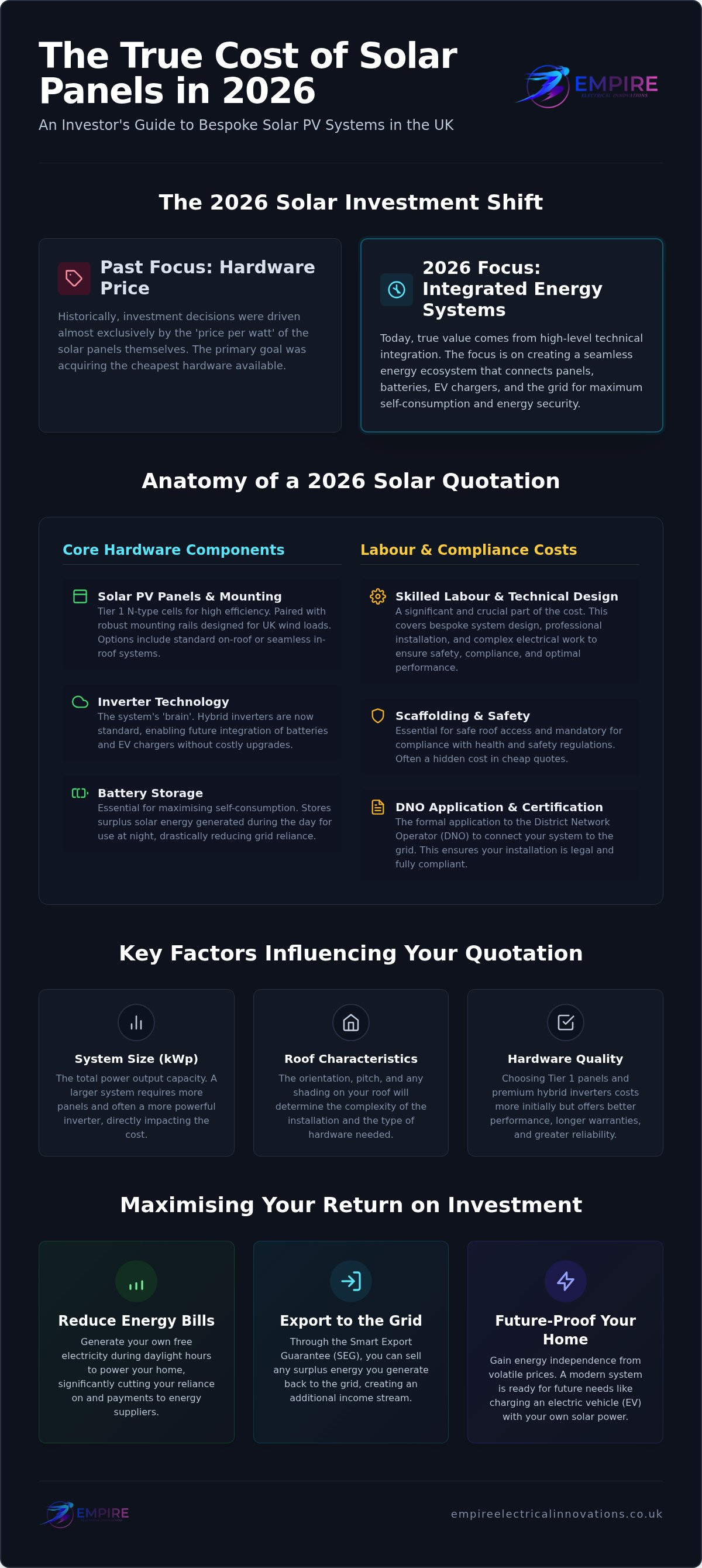
Investing in solar PV in 2026 represents a fundamental shift from simple hardware procurement to high-level technical integration. While historical buyers focused purely on the price per watt, the modern solar panel installation cost reflects a more sophisticated energy ecosystem. Hardware is now the baseline. The true value lies in how these components communicate with the grid, your battery storage, and your EV charger. This evolution means that labour and specialised design now form a larger portion of your quotation than in previous years.
Energy security is the primary driver for this change. With the Ofgem energy price cap sitting at £1,663 for typical households in mid-2026, the financial incentive has never been clearer. Volatility remains a constant threat to domestic and commercial budgets alike. Solar provides a fixed-cost hedge against this uncertainty. As UK solar power capacity continues its upward trajectory, the infrastructure supporting it has become more robust. We've moved away from "panels only" setups toward fully integrated energy hubs that prioritise self-consumption. These modern systems function as part of a wider strategy that includes:
Battery storage for night-time energy use.
EV chargers that prioritise surplus solar generation.
Smart thermal stores for hot water production.
Pivotal Year Dynamics
Efficiency is the 2026 watchword. The widespread adoption of N-type cell technology means you'll need fewer panels to achieve high-yield outputs. This reduces the physical footprint on rooftops across Hertfordshire and London, allowing for sleeker, more aesthetic designs. Modern projects must also adhere to the latest Part L Building Regulations. These standards ensure that every new installation contributes meaningfully to national carbon reduction targets. Property developers in the South East now view solar as a core utility rather than an optional extra, driving a standard of excellence that benefits every homeowner.
Commercial Scaling Factors
Business parks in Buckinghamshire and Bedfordshire face different challenges than residential streets. Commercial energy projects require a different calibre of infrastructure to handle higher loads and longer operating hours. High-yield systems depend on commercial-grade inverters and heavy-duty mounting rails designed for extreme longevity. The initial solar panel installation cost for a business reflects these industrial standards. Bespoke design is mandatory. Every roof pitch and orientation must be analysed to ensure the system delivers maximum performance over its 25-year lifespan. This methodical approach ensures that commercial entities see a predictable, reliable return on their infrastructure investment.
Breaking Down the Components of Installation Costs
A transparent breakdown of the solar panel installation cost requires looking beyond the panels themselves. A high-performance system is a synergy of hardware, structural engineering, and electrical compliance. In 2026, we've seen a shift where the "hidden" elements of an installation often dictate the system's ultimate reliability and safety. Hardware provides the foundation, but the precision of the integration determines the long-term value of your investment.
Solar PV Panels and Mounting Hardware
Tier 1 manufacturers remain the benchmark for panel longevity and performance. These panels are paired with mounting rails and cabling designed to withstand the specific wind loads found across Hertfordshire and Buckinghamshire. You'll need to choose between standard on-roof mounting and premium in-roof integrated systems. Integrated options offer a seamless aesthetic that mirrors the roofline, but they require more intensive labour and specialised flashing kits. Choosing high-efficiency N-type cells ensures you generate more power from a smaller roof area, which is particularly beneficial for urban properties in London.
Inverters and Smart Energy Management
The inverter is the most hardworking component of your system. It converts raw solar energy into usable electricity for your home whilst managing the flow of power. You'll choose between string inverters, which are cost-effective for simple roofs, and micro-inverters, which optimise performance on shaded or complex orientations. For those seeking a future-ready setup, hybrid inverters are now the standard choice. These units allow for the seamless integration of battery storage and EV chargers without needing to replace core hardware as your energy needs grow. Smart monitoring software is included with these units, providing real-time data on your production and consumption patterns.
Labour, Compliance, and Certification
Professional labour accounts for a significant portion of the project budget. This includes the installation of safe scaffolding and the execution of detailed electrical testing to ensure everything is grid-compliant. MCS accreditation is a strict requirement for any homeowner wishing to benefit from the Smart Export Guarantee (SEG). This certification proves the system meets rigorous UK standards and has been installed by a verified specialist. When reviewing solar panel costs and savings, it's clear that skipping professional commissioning often leads to higher maintenance costs and reduced efficiency. In 2026, battery storage has also become a primary cost driver. Integrating a battery allows you to store surplus energy for evening use, significantly reducing your reliance on the grid during peak pricing hours. While this increases the initial solar panel installation cost, the impact on your monthly bills often justifies the investment.
Key Factors Influencing Your Bespoke Quotation
Every property presents a unique engineering challenge. A generic calculator cannot account for the architectural nuances of a period property in Hertfordshire or the grid limitations of a modern development in Buckinghamshire. When determining your solar panel installation cost, several site-specific factors dictate the final technical design and budget requirements. Compliance with the latest Part L Building Regulations is now a standard part of our design process, ensuring your system meets the highest efficiency benchmarks for 2026.
Roof Type and Structural Integrity
The material of your roof significantly impacts the labour hours required for a safe installation. Whilst standard interlocking tiles are straightforward, properties in Bedfordshire often feature slate or clay tiles that require specialised mounting brackets to maintain a watertight seal. A structural survey is essential for 2026 arrays to confirm the timber rafters can support the additional dead load of panels and mounting hardware. Shading from nearby trees or structures also influences the choice of inverters or optimisers, as detailed in the Energy Saving Trust guide to solar panels. These variables ensure the system is built to last for decades.
DNO Applications and Grid Constraints
Grid connectivity is a critical variable that many national installers overlook. For systems exceeding 3.68kW per phase, a G99 application to UK Power Networks is mandatory. This process ensures the local infrastructure can handle your system's export capacity. In some parts of Buckinghamshire, grid constraints may require your installer to negotiate specific export limits. Managing these technical hurdles is a core part of a specialist's role. It ensures your installation is fully authorised and grid-compliant before the first panel is even mounted.
Integration with EV Charging and Batteries
Future-proofing your home often involves combining solar PV with other green technologies. There is significant cost-efficiency in installing EV chargers or battery storage simultaneously. This approach reduces total labour time and ensures all components are balanced from day one. You can read more about Maximising Efficiency with Solar Battery Installation in Hertfordshire (2026) to understand how these systems interact. Finally, your existing electrical consumer unit must be assessed. Older fuse boards often lack the necessary surge protection or RCD requirements for modern solar PV, necessitating an upgrade to ensure the safety of your energy ecosystem.
Calculating ROI: Savings, Payback, and Export Tariffs
The true value of your investment isn't found in the initial solar panel installation cost, but in the net financial gain realised over the system's 25-year lifespan. Modern ROI calculations have moved beyond simple bill reductions. In 2026, a high-performance system functions as a two-way financial asset. You save money by avoiding expensive grid electricity whilst simultaneously generating a secondary income stream through export tariffs. For properties in Hertfordshire and the South East, this dual-benefit model has become a primary driver for adoption in a highly green-conscious property market.
Self-consumption remains the fastest route to a full payback. Every kilowatt-hour (kWh) you generate and use directly in your home replaces a unit you would otherwise purchase from the grid at the current price cap rate. This is why integrated energy ecosystems are so effective. By diverting surplus power to a battery or an EV charger, you minimise the amount of energy you buy back during peak evening hours. Precision in system sizing ensures you aren't over-investing in capacity you won't use, keeping your solar panel installation cost aligned with your actual consumption patterns.
The Smart Export Guarantee (SEG) in 2026
Monetising your excess energy is simpler than ever in 2026. Under the Smart Export Guarantee, energy suppliers are required to pay you for every unit of carbon-free electricity you feed back into the grid. Rates amongst major UK suppliers have become increasingly competitive; some providers now offer up to 20p per kWh for exported power. To access these rates, a smart meter is essential. It provides the half-hourly data required for accurate billing. Many homeowners now opt for flexible "smart" tariffs that offer higher rewards for discharging battery storage during periods of high grid demand, further accelerating the return on their infrastructure investment.
Long-term Maintenance and Performance
Modern solar infrastructure is remarkably resilient. High-quality glass-glass panels require minimal maintenance beyond occasional cleaning to ensure maximum light absorption. However, a realistic ROI model must account for the mid-life replacement of the inverter. These components typically have a service life of 10 to 12 years. Budgeting for this single hardware refresh ensures your system continues to perform at peak efficiency for its second decade of operation. Professional monitoring software helps protect your ROI by alerting you to any performance drops, preventing "silent" failures that could otherwise go unnoticed for months.
Understanding these variables is the first step toward energy independence. If you're ready to see how these figures apply to your specific property, we invite you to request a bespoke solar PV quotation from our technical team.
Professional Installation: Why Quality Outlasts Initial Price
The allure of the lowest possible solar panel installation cost often masks significant technical compromises. National installers frequently rely on standardised kits and high-volume labour models that prioritise speed over precision. This "one-size-fits-all" approach fails to account for the unique structural and electrical requirements of your specific property. True value is found in bespoke engineering. A system designed for the specific orientation of a roof in Hertfordshire or the grid constraints of a Buckinghamshire development will always outperform a generic alternative.
A professional site survey is the cornerstone of an accurate forecast. We don't rely on satellite imagery alone. A physical inspection allows us to identify potential complications, such as required consumer unit upgrades or specialised roof fixings, before any work begins. This transparency prevents the "hidden extras" that often plague budget quotes halfway through a project. Choosing a local specialist ensures you have a partner who understands regional logistics and can provide rapid response times long after the initial commissioning is complete.
The Dangers of "Budget" Solar Quotes
Budget-focused contractors often cut corners on the components that aren't immediately visible. Low-quality mounting hardware is a common point of failure. In the South East, where wind loads can be significant, substandard rails and brackets increase the risk of mechanical damage or roof leaks. Electrical safety is another area where "cheap" proves expensive. Undersized cabling leads to resistive energy loss, directly reducing your generation efficiency and creating potential fire hazards. An established contractor provides long-term workmanship guarantees, ensuring that your solar panel installation cost remains a one-time investment rather than the start of a cycle of repairs.
Your Next Steps with Empire Electrical Innovations
We position ourselves as a trusted specialist for those who value workmanship and future-readiness. Our process is methodical and disciplined. When you book a professional solar survey in Hertfordshire or Bedfordshire, you're engaging with technical experts who prioritise compliance and standards. We'll assess your roof's structural integrity, evaluate your current electrical infrastructure, and design a system that integrates seamlessly with your energy needs.
During the bespoke quotation process, we provide a clear breakdown of every component and labour stage. This ensures you have total confidence in the ROI of your new energy ecosystem. For a deeper look at what to look for in a local partner, read our Professional Solar Panel Installation in Hertfordshire: The 2026 Buyer’s Guide. We're ready to help you navigate the transition to clean, reliable power with a system built for the decades ahead.
Securing Your Energy Future in 2026
The landscape of renewable energy has evolved into a sophisticated ecosystem where technical integration outweighs simple hardware procurement. Determining a realistic solar panel installation cost requires a focus on future-readiness; from battery storage compatibility to grid-compliant design. A system built to these standards doesn't just reduce bills. It provides a decade-spanning hedge against market volatility.
As NAPIT and MCS Accredited Installers, we combine a comprehensive design-to-installation service with expert local knowledge of Hertfordshire, Bedfordshire, and Buckinghamshire. We don't believe in one-size-fits-all kits. Instead, we prioritise workmanship and compliance to ensure your infrastructure investment remains secure and high-performing. Our methodical approach guarantees that every project meets the highest professional standards.
If you're ready to move beyond generic estimates and secure your energy independence, our technical team is here to help. Request Your Bespoke Solar Survey and Quotation to begin your transition to a cleaner, more reliable energy future. We look forward to partnering with you on your project.
Frequently Asked Questions
How much does a typical 4kW solar system cost in 2026?
Total project costs fluctuate based on component quality, roof complexity, and the specific technology chosen for your home. A standard 4kW system for a 3-bedroom property accounts for high-efficiency N-type panels and professional MCS-certified labour. Factors like roof accessibility and the choice between string or micro-inverters will influence the final figure. Bespoke quotations are essential for accuracy to avoid the pitfalls of generic online calculators.
Do I need planning permission for solar panels in Hertfordshire?
Most residential installations fall under "Permitted Development" rights and don't require formal planning permission from local authorities. However, specific restrictions apply if your property is a listed building or located in a Conservation Area, which is common in parts of St Albans or Hitchin. You should always verify local council guidelines or consult a specialist to ensure full compliance before starting any technical work on your roof.
Can I install solar panels myself to save on costs?
DIY installation is strongly discouraged as it invalidates your eligibility for the Smart Export Guarantee (SEG) payments. To access these export tariffs and ensure the system is grid-compliant, the work must be completed by an MCS-accredited installer. Self-installation also carries significant safety risks regarding structural integrity and high-voltage electrical work. This could compromise your home insurance and the long-term safety of your property's electrical infrastructure.
How long does the actual installation process take?
A standard residential installation typically takes two to three days to complete from start to finish. The first day usually involves erecting safe scaffolding and mounting the specialised roof hardware. The second day focuses on panel placement and electrical commissioning, including the inverter and battery storage setup. More complex commercial projects or those requiring extensive consumer unit upgrades may take longer to finalise and test.
Will solar panels still save me money if my roof isn’t south-facing?
East and west-facing roofs are highly effective for modern solar PV systems and offer excellent financial returns. While they may generate slightly less total energy than a south-facing roof, they often provide better power distribution for morning and evening consumption. This helps lower your overall solar panel installation cost by maximising self-consumption during the hours when most households actually use the most electricity.
What happens to the installation cost if I add a battery later?
Retrofitting a battery usually costs more than installing one alongside your initial solar PV array. A later addition often requires a separate AC-coupled inverter or an upgrade to a hybrid inverter if one wasn't installed originally. Combining these technologies from the start reduces total labour hours and ensures that all components are perfectly balanced for maximum efficiency. This methodical approach secures the best performance from day one.
Are there any grants available for solar panels in 2026?
Direct grants are primarily targeted at low-income households through schemes like ECO4 or the Home Upgrade Grant (HUG) for properties not connected to the gas grid. For most homeowners, the primary incentives in 2026 are the 0% VAT rate on installations and interest-free loans provided through the Warm Homes Plan. These measures aim to reduce the initial solar panel installation cost and encourage long-term energy independence.
How much extra does it cost to integrate an EV charger?
The additional investment depends on the charger's power output and the distance from your consumer unit to the charging point. Integrating an EV charger during your solar installation is highly efficient as it allows for specialised "solar-only" charging modes. This ensures your vehicle runs on surplus green energy rather than grid power. Doing this work simultaneously saves on separate call-out fees and scaffolding requirements.


Solar panel maintenance does not always involve major expenses, but homeowners should still allow for inspections, monitoring, cleaning where needed, and potential component servicing. Installation costs are usually influenced by the system size and property requirements. Solar Rebate Brisbane can be an important part of the budgeting process because incentives may affect the initial investment. Checking current information before purchasing helps homeowners understand costs and plan their solar installation more effectively.