
Solar Panel Payback Period UK: 2026 Investment Analysis

In 2026, the traditional calculation for a solar panel payback period uk has fundamentally shifted from a simple waiting game to a strategic exercise in energy management. You've likely noticed that despite the national transition toward renewables, your monthly electricity bills remain stubbornly high. With the current energy price cap set at £1,862 per year, the financial pressure on UK households is significant. It's understandable to feel uncertain when faced with fluctuating Smart Export Guarantee rates and the technical choice of whether to include battery storage.
We're here to provide clarity. This analysis reveals exactly how long it takes for a modern solar installation to pay for itself in today's economic climate and how you can accelerate that timeline. You'll discover a clear strategy to maximise self-consumption and validate why solar remains a premier future-proof investment. We will examine the impact of 2026 export tariffs, the critical role of battery integration, and how a bespoke design ensures your system delivers maximum long-term value.
Table of Contents
Defining the Solar Panel Payback Period in 2026
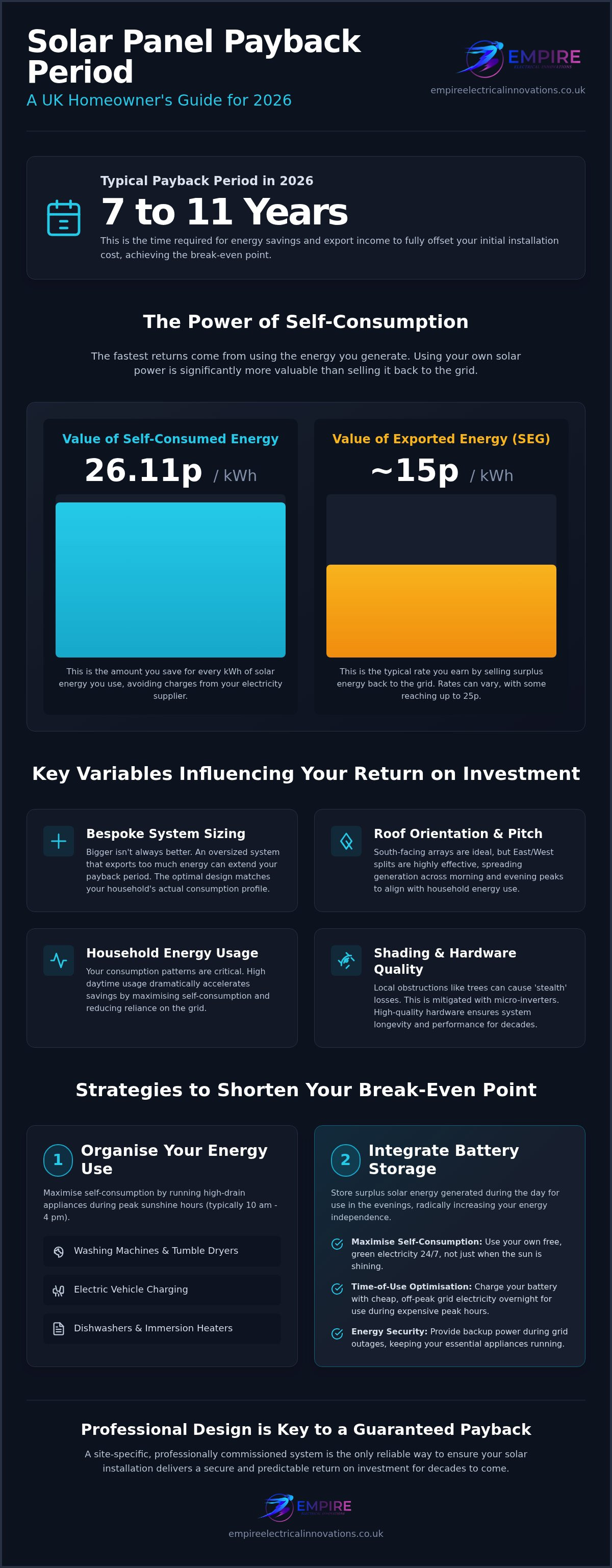
Understanding the solar panel payback period uk is essential for any property owner looking to secure their energy future. In 2026, we define this period as the duration required for cumulative energy savings and export income to offset the initial installation cost. It is no longer a calculation based on government subsidies. It is a measurement of energy independence. Most well-designed UK systems now reach their break-even point within 7 to 11 years. This shift reflects a move away from historical Feed-in Tariffs toward self-consumption as the primary driver of return on investment. Fundamentally, the payback period is a balance of initial capital expenditure versus the long-term value of avoided grid costs.
The Core Components of the Payback Equation
To calculate a realistic break-even point, we must analyse three specific financial pillars. First is the upfront capital expenditure, which covers the procurement of high-efficiency panels, advanced inverters, and professional labour. Second is the operational savings. Every kilowatt-hour (kWh) generated and used on-site represents a unit of electricity you do not buy from the grid. With the current unit rate for electricity at 26.11 pence per kWh, these savings accumulate rapidly. Finally, we consider export revenue through the Smart Export Guarantee (SEG). Whilst rates vary amongst suppliers, some providers offer up to 25p per kWh for surplus energy. A baseline understanding of Solar power technology helps in grasping how these components interact to produce a predictable financial outcome.
Why 2026 is a Landmark Year for Solar ROI
Several factors make 2026 a pivotal moment for solar investment. Panel efficiency has reached new levels, allowing owners to generate significantly more power from limited roof dimensions. Energy price volatility also plays a role. As the price cap remains high at £1,862 per year for typical households, the speed of financial recovery increases because the value of every generated unit is higher. Additionally, strict Part L building regulations solar panels are now influencing system design across the South East. These regulations demand higher energy performance standards, often making solar integration a standard feature of compliant, future-ready properties. This regulatory environment ensures that systems are designed for performance rather than just presence, which directly shortens the solar panel payback period uk.
Variables Influencing Your Renewable Energy ROI
Determining a precise solar panel payback period uk requires more than a standard estimation. It involves a technical assessment of your property's specific characteristics. One common misconception is that a larger system automatically delivers a faster return. In reality, an oversized array that generates surplus energy you cannot use or store effectively can actually extend your break-even point. This is because the value of self-consumed electricity, at approximately 26p per kWh, is significantly higher than the typical 15p per kWh earned through export. Matching capacity to your actual consumption profile is the foundation of a high-yield investment.
Roof orientation and pitch are equally decisive. Whilst south-facing arrays are often cited as the gold standard, east/west splits are increasingly popular in 2026. These configurations spread generation across the day, better aligning with the morning and evening peaks of a typical household. Local obstructions such as chimneys or trees can introduce 'stealth' losses. We mitigate this using micro-inverters, ensuring that a single shaded panel does not bottleneck the entire string. Modern developments must also adhere to strict building standards. Ensuring professional solar panel installation Hertfordshire is now essential for both regulatory compliance and protecting your long-term financial recovery.
Geographic and Climatic Considerations in the South East
Location dictates potential. Homeowners in Hertfordshire, Bedfordshire, and London benefit from some of the highest solar irradiance levels in the country. However, local infrastructure often presents unique challenges. Distribution Network Operator (DNO) constraints can limit the amount of power you are permitted to export to the grid, which directly influences your system sizing and ROI. As outlined in the UK Government's Solar Roadmap, the strategic deployment of rooftop solar is a pillar of national energy security, but local grid capacity remains a variable that only a professional site survey can accurately navigate.
Hardware Choices and Longevity
The hardware you select today determines your savings for the next three decades. Tier 1 panels may require a higher initial investment, but their superior degradation rates ensure they produce more power in year 25 compared to budget alternatives. You must also account for inverter replacement cycles, typically occurring every 12 to 15 years. Planning for these mid-term maintenance costs prevents unexpected dips in your cumulative savings. Finally, maintaining MCS certification is non-negotiable. It is the only way to access the best export tariffs available in 2026. A detailed site survey remains the most reliable method to weigh these hardware choices against your specific energy goals.
The Battery Storage Impact on Financial Recovery
In 2026, the inclusion of energy storage is often the deciding factor in the overall efficiency of a renewable system. Whilst earlier market analysis suggested that storage might delay your break-even point, the current disparity between energy import and export rates has reversed this trend. Storing your own generated power for evening use is now significantly more profitable than selling it back to the grid. Exporting surplus at 15p per kWh whilst buying back at 26p per kWh represents a missed financial opportunity. Professional solar battery installation Hertfordshire can increase self-consumption from 30% to over 70%.
Modern batteries also facilitate 'Time-of-Use' tariff optimisation. This allows homeowners to charge their storage from the grid during off-peak hours when prices are lowest, then discharge it during expensive peak periods. This practice, known as energy arbitrage, can shave years off your solar panel payback period uk. When selecting a system, the focus must be on 'usable capacity' rather than nominal capacity. Your storage should be sized to match your specific evening energy profile to ensure you aren't paying for capacity you won't use, or running out of power before the sun rises.
Smart Energy Management Systems
True financial recovery is driven by visibility and automation. Smart energy management systems integrate your solar PV with home technology to automate energy use, such as running high-drain appliances when the battery is full. Hybrid inverters play a central role here, reducing installation complexity by managing both the panels and the battery through a single unit. Real-time monitoring apps change user behaviour by visualising energy flow. When you can see exactly how much power you are drawing from the grid, you naturally adjust your habits to maximise savings.
Battery Lifespan and ROI
Longevity is the foundation of storage value. Lithium Iron Phosphate (LFP) technology is now the industry standard, offering superior cycle life and safety compared to older lithium-ion variants. Most LFP batteries come with 10-year warranties and are rated for 6,000 cycles or more. To understand the true value, we calculate the 'Cost Per Cycle' rather than just the upfront price. For homeowners in London and Bedfordshire with existing arrays, retrofitting storage is a viable way to future-proof their investment and capture energy that would otherwise be lost to the grid at low export rates.
Strategies to Accelerate Your Solar Break-Even Point
Shortening the solar panel payback period uk requires a combination of behavioural shifts and technical optimisations. The most immediate strategy is the heavy prioritisation of daytime loads. By organising high-drain appliances, such as dishwashers, washing machines, and heat pumps, to run whilst the sun is at its zenith, you directly reduce the need to draw power from the grid during expensive peak hours. This ensures you consume energy worth 26.11p per kWh rather than exporting it for a lower rate. Selecting the right export tariff is also critical. In 2026, Smart Export Guarantee (SEG) rates amongst major suppliers vary significantly. With providers like Ecotricity offering 16p per kWh and others reaching up to 25p per kWh, regularly reviewing your provider ensures your surplus energy generates the highest possible revenue. It's a strategic move that pays dividends over time.
The EV Charger Synergy
The integration of electric vehicles offers a significant opportunity to slash your break-even timeline. Both residential units and commercial EV charger installation Hertfordshire now frequently feature 'Solar Divert' modes. This technology ensures your car only charges using surplus solar energy that would otherwise be exported at a lower rate. When you compare the cost of 'Solar Miles' to 'Grid Miles', the financial logic is undeniable. Powering your commute from your roof effectively removes one of the largest monthly household expenses. We are also seeing the emergence of V2H (Vehicle-to-Home) technology. This allows your car to act as a secondary domestic battery, further increasing your self-consumption and protecting your long-term ROI. You aren't just driving for free; you're powering your home with your car.
Maintenance and Monitoring for Peak Performance
Consistent performance is vital for a secure return. Environmental factors, particularly in urban London environments, can lead to a build-up of dirt and debris that reduces panel yield. Regular annual health checks are essential to identify 'invisible' faults, such as micro-cracks in strings or degrading inverters, before they impact your savings. This is equally important for solar PV for commercial buildings, where even a small drop in efficiency represents a substantial financial loss. Legacy systems can also benefit from modern inverter upgrades, which often incorporate better power tracking technology to squeeze more value from existing arrays. To ensure your system is performing at its peak, you should arrange a bespoke solar performance review today.
Professional Design: The Key to a Guaranteed Payback
"Off-the-shelf" solar kits often fail to deliver on their promised ROI because they ignore the nuanced variables of a specific property. A solar panel payback period uk estimate is only as reliable as the data used in the initial modelling. Generic online calculators cannot account for specific roof shading, local irradiance levels, or the precise half-hourly energy consumption patterns of your household. At Empire Electrical Innovations, we move beyond estimates to provide a technical calculation based on a physical audit. This ensures that every component, from the panel wattage to the inverter type, is synchronised for maximum performance. A bespoke design prevents the financial waste of installing a system that is either underpowered for your needs or unnecessarily oversized.
The journey from a preliminary quote to final commissioning involves several critical technical milestones. This includes structural roof assessments, electrical infrastructure audits, and the formal DNO application process. We handle these complexities to ensure your system is compliant with all current UK regulations. Professional commissioning is the point where theoretical design becomes real-world performance. It is the only way to guarantee that your projected payback period is grounded in reality. As a specialist based in the Home Counties, we offer the proximity and expertise required for long-term support. You aren't just buying panels; you're entering a partnership focused on performance.
Bespoke System Modelling
Accurate forecasting requires more than just knowing where the sun is. We utilise PVGIS data and historical local weather patterns to build a bespoke model of your energy future. This is critical for Hertfordshire businesses, as commercial ROI profiles differ from residential ones due to higher daytime base loads. By matching system capacity to your actual usage, we prevent the common pitfall of over-investing in hardware that fails to contribute to self-consumption. Precision in the design phase is what separates a standard installation from a high-yield investment that shortens your solar panel payback period uk.
Compliance, Standards, and Trust
Financial security in the renewable sector is built on rigorous standards. Membership in the Microgeneration Certification Scheme (MCS) and the Renewable Energy Consumer Code (RECC) is non-negotiable for any property owner. These certifications are the foundation of your ability to access Smart Export Guarantee (SEG) payments and ensure that your installation meets the highest safety requirements. Our approach prioritises reliability and future-readiness. We manage the entire project flow, ensuring that the work being done today remains an asset for the next 25 years. This methodical approach provides the peace of mind that your transition to solar is a secure, professionally managed investment.
Book your free bespoke solar survey today to receive a precise payback calculation for your property.
Securing Your Energy Independence in 2026
The transition to solar is no longer just an environmental choice but a methodical financial strategy. By prioritising self-consumption and integrating intelligent battery storage, you can significantly compress your solar panel payback period uk. Success in 2026 depends on moving away from generic kits and embracing bespoke engineering that aligns with your specific usage patterns. Every property has a unique energy profile that requires a tailored approach to hardware selection and professional commissioning. This ensures that your investment remains efficient and productive for decades to come.
As specialist installers across Hertfordshire, Bedfordshire, and London, we provide the technical expertise required for complex Solar, Battery, and EV charger integrations. Our full MCS and NICEIC accreditation ensures your system is built to the highest industry standards for long-term reliability. Secure your future energy savings with a bespoke solar survey from Empire Electrical Innovations. Your path to energy autonomy starts with a precise, data-driven plan. We look forward to helping you future-proof your property and achieve a secure return on your renewable investment.
Frequently Asked Questions
What is the average solar panel payback period in the UK for 2026?
In 2026, the average solar panel payback period uk typically falls between 7 and 11 years. This timeframe is influenced by the current energy price cap of £1,862 and the 0% VAT relief on installations. Your specific break-even point depends on your property's orientation and how much energy you consume during daylight hours. A bespoke design ensures you aren't waiting longer than necessary for your investment to turn a profit.
Do solar panels still pay back if I don't have a battery?
Solar panels still provide a return without a battery, but the payback period is typically longer. Without storage, you only save money on the electricity you use whilst the sun is shining. This often limits self-consumption to around 30%. To maximise ROI without a battery, you must be disciplined in running high-drain appliances during the day. However, most modern UK homes find that adding storage significantly accelerates their financial recovery.
How does the Smart Export Guarantee (SEG) affect my ROI?
The Smart Export Guarantee (SEG) acts as a secondary revenue stream by paying you for surplus energy sent back to the grid. In 2026, rates vary amongst suppliers, with some offering up to 25p per kWh. Whilst these payments help shorten your break-even point, they are lower than the 26.11p cost of importing power. Therefore, SEG should be viewed as a bonus rather than your primary method for achieving a fast return.
Will installing solar panels increase my property's resale value in Hertfordshire?
Evidence suggests that solar installations can enhance property value across Hertfordshire and the South East. Modern buyers increasingly prioritise energy efficiency and lower running costs when searching for a home. With the 2026 Part L building regulations pushing for higher standards, a professionally commissioned system makes your property more competitive. It transforms your house into a future-ready asset that offers immediate financial benefits to any prospective new owner.
Can I shorten my payback period by installing an EV charger?
Installing an EV charger is one of the most effective ways to accelerate your return. By using 'Solar Divert' technology, you can power your commute using free energy from your roof instead of buying grid electricity. This replaces expensive fuel costs with zero-cost solar miles. When you offset the price of petrol or public charging, the cumulative savings drastically reduce the overall solar panel payback period uk for your entire system.
Is it worth installing solar panels on a North-facing roof in the UK?
We generally advise against North-facing installations as they typically generate 40% to 50% less energy than South-facing arrays. This significant drop in yield makes the payback period unacceptably long for most homeowners. If you have limited roof space, we suggest exploring East or West elevations instead. These orientations provide a more consistent energy spread throughout the morning and evening, which better matches the typical electricity usage patterns of UK households.
What maintenance costs should I include in my payback calculation?
You should budget for an inverter replacement approximately every 12 to 15 years. Whilst panels often have 25-year warranties, the inverter is the hardest-working component and may require earlier attention. Periodic cleaning is also advisable, particularly in urban London environments where debris can reduce yield. Including these modest operational costs in your initial modelling ensures your financial projections remain realistic and that your system continues to perform at its peak.
How do the 2026 energy price caps influence solar viability?
Higher energy price caps directly increase the viability of solar power. With the current cap at £1,862 and unit rates around 26p per kWh, the value of every unit you generate yourself is higher. When grid electricity is expensive, the 'avoided cost' of not buying from your supplier grows. This creates a stronger financial incentive to install solar now, as the savings generated each month contribute more significantly toward clearing your initial capital expenditure.


Comments