
Telecoms Ducting Contractors in Hertfordshire: The 2026 Infrastructure Guide

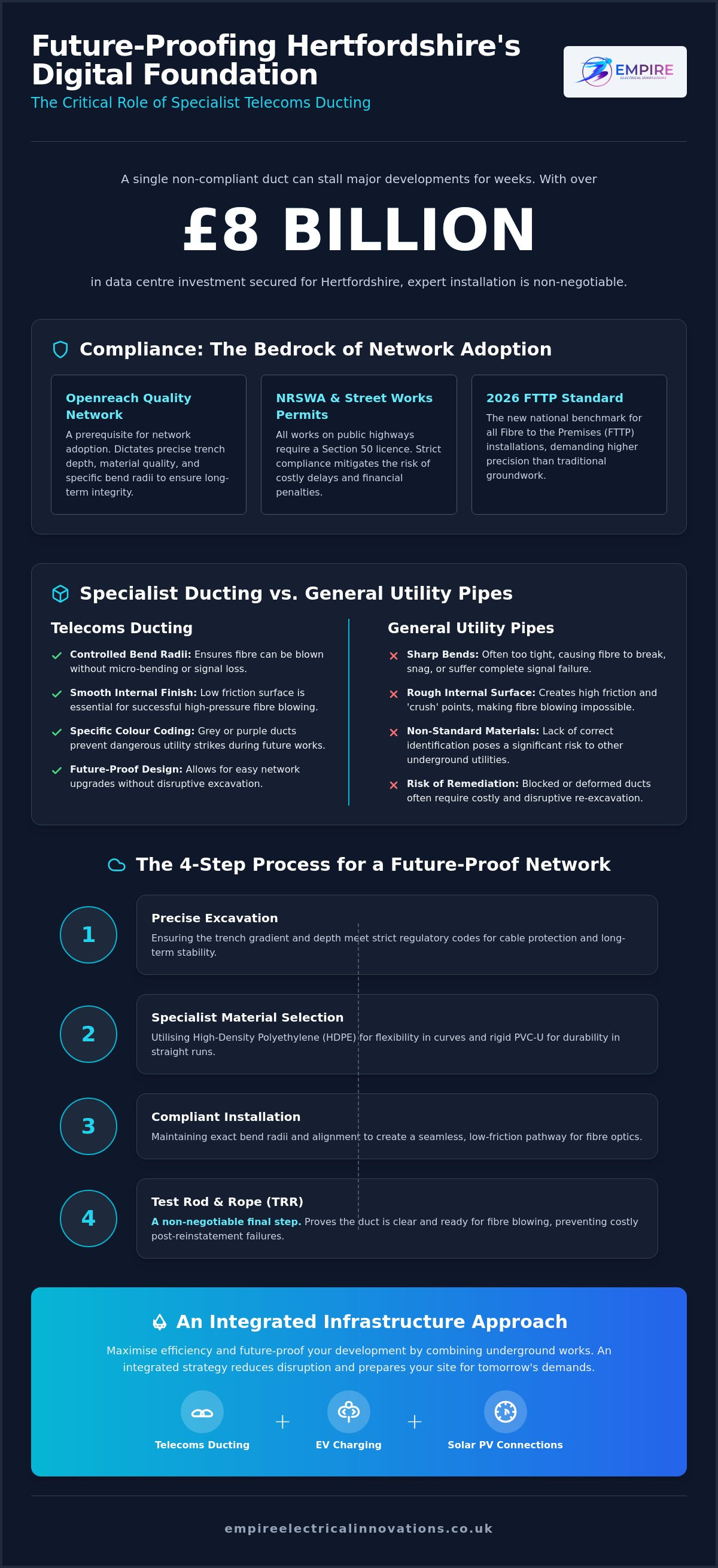
With over £8 billion in data centre investment currently secured for Hertfordshire projects, your underground infrastructure is no longer just a utility. It is the strategic foundation for the UK’s AI-driven economy. You likely know that a single non-compliant duct or a missed NRSWA permit can stall a major development for weeks, creating avoidable friction between civils teams and fibre providers. Finding expert telecoms ducting contractors Hertfordshire is the difference between a project that stays on track and one that sinks into costly delays.
We recognise that you need more than just pipes in the ground; you need a system that facilitates seamless fibre blowing and long-term reliability. This guide provides the technical clarity required to install a future-proofed underground network that meets the latest 2026 standards. We will explore essential installation techniques, local authority permit requirements, and how to manage the transition from civils to connectivity whilst reducing risk. This ensures your project remains robust, compliant, and ready for the next generation of digital infrastructure.
Table of Contents
Understanding Telecoms Ducting in Modern Infrastructure
Telecoms ducting is a system of underground channels designed as a protected pathway for fibre optic and copper cables. In the current landscape, the focus has shifted entirely from traditional copper to 2026-standard FTTP (Fibre to the Premises) requirements. This transition demands a level of precision that goes beyond basic groundworks. Specialist telecoms ducting contractors Hertfordshire recognise that these ducts are the arteries of a modern development. They aren't just burying pipes; they are creating a scalable network foundation that must remain functional for decades.
High-quality ducting represents the most critical phase of underground civil engineering. Once the ground is reinstated, correcting a collapsed or misaligned duct becomes a logistical nightmare and a significant financial drain. The process starts with a precise excavation or depression in the ground, ensuring the gradient and depth meet strict regulatory codes. We utilise specific materials like High-Density Polyethylene (HDPE) for its superior flexibility in curved runs and PVC-U for its rigid durability in straight sections. These materials are chosen for their resistance to environmental stress and their ability to protect the integrity of the network under the heavy loads of Hertfordshire's evolving commercial hubs.
The Role of Ducting in Network Reliability
Ducting serves as a primary defensive shield for the network. It protects sensitive fibre cables from ground movement and moisture ingress, which are the leading causes of signal degradation and hardware failure. Beyond immediate protection, a well-engineered duct system facilitates easy upgrades. It allows for new cables to be pulled or blown through without the need for future disruptive excavation. This foresight is essential for future-proofing developments against evolving bandwidth needs. Crucially, the internal finish of the duct must be smooth and free of debris to prevent 'crush' points during high-pressure fibre blowing operations.
Telecoms Ducting vs. General Utility Pipes
It's a common mistake to view telecoms ducting as a generic utility. It's fundamentally different from water or gas piping. Telecoms infrastructure must account for specific bend radii and internal friction coefficients. If a bend is too sharp, the fibre optic cable will either fail to blow through or suffer from micro-bending losses that kill data speeds. Standard UK colour coding, usually grey for general telecoms or purple for motorway communications, is strictly followed to ensure clear identification and prevent dangerous utility strikes during future maintenance.
General groundworkers often lack the specialised equipment or technical knowledge to maintain these tight tolerances. This often leads to blocked or deformed ducts that cannot be roped. Engaging dedicated telecoms ducting contractors Hertfordshire ensures that your sub-surface assets are built to a standard that allows for a seamless transition from civil works to active fibre installation.
Compliance and Standards for UK Telecoms Network Builds
Compliance is the bedrock of any sustainable infrastructure project. For developments in the South East, engaging specialist telecoms ducting contractors Hertfordshire who prioritise regulatory alignment ensures your project meets all legal requirements from day one. Every installation must follow the UK Compliance and Standards set out by the Department for Transport. This ensures that any excavation on the public highway remains safe, organised, and fully documented. With the recent Infrastructure Planning (Fees) (Amendment) Regulations 2026 coming into force on June 8, 2026, understanding the updated fee structures for local authority coordination is now a critical part of project planning.
Adhering to the Openreach 'Quality Network' standards is a prerequisite for any developer aiming for a seamless network adoption. These rules dictate everything from the depth of the trench to the specific bend radii of the duct. If these standards aren't met, the network provider may refuse to adopt the infrastructure. This leaves the developer with the significant cost of remediation. High-quality work at the civil stage prevents these setbacks and guarantees that the network is adoption-ready upon completion.
NRSWA and Street Works Permits
Working on public highways requires a Section 50 licence. This permit allows contractors to install new apparatus in the road. It's a complex process that demands precise coordination with Hertfordshire County Council to manage traffic and safety. Accredited supervisors must be present on-site to oversee the works, ensuring that the final reinstatement matches the existing surface perfectly. This methodical approach reduces the risk of long-term settlement issues or council fines. Using experienced telecoms ducting contractors Hertfordshire ensures that these administrative and technical hurdles are cleared without delaying the wider build schedule.
Technical Build Specifications (Openreach & AltNets)
Modern fibre optic networks have strict 'draw-in' requirements. This means the duct must be clear of all debris and have a consistent internal diameter to facilitate fibre blowing. We use a mix of pre-formed modular chambers and traditional brick-built options depending on the site's specific load requirements and local soil conditions. Every trench is marked with high-visibility warning tapes and protection tiles. These simple steps prevent future utility strikes and ensure the safety of any maintenance crews working on the site years later.
Environmental considerations are equally vital. Managing soil displacement is a particular challenge amongst Hertfordshire sites, where clay-heavy earth often requires specialist treatment. We prioritise recycling materials where possible, reducing the environmental footprint of the civil works. Health and Safety Executive (HSE) guidelines are non-negotiable. This includes thorough CAT scanning and signal generating to locate existing services before any ground is broken, protecting both the workers and the integrity of the local utility network.
Specialist Installation Techniques: From Trenching to TRR
For many new-build construction sites, traditional open-cut trenching remains the most cost-effective solution. It allows for direct visual inspection of the installation and ensures that the ducting sits exactly where the site plans dictate. However, in the congested underground environments typical of London and Hertfordshire, precision is paramount. Expert telecoms ducting contractors Hertfordshire must navigate a complex web of existing gas, water, and power lines. This requires a methodical approach and the use of ground-penetrating radar to avoid service strikes. Adhering to UK Government guidance on data ducting ensures these installations meet the long-term requirements for residential and commercial developments.
Managing existing infrastructure is as much about strategy as it is about physical labour. In established urban areas, we often encounter "congested" ducts that are already partially filled with legacy copper cabling. Successfully integrating new fibre pathways requires a deep understanding of sub-surface logistics. We prioritise non-disruptive methods where possible, but when open-cut is necessary, we ensure the reinstatement meets local authority standards perfectly. This "no-nonsense" approach to complex civils work minimises the risk of project creep and keeps the build on schedule.
Test Rod and Rope (TRR) Procedures
Before any cable can be installed, the duct network must be verified. Test Rod and Rope is the essential preparatory phase. It involves pushing flexible rods through the duct to identify blockages, silt accumulation, or collapsed sections. Once the route is proven, we install a high-strength draw rope. This enables follow-on teams to pull cables through without resistance. For developers, test rod and rope telecoms procedures are the best insurance against project delays. They provide absolute certainty that the underground assets are functional before the final reinstatement of the ground.
Fibre Blowing and Cabling Integration
Fibre blowing has revolutionised how we install network infrastructure. This technique uses high-pressure compressed air to "float" the fibre optic cable through the duct. It significantly reduces the friction and mechanical tension associated with traditional pulling methods. Successful installation depends entirely on the integrity of the ducting. Even a minor deformation or a poorly fitted coupling can cause the air pressure to drop, stalling the process. By utilising specialist fibre blowing services, contractors can achieve much greater installation distances in a single day. This efficiency is vital for meeting the tight deadlines of 2026 infrastructure projects.
Strategic Considerations for Hertfordshire Construction Projects
Hertfordshire has become a focal point for the UK’s digital expansion, recently securing over £8 billion in data centre investments from major entities like Google and Equinix. This surge in high-capacity demand requires a sophisticated approach to civil engineering. Professional telecoms ducting contractors Hertfordshire must account for the county's specific geological profile. Much of the region sits on clay-heavy soil, which expands and contracts with moisture levels. Without correct bedding and compaction techniques, ducts can shift or deform over time, leading to fibre breakage or blocked pathways that prevent future maintenance.
Coordinating with Hertfordshire County Council is equally vital. Permit lead times and specific reinstatement requirements vary across the county’s districts. In May 2026, the Project Gigabit contract for Hertfordshire was redesigned to better align with commercial rollouts, with CityFibre and Openreach expanding their footprints. This shifting landscape means developers must be agile. Securing the correct NRSWA permits and ensuring ducting is installed to adoptable standards prevents the risk of the local authority refusing to take over the highway works, a mistake that often leads to expensive remedial costs.
Integrated Infrastructure: Telecoms and EV Charging
The rise of green technology has created a need for "multi-utility" thinking. Modern smart EV chargers are no longer standalone electrical units; they require robust data connections to manage load balancing and payment processing. Laying telecoms infrastructure for new housing developments alongside power feeds in a single trenching operation is the most efficient way to build. This integrated approach reduces site disruption and significantly lowers the total cost of civil works. By organising these services with a single specialist contractor, you ensure that the data ducting is protected from electromagnetic interference while remaining easily accessible for future fibre blowing.
Hertfordshire Site Access and Planning
Historic Hertfordshire towns present unique logistical hurdles. Navigating narrow access routes in centres like St Albans or Hertford requires meticulous safety planning and compact machinery. We work closely with developers to ensure that the "heavy" civil phase of ducting is completed before final landscaping begins. This prevents the need to lift expensive paving or disturb established greenery later in the project. Our experience in managing telecoms infrastructure for London construction projects has equipped us with the discipline needed for these high-pressure, space-constrained environments.
Planning for 2030 and beyond means installing high-density ducting today. As AI-driven data traffic overtakes video streaming as the primary network driver, the capacity of your underground assets will be the deciding factor in your development's long-term value. If you are ready to secure your site’s connectivity, contact our telecoms ducting contractors Hertfordshire to discuss a bespoke infrastructure plan.
Partnering with Empire Electrical Innovations for Infrastructure Success
Choosing the right partner for your underground assets is a decision that impacts the entire lifecycle of a development. We provide bespoke infrastructure solutions that are tailored to the specific demands of both commercial and residential sites. As established telecoms ducting contractors Hertfordshire, we recognise that site managers face increasing pressure to coordinate multiple utility streams within tight windows. Our approach simplifies this by centralising electrical and telecoms civils. This reduces project management overheads and eliminates the common friction between separate groundworkers and technical installers.
We deliver a comprehensive service that covers every stage of the process. This begins with an initial site survey to identify potential sub-surface obstacles and ends with final fibre blowing and commissioning. By managing both the heavy excavation and the delicate fibre installation, we ensure that the ducting is fit for purpose from the moment it’s buried. This integrated model is particularly beneficial for modern sites requiring Solar PV and EV charging infrastructure alongside high-speed data. It allows for a unified trenching strategy that maximises space and minimises disruption to the build schedule.
Our Commitment to Quality and Compliance
Our project management is methodical and highly organised. We prioritise meeting deadlines without compromising on the technical standards required for network adoption. By using industry-aligned terminology and following Openreach 'Quality Network' specifications, we ensure your infrastructure is ready for any major provider to take over. Safety remains at the core of our operations. Every project is backed by comprehensive risk assessments and method statements (RAMS). This disciplined approach protects your workforce and ensures that all works on the public highway or private land are conducted to the highest professional standards.
Precision workmanship is a hallmark of our brand. We don't just meet the minimum requirements; we aim for long-term reliability. This means using the correct bedding materials for Hertfordshire's clay soils and ensuring every coupling is airtight for future fibre blowing. This attention to detail prevents the "crush" points and blockages that often plague less specialised installations. We act as a reassuring partner, providing the technical expertise needed to navigate the complexities of 2026 infrastructure regulations with confidence.
Contact Us for a Specialist Site Survey
If you are planning a development in the South East, our team is ready to assist with your infrastructure requirements. We can help you organise the civil works, manage local authority permits, and execute the technical cabling phases of your project. Whether you need a simple duct run or a complex multi-utility network, we provide the quiet authority and technical competence required to get the job done right. We offer no-obligation quotes for all our services, including TRR, cabling, and specialist ducting. Take the first step toward a compliant, future-proofed network today. Discuss your telecoms infrastructure project with Empire Electrical Innovations and ensure your site is ready for the digital demands of tomorrow.
Securing Your Network’s Future
Underground infrastructure is the silent engine of your development. Getting it right at the civil stage prevents the friction that often stalls modern construction projects. By prioritising Openreach-standard builds and rigorous TRR testing, you ensure your site is ready for seamless fibre blowing and network adoption. Engaging professional telecoms ducting contractors Hertfordshire provides the technical certainty needed to navigate local council permits and complex geological conditions without the stress of non-compliance.
Our NRSWA accredited team specialises in FTTP infrastructure. We deliver integrated electrical and telecoms solutions that reduce project risk and streamline site management. This methodical approach ensures that your sub-surface assets are built for longevity and performance, allowing for effortless upgrades as network demands evolve. We focus on workmanship that meets the highest professional standards, giving you peace of mind that your investment is secure. A compliant, future-proofed duct network isn't just a requirement; it's a strategic asset for your development's long-term value.
Ready to build a robust foundation for your site’s connectivity? Start your Hertfordshire infrastructure project with a specialist consultation. We are here to help you deliver a successful, future-proofed development.
Frequently Asked Questions
What is the difference between a telecoms duct and a standard electrical conduit?
Telecoms ducts are engineered specifically for data cables, prioritising low internal friction and precise bend radii. Unlike standard electrical conduits, telecoms ducting must facilitate fibre blowing, which requires a smooth internal finish and airtight couplings to maintain high air pressure. These ducts are also built to withstand specific sub-surface stresses whilst protecting sensitive glass fibres from moisture and ground movement.
Does my contractor need to be NRSWA accredited to install ducting in Hertfordshire?
Yes, any contractor excavating the public highway must hold New Roads and Street Works Act (NRSWA) accreditation. This ensures the team is qualified to manage traffic safety and reinstate road surfaces to local authority standards. Engaging accredited telecoms ducting contractors Hertfordshire is also a mark of quality for private sites, as it guarantees the installation meets the rigorous standards required for eventual network adoption.
How deep should telecoms ducting be buried according to UK standards?
Burial depths are determined by the location of the installation to ensure long-term protection. In footways, ducts are typically buried at a depth of 350mm from the surface. In carriageways, this depth increases to between 450mm and 600mm depending on the road category and local council requirements. These standardised depths protect the infrastructure from surface loads and accidental damage during future utility works.
What is Test Rod and Rope (TRR) and why is it necessary before cabling?
Test Rod and Rope is a verification process used to confirm a duct route is viable. We push flexible rods through the network to identify any silt, blockages, or collapsed sections that occurred during the civil works. Once the route is proven clear, we install a high-strength draw rope. This step is vital because it prevents cabling teams from arriving at a site only to find the infrastructure is unusable.
Can telecoms ducting be installed in the same trench as power cables?
Yes, multi-utility trenches are common in modern developments, provided specific separation distances are maintained. Power and telecoms lines usually require a minimum clearance of 50mm to 100mm to prevent electromagnetic interference and ensure safety during future maintenance. Using a single contractor for both services often results in a more organised trench layout and reduced site disruption during the civil engineering phase.
What are the standard colours for telecoms ducting in the UK?
Grey is the industry-standard colour for general telecommunications ducting across the UK. However, you will often see purple used specifically for motorway and trunk road communication networks. These colours are standardised under national guidelines to ensure that any future utility workers can immediately identify the service type. Correct colour coding is essential for preventing utility strikes and ensuring the safety of maintenance crews.
How do I ensure my new-build telecoms infrastructure will be adopted by Openreach?
Adoption depends entirely on following the Openreach 'Quality Network' build specifications from the start. This includes using approved materials, maintaining correct burial depths, and ensuring all chambers are clear of debris. Partnering with specialist telecoms ducting contractors Hertfordshire ensures your civil works are compliant. We provide the technical documentation and workmanship standards required to pass inspection, avoiding the need for expensive remedial works before the network goes live.
What is fibre blowing and how does it affect the choice of ducting?
Fibre blowing uses compressed air to "float" fibre optic cables through a duct, reducing mechanical tension. This technique requires high-quality, smooth-walled HDPE ducting that can maintain a consistent internal pressure. If the ducting is of poor quality or has misaligned joints, the air will escape, causing the installation to stall. Choosing the correct ducting material is therefore essential for achieving long-distance cable runs efficiently.


Comments