
Telecoms Infrastructure Contractors in London: A 2026 Professional Guide

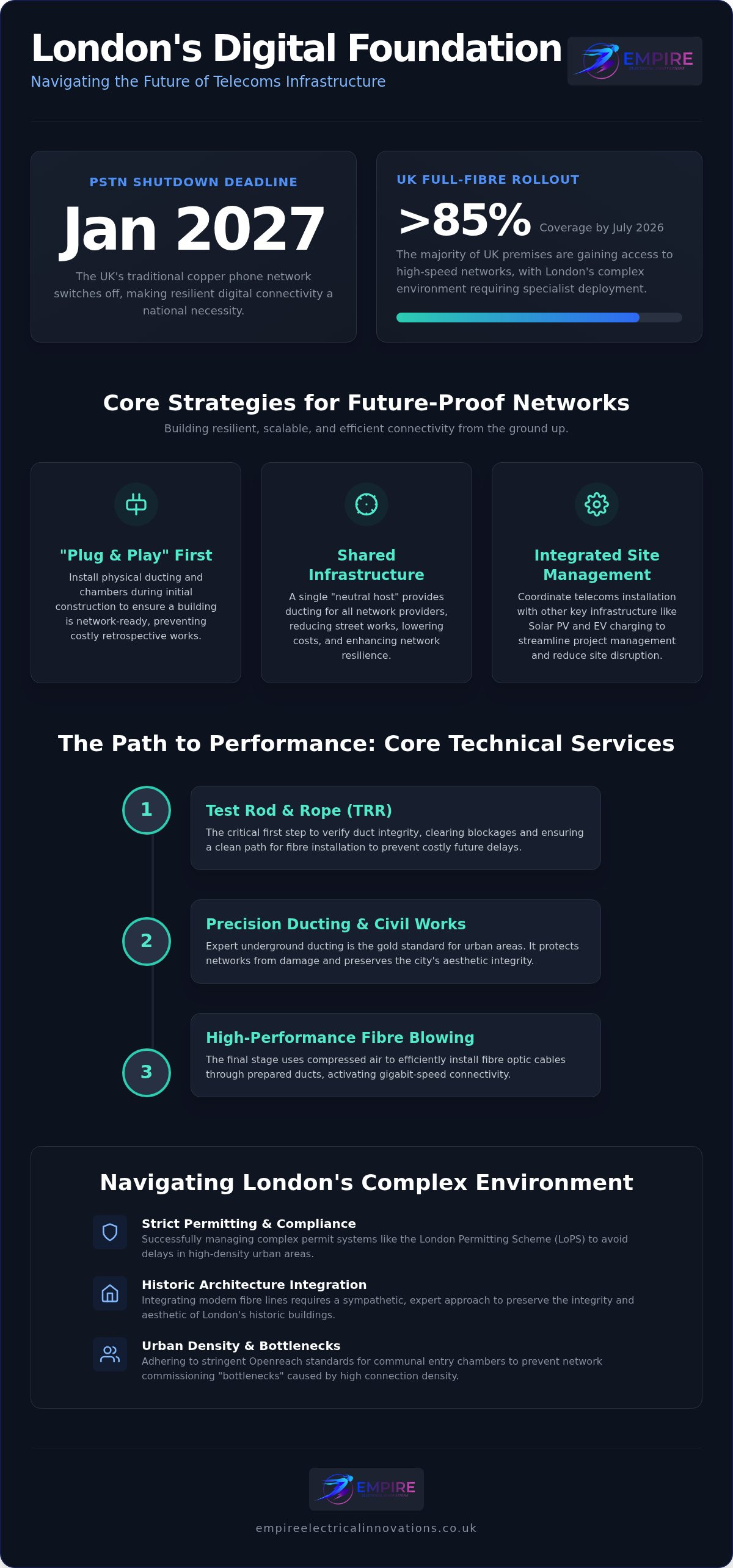
With the Public Switched Telephone Network (PSTN) shutdown scheduled for January 2027, the demand for resilient digital connectivity has reached a critical peak. By July 2026, over 85% of UK premises have gained access to full-fibre networks, yet the capital remains a uniquely challenging environment for deployment. For developers and network providers, selecting telecoms infrastructure contractors London is no longer just about basic excavation. It is about precision. Compliance. Performance.
You likely know the frustration of commissioning delays caused by poor ducting or a disconnect between civil works and technical installation. These hurdles threaten project timelines and inflate overheads in an increasingly regulated market. This guide provides a professional framework for managing these complexities, from initial Test Rod and Rope (TRR) to precision fibre blowing. We will examine how specialist contractors deliver future-proofed networks that meet the July 2026 Telecommunications Security Code of Practice whilst reducing lead times through methodical, integrated site management.
Table of Contents
The Evolving Landscape of London’s Telecommunications Infrastructure
The UK's digital backbone has undergone a massive transformation as we move through 2026. With the national carrier infrastructure market valued at USD 29.9 billion this year, London remains the primary driver of this expansion. High-capacity fibre is no longer a luxury for the commercial sector; it's a utility as vital as water or electricity. Understanding the historical context of Telecommunications in the United Kingdom helps illustrate how we've moved from copper-based systems to the current full-fibre standard. For businesses in the capital, this shift demands a more robust approach to physical asset management.
Modern developers now prioritise "plug and play" infrastructure. This approach involves installing the physical "bones" of the network—such as ducting and chambers—long before a tenant moves in. It prevents the need for retrospective digging, which is often blocked by strict local authority regulations or high reinstatement costs. Specialist telecoms infrastructure contractors London focus on these early-stage civil works to ensure a building is network-ready from day one. This level of foresight reduces project lead times and ensures that the final fibre installation is a simple, non-invasive process.
In 2026, Openreach standards for communal entry chambers have become more stringent to handle the density of urban connections. These chambers serve as the primary interface between the public highway and private property. They must be positioned to allow easy access for multiple providers whilst maintaining structural integrity. Getting this right during the initial civil stage avoids the "bottleneck" effect that often delays network commissioning for months. It's about creating a seamless path from the street to the server room.
The Shift Toward Neutral Host and Shared Infrastructure
The "share rather than self-deploy" model is gaining significant traction across Central London. Instead of multiple providers digging separate trenches, a single neutral host provides the physical ducting for everyone to use. This shared asset model improves connectivity resilience and reduces urban disruption. The benefits include:
Reduced street works and associated traffic congestion.
Lower capital expenditure for individual network providers.
Enhanced network resilience through diverse routing in shared ducts.
Easier upgrades for future 6G requirements without new excavation.
As we look toward 2027 and beyond, the physical capacity of these ducts must be oversized. This accommodates denser cabling and the hardware required for 5G Standalone (5G SA) networks without requiring further groundworks.
London-Specific Challenges for Infrastructure Contractors
Operating within the "Square Mile" requires meticulous planning and a no-nonsense approach to compliance. Telecoms infrastructure contractors London must navigate complex permit systems like the London Permitting Scheme (LoPS) to manage street works in high-density areas. Integrating modern fibre lines with historic London architecture requires a sympathetic, expert touch. We find that the precision required in the capital is equally valuable when working across Hertfordshire and the Home Counties. Local knowledge of soil conditions, utility maps, and regional council requirements is essential for a clean, compliant installation that stands the test of time.
Specialist Services: From Telecoms Ducting to Fibre Blowing
Resilient digital networks are built on the quality of their physical foundations. Whilst the focus often rests on final connectivity speeds, the civil engineering behind the scenes determines the long-term viability of the installation. For telecoms infrastructure contractors London, this begins with a strategic choice between underground and overhead deployment. In high-density urban environments, underground ducting is the gold standard, providing protection from the elements and maintaining the aesthetic integrity of the capital's streets. Overhead installations remain a viable, cost-effective alternative for specific suburban locales or where existing pole infrastructure allows for rapid deployment without extensive excavation.
Adhering to the Critical National Infrastructure Charter is essential during these works. This ensures that every duct laid and every cable pulled contributes to a secure, standardised national network. Professional contractors don't just dig trenches; they create engineered pathways designed to house high-density fibre for decades. This methodical approach prevents the "rat's nest" of cabling often found in legacy systems, replacing it with organised, accessible infrastructure that facilitates easy maintenance and future upgrades.
The Critical Role of Test Rod and Rope (TRR)
Test Rod and Rope (TRR) is the diagnostic heart of network preparation. It involves proving the integrity of the ducting before any fibre is deployed. By passing a flexible rod through the system, contractors can identify blockages, collapses, or debris that would otherwise stall a project. Once the route is proven, a draw rope is left in place. This simple step prevents costly delays during the installation phase. It's a proactive measure that ensures the technical team isn't met with unexpected obstructions when the expensive fibre assets arrive on site.
Advanced Fibre Optic Blowing Techniques
Modern network requirements demand more than traditional cable pulling. Traditional methods can cause mechanical stress, leading to microscopic fractures in the glass core. Fibre blowing is a method that uses air to "float" cables through ducts to minimise friction. This technique allows for longer, continuous runs without the need for intermediate splicing points, which inherently reduces signal loss and potential failure points.
The process requires specialised equipment, including high-pressure compressors and precision blowing heads that monitor the speed and tension of the cable in real-time. By using compressed air to carry the cable, the risk of damage is virtually eliminated. If you're planning a complex network rollout, partnering with telecoms infrastructure contractors London ensures these technical stages are handled with the necessary precision to protect your investment.
Navigating Compliance and Technical Standards for UK Projects
Compliance isn't a checkbox; it's the foundation of network integrity. Expert telecoms infrastructure contractors London must demonstrate a deep understanding of both Openreach and alternative network (AltNet) technical specifications. These standards dictate everything from the minimum bend radius of fibre cables to the specific load-bearing capacity of communal entry chambers. Adherence ensures that the infrastructure remains compatible with the wider UK network, preventing costly remedial works during the handover phase. It's about getting the civil engineering right the first time.
The legal framework is equally rigorous. Contractors must operate within the UK telecommunications compliance standards, which include the revised Telecommunications Security Code of Practice issued in July 2026. This "quiet authority" in compliance is what separates a specialist from a generalist. It provides clients with the security that their installation is not only functional but fully legal and resilient against modern security threats. A methodical approach to these regulations is a non-negotiable trait for any professional partner.
Health and safety in underground works remains a primary concern. Working in confined spaces or near existing high-voltage utilities requires methodical risk assessment and specialised training. For new developments, integrating telecoms also involves compliance with Part L building regulations. This ensures that the building's digital infrastructure supports modern connectivity requirements whilst maintaining the high standards of efficiency expected in 2026. Safety and compliance are the twin pillars of every successful network deployment.
Quality Assurance in Telecoms Installation
Rigorous testing and commissioning protocols are the final hurdles before a network goes live. Every metre of fibre blown must be verified using industry-standard testing to ensure signal integrity. Documenting network routes is essential for long-term property management; it allows future technicians to locate assets without invasive exploratory digging. It's vital to confirm that your contractor is fully accredited and carries appropriate professional indemnity insurance to protect the project's longevity.
Future-Proofing through Standards
High standards today protect asset value tomorrow. Planning for capacity increases now prevents the need to re-dig London streets in five years' time. Bespoke solutions often outperform generic "off-the-shelf" cabling packages because they are tailored to the specific geometry and demand of the site. This long-term view turns a technical installation into a resilient property asset, ensuring the building remains competitive as connectivity demands evolve and 5G Standalone networks become the baseline.
Preparing Construction Sites for High-Capacity Network Integration
Successful network deployment begins long before the first fibre optic cable arrives on site. For developers, the most efficient approach involves integrating telecommunications with other essential infrastructure during the initial groundworks phase. Coordinating telecoms infrastructure contractors London with solar PV and EV charging teams allows for shared trenching and reduced civil costs. This integrated strategy prevents the common issue of utility conflicts, where newly laid power lines inadvertently obstruct the planned path for telecoms ducting. Early-stage planning ensures that the site's "digital foundation" is as robust as its structural one.
Managing the transition from temporary site power to a permanent network connection requires meticulous scheduling. During the construction phase, temporary connections often suffice for site offices, but the final handover demands a fully commissioned, high-capacity link. Using a single specialist for both electrical and telecoms works streamlines this process. It eliminates the communication silos that often lead to delays, ensuring that ducting, cabling, and power requirements are handled by a unified team with a comprehensive understanding of the project's technical goals. This "no-nonsense" approach to site management significantly reduces project lead times.
A Developer’s Checklist for Telecoms Infrastructure
To ensure a seamless installation, we recommend a structured approach to infrastructure preparation. Following these steps helps maintain compliance and avoid last-minute remedial works:
Step 1: Conduct a professional site survey and duct integrity test (TRR) to prove the route.
Step 2: Define bandwidth and resilience requirements based on the specific needs of the end-user.
Step 3: Organise the installation of communal entry chambers according to current Openreach or AltNet standards.
Step 4: Execute precision fibre blowing and final network commissioning to verify signal integrity.
Managing Logistics on London Construction Sites
London's high-density environment presents unique logistical hurdles. Space constraints often make it difficult to position specialist machinery or large cabling drums without blocking access for other trades. Expert telecoms infrastructure contractors London overcome these challenges through disciplined site organisation and "just-in-time" delivery of materials. Scheduling works during off-peak hours or weekends can further minimise disruption to surrounding businesses and traffic flow. Maintaining a clean and safe environment during civil ducting works isn't just about safety; it's about professional site discipline that reflects the quality of the technical work being performed. If you're looking to streamline your next development, consider how a specialist telecoms and electrical partner can simplify your site logistics.
Empire Electrical Innovations: Your London Telecoms Specialist
Empire Electrical Innovations operates as a trusted specialist in the capital's technical landscape. We provide a partnership-first approach to every project. This ensures we align our technical delivery with your commercial objectives. As experienced telecoms infrastructure contractors London, we understand that site managers value clear communication over empty promises. Our no-nonsense business attitude means we focus on workmanship and compliance. We don't just install cables; we build resilient property assets. Every civil ducting task is treated as a critical component of the building's long-term value.
Integrated Energy and Data Solutions
Modern developments require a holistic view of utility installation. We frequently link commercial EV charging infrastructure with telecoms ducting to maximise site efficiency. This integrated method supports sustainable energy goals by reducing redundant excavation and streamlining project management. Our expertise extends beyond the city, offering high-standard solar PV installation Hertfordshire for developers looking to future-proof their buildings. We maintain a strong track record across London, Bedfordshire, and Buckinghamshire. This regional presence allows us to respond quickly to the unique demands of each project. By coordinating data and energy infrastructure, we ensure your site is ready for the digital and green transitions of 2026.
Start Your Infrastructure Project
Every successful network begins with a precise design. We provide bespoke telecoms ducting contractors Hertfordshire services tailored to the specific geometry of your site. Our process starts with a free site survey to identify potential challenges before they impact your timeline. This immediate value provides a clear roadmap for your installation. Whether you require specialist fibre blowing or initial TRR services, our team delivers methodical results. We prioritise precision in every run. Request a bespoke design for your next London development to ensure full compliance with 2026 standards. Contact our specialist team today to begin your infrastructure project. We look forward to providing the technical performance your network demands.
Securing the Future of London’s Digital Infrastructure
The transition to a full-fibre UK by 2027 requires more than standard cabling. It demands a methodical approach to civil engineering and technical precision. By prioritising specialist TRR and fibre blowing services, you ensure your network remains resilient against the evolving demands of 5G Standalone and beyond. We've explored how integrating data pathways with renewable energy systems creates a more efficient, future-proofed site. This integrated strategy reduces project lead times whilst maintaining full compliance with the latest 2026 standards.
Selecting the right telecoms infrastructure contractors London is a strategic decision that protects your long-term property value. Whether you're managing a complex urban development or a regional project across the Home Counties, professional workmanship is non-negotiable. Empire Electrical Innovations provides the quiet authority and technical expertise needed to deliver these high-capacity solutions. We remain committed to being a reliable partner for developers who value precision, performance, and professional compliance. It’s time to build a network that lasts.
Contact Empire Electrical Innovations for a specialist telecoms infrastructure quote to begin your next project with confidence. We look forward to building your network's foundation.
Frequently Asked Questions
What is the role of a telecoms infrastructure contractor on a construction site?
Telecoms infrastructure contractors manage the civil works and technical installation of communication networks. This includes digging trenches, laying ducts, and installing entry chambers. They bridge the gap between initial groundworks and final network commissioning. By coordinating with other trades, they ensure that data pathways are protected from damage during the build. Their presence prevents the need for retrospective excavation, which is both costly and disruptive for property developers.
How does fibre blowing differ from traditional cable pulling?
Fibre blowing uses compressed air to "float" cables through ducts, whereas traditional pulling relies on mechanical force. This air-driven method significantly reduces friction and tension on the delicate glass cores. It allows for much longer continuous runs without the need for splicing, which maintains signal integrity. Professional telecoms infrastructure contractors London use this technique to accelerate deployment whilst protecting the high-value fibre assets from microscopic fractures or structural damage.
What is TRR in telecoms and why is it necessary before fibre installation?
TRR stands for Test Rod and Rope, a critical diagnostic process for proving duct integrity. Technicians pass a flexible rod through the underground system to identify blockages, debris, or collapsed sections. Once the route is confirmed clear, a draw rope is left in place for the fibre installation team. Skipping this step often leads to project stalls and expensive remedial works if a cable gets stuck in a faulty or obstructed duct.
Can telecoms ducting be installed alongside solar and EV charging infrastructure?
Yes, integrating telecoms with solar PV and EV charging infrastructure is a highly efficient strategy for modern developments. Sharing trenches for multiple utilities reduces civil costs and minimises ground disruption. It requires careful planning to ensure that power cables don't interfere with data pathways. This integrated approach allows developers to manage their site's energy and connectivity requirements through a single, coordinated workflow, improving overall project timelines and site discipline.
What regulations govern telecoms infrastructure in London?
Projects must comply with the Telecommunications (Security) Act 2021 and the revised July 2026 Security Code of Practice. In London, contractors also navigate the London Permitting Scheme (LoPS) for street works and adhere to strict Openreach technical specifications for communal entry chambers. These regulations ensure that all new installations are secure, standardised, and compatible with the national grid. Adhering to these standards is essential for successful site commissioning and legal compliance.
How much does it cost to install commercial telecoms infrastructure in London?
Costs are project-dependent and vary based on the scale of civil works and technical requirements. Factors such as the length of the ducting run, the number of chambers required, and the complexity of the fibre blowing process all influence the final quote. Whilst industry day rates for engineers provide a baseline, a bespoke site survey is necessary for an accurate estimate. Developers should focus on the long-term value of a compliant, resilient installation over initial costs.
How can I ensure my new development is future-proofed for 6G and beyond?
Future-proofing requires installing oversized ducting and high-capacity chambers during the initial build. This allows for the deployment of denser fibre networks or new hardware without further excavation. Partnering with telecoms infrastructure contractors London who prioritise scalable designs is vital. By creating an accessible, modular infrastructure today, you ensure the building can adapt to the higher frequencies and lower latency requirements of 6G technology as it emerges in the coming decade.
Why should property developers prioritise communal entry chambers?
Communal entry chambers act as the central hub for all external network providers entering a building. Prioritising these installations prevents "provider lock-in" and gives tenants a choice of multiple AltNets or Openreach services. It also simplifies the maintenance of external connections without disrupting internal building operations. Properly installed chambers according to 2026 standards are essential for creating a "plug and play" environment that attracts high-value commercial tenants who demand resilient connectivity.


Comments