
Test Rod and Rope Telecoms: The 2026 Guide to Network Preparation

What if a single overlooked blockage in an underground duct could jeopardise your entire 2026 fibre rollout schedule? For project managers and developers across London and Hertfordshire, the pressure to deliver gigabit-capable infrastructure under the Telecoms Access Review 2026-31 is relentless. You've likely experienced the frustration of a project grinding to a halt because a "clear" pathway was actually obstructed by silt or collapsed ducting. Professional test rod and rope telecoms services act as the essential first line of defence against these unforeseen obstacles. It's the most effective way to ensure your project stays on track and within budget.
We understand that reliability is the foundation of any successful infrastructure project. This guide will show you how thorough TRR services secure your fibre deployment, helping you avoid the high costs of remedial excavation and ensuring your network is future-ready. We'll examine the technical TRR process, explain how to navigate current industry standards, and demonstrate how to reduce the risk of installation failure before the first cable is even blown. By the end, you'll have a clear roadmap for preparing your network for the demands of 2026 and beyond.
Table of Contents
What is Test Rod and Rope (TRR) in Telecoms?
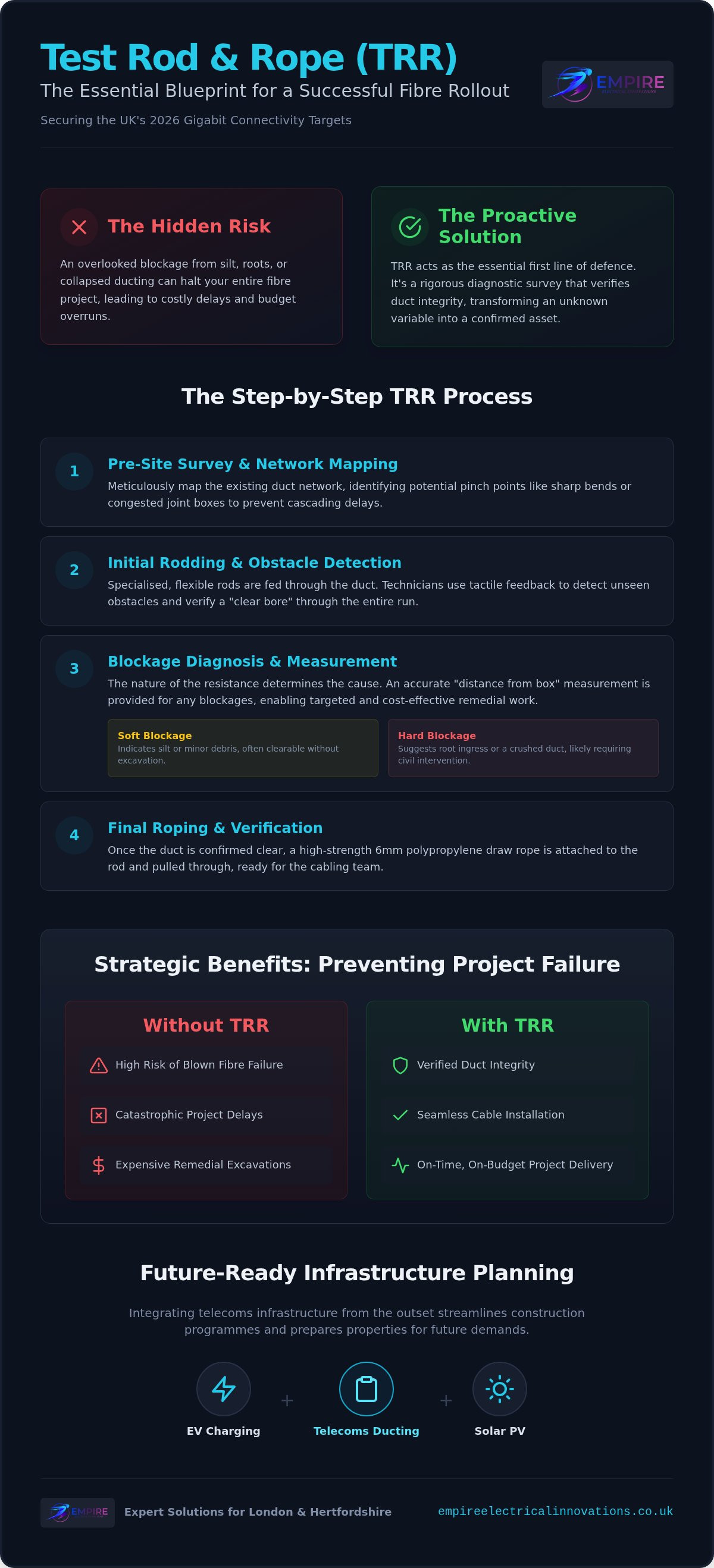
Test rod and rope telecoms is the indispensable diagnostic phase of any underground network project. It serves as a rigorous audit of existing ducting to ensure the physical path is viable for new fibre optic cables. It isn't just about clearing a path. It's a comprehensive survey that protects the long-term value of the infrastructure being installed today. By identifying critical failures like silt ingress, root penetration, or structural collapses early, contractors prevent the catastrophic delays that occur when a fibre blow fails midway through a run.
The UK is currently operating under the Telecoms Access Review 2026-31. This regulatory framework prioritises the rapid expansion of gigabit-capable networks. With full-fibre coverage reaching 78% of premises by mid-2025, the industry focus has shifted toward the "final mile" and complex urban retrofitting. Industry bodies like the Telecommunications Industry Association (TIA) develop the standards that govern these physical layers, making professional TRR procedures essential for maintaining compliance. Testing is the only way to transform an unknown underground variable into a verified asset.
The Anatomy of a TRR Project
Successful network preparation relies on specialised equipment. The process begins with the test rod. These are flexible, high-tensile rods designed to navigate the tight bends of legacy ducting without snapping. They're resilient. They're precise. Once the rod successfully traverses the duct, it's used to pull through a draw rope. In the UK, high-quality 6mm blue polypropylene rope is the standard. It provides the necessary tensile strength to pull heavy fibre bundles through hundreds of metres of underground pipework. Our teams navigate complex access points, including manholes and joint boxes, to ensure every customer termination point is reachable and clear.
Why Preparing Legacy Ducts Matters
Underground infrastructure often suffers from an "out of sight, out of mind" fallacy. This is a mistake. In regions like London and the Home Counties, environmental shifts and heavy traffic loads cause significant ground movement. Over decades, this pressure leads to joint misalignments and duct deformation. Legacy copper networks were more forgiving of these minor defects, but modern fibre optic cables require a "clear bore" to prevent signal attenuation or physical damage during the blowing process. Test rod and rope telecoms serves as the essential verification step that confirms duct integrity before any cable deployment begins. It's the difference between a seamless handover and a costly civil works nightmare.
The Step-by-Step TRR Process for Site Managers
Effective network preparation starts long before a cable drum arrives on site. For site managers, the test rod and rope telecoms process begins with a meticulous pre-site survey. This phase involves mapping the existing duct network and identifying potential pinch points, such as sharp bends or heavily congested joint boxes. A methodical approach here prevents the cascading delays often seen in large-scale urban rollouts. Precision is mandatory.
Once the route is mapped, technicians begin the initial rodding. This involves feeding specialised rods through the duct to verify a "clear bore" through the entire run. It's a tactile operation. Technicians rely on the feedback from the rods to identify obstacles that aren't visible from the surface. If a rod meets resistance, the team must determine whether it's a minor obstruction or a structural failure requiring civil intervention.
Rodding and Obstacle Detection
Expertise lies in interpreting the "feel" of the rod. A soft, spongy resistance often indicates silt ingress or minor debris that can be cleared with high-pressure water or multiple passes. Conversely, a hard, unyielding stop usually points to root ingress or a crushed duct section. In urban London environments, these technical challenges are common due to historical ground movement and heavy traffic loads. Technicians must provide accurate "distance from box" measurements for every blockage discovered. This precision allows site managers to organise targeted excavations, minimising disruption and reducing remedial costs.
Final Roping and Verification
After confirming the duct is clear, the team attaches a high-strength draw rope to the rod and pulls it back through the run. This rope must be secured properly at both ends to ensure it remains accessible for the subsequent cabling team. The process concludes with duct proofing. This involves pulling a "mandrel" or cylindrical gauge through the duct to ensure it adheres to international standards for duct inspection. This step verifies that the duct meets the minimum diameter specifications required for the specific fibre bundle being installed. A comprehensive TRR report is then issued, serving as the official handover document that permits fibre blowing to proceed. If you require a detailed audit of your current infrastructure, our team provides specialist telecoms infrastructure surveys across the Home Counties.
Strategic Benefits: Why TRR Saves Project Budgets
Budget overruns in telecoms often stem from a single source: the unknown. Proceeding with cable installation without verified duct integrity is a high-stakes gamble. If a fibre blow fails midway through a run, the cost isn't just the lost labour. It's the abandoned cable, the project delay, and the emergency civil works required to rectify the issue. Professional test rod and rope telecoms services eliminate this risk by providing certainty before a single metre of fibre is deployed.
Targeted excavations are the primary driver of cost savings. When a blockage is identified during the TRR phase, technicians provide precise measurements from the access point. This allows for surgical intervention. Rather than excavating an entire street, civil teams can focus on a specific two-metre section. This approach is particularly vital across Hertfordshire and Buckinghamshire, where minimising trenching in sensitive or high-traffic areas reduces both environmental impact and local authority permit fees.
TRR vs. Traditional Trenching
Disruption management is critical in busy commercial centres and residential estates. Traditional trenching is slow. It's loud. It's invasive. In contrast, TRR utilises existing assets to accelerate the "homes passed" metric for developers. Industry data suggests that utilising existing ducting via TRR can reduce the need for new excavations by up to 70% in established legacy networks. This efficiency allows projects to move from the planning phase to active commissioning weeks ahead of schedule.
Risk Mitigation for Property Developers
For modern developers, compliance is a core pillar of project success. Ensuring that infrastructure meets Part L requirements and current telecoms standards is mandatory. TRR serves as a final quality check, confirming that the installed ducting is fit for purpose and free from defects. It also reduces the liability associated with damaging third-party utilities. By avoiding unnecessary trenching, the risk of striking gas, water, or power lines is significantly lowered. Partnering with experienced telecoms ducting contractors Hertfordshire ensures that your network preparation is handled with the precision required for 2026 standards. Leaving a draw rope in situ also provides long-term value, facilitating future network upgrades without the need for further diagnostic work.
Integrating TRR into Modern Infrastructure Planning
Modern infrastructure planning demands a unified approach. In 2026, the traditional silos of utility installation are disappearing. Developers now plan telecommunications alongside EV charging points and large-scale solar PV arrays to create cohesive, energy-efficient sites. Professional test rod and rope telecoms services provide the verified backbone for these integrated systems. By ensuring that ducting pathways are clear and roped early, project managers can prevent the "last-minute" discovery of blockages that frequently derail handover schedules.
Timing is everything in a complex construction programme. We recommend scheduling TRR as soon as the primary ducting is backfilled and the ground is stabilised. Waiting until the final weeks of a project creates unnecessary risk. Early verification allows for remedial works to be completed whilst civil teams are still on site, avoiding the high costs of recalling contractors. This proactive approach is essential for multi-dwelling units (MDUs) and large-scale warehouse developments where the sheer volume of cabling requires absolute pathway certainty.
Coordinating street works in London and the Home Counties requires precision. Accessing existing network joint boxes often involves navigating busy public highways and residential centres. We manage the interface with local authorities to ensure all necessary street works permits are in place before rodding begins. This coordination reduces lead times and ensures that the infrastructure is ready for the fibre provider the moment they arrive to blow the cable.
Telecoms and the Smart Site Revolution
The smart site revolution relies on high-speed data. Modern building management systems and energy monitoring tools require reliable fibre connectivity to function. For commercial sites, this connectivity is the foundation for solar PV for commercial buildings, allowing for real-time performance tracking and grid integration. TRR facilitates these data links by guaranteeing that the underground infrastructure can support the high-density fibre required for smart building ecosystems. It's an investment in the site's future operational intelligence.
Compliance and Health & Safety
Operational safety is our highest priority. Rigorous test rod and rope telecoms protocols ensure that all work adheres to NRSWA (New Roads and Street Works Act) standards. Our teams are fully qualified for confined space entry, which is a mandatory requirement for accessing deep joint boxes and manholes safely. We also implement strict quality assurance checks during the roping phase. Every draw rope must meet specific tension requirements to ensure it doesn't snap or burn during the high-speed fibre blowing process. If you're planning a multi-utility rollout, contact our team for bespoke telecoms infrastructure solutions that align with your 2026 project goals.
Bespoke Telecoms Solutions with Empire Electrical Innovations
Empire Electrical Innovations delivers end-to-end infrastructure support. We manage the entire lifecycle of a project. This starts with initial surveys and moves through to test rod and rope telecoms, fibre blowing, and final commissioning. Our team provides the technical precision required for modern, high-capacity networks. We don't just clear ducts. We ensure your infrastructure is future-ready. Every project is handled with the methodical discipline required to meet 2026 connectivity standards.
Our local expertise is a primary advantage for developers. Serving Hertfordshire, Bedfordshire, and London, our teams bring a no-nonsense attitude to every site. We understand the specific geological and regulatory challenges of the South East. This local knowledge allows us to reduce lead times and navigate local authority requirements efficiently. By combining electrical, renewable, and telecoms expertise, we provide a single, trusted point of contact for all your site's utility needs.
The Empire guarantee is built on professional standards and clear communication. We believe in transparency. You'll receive detailed reports and honest assessments of your duct integrity. Our workmanship is designed for longevity, ensuring that the infrastructure we prepare today remains functional for decades. We focus on being an established and compliant partner that prioritises your project's success over empty marketing promises.
Why Choose a Specialist Contractor?
Reliability is the foundation of our service. We embody "quiet authority" by delivering results without the need for high-pressure sales tactics. Our partnership-first approach ensures we act as a collaborative extension of your project team. We've successfully delivered TRR and cabling projects across the South East, consistently meeting the rigorous standards of major network providers. We value workmanship and precision. We understand that our role is to make your fibre deployment seamless and predictable.
Get Your Infrastructure Project Started
Planning your 2026 network rollout requires early engagement and expert insight. We provide professional site surveys and bespoke quotations for commercial telecoms projects, ensuring every assessment is tailored to your site's unique requirements. Our commitment to compliance ensures all work meets current industry standards and health and safety regulations. Partner with Empire Electrical Innovations for your next project to secure a reliable, compliant, and efficient network deployment. We're ready to support your infrastructure goals with the expertise your project deserves.
Future-Proofing Your 2026 Infrastructure Strategy
Successful fibre deployment depends on the integrity of the underground path. Reliability is not optional. Professional test rod and rope telecoms services transform unknown duct conditions into verified assets, ensuring your project meets the rigorous standards of current regulatory frameworks. By identifying blockages early and providing precise data for targeted civil works, you eliminate the risk of costly installation failures and unnecessary project delays.
As a NICEIC Approved Contractor with specialist telecoms infrastructure expertise, we serve Hertfordshire, London, and the South East with a focus on compliance. Whether you're integrating telecoms with renewable energy or managing a large-scale urban development, our partnership-first approach provides the technical reliability your project demands. Contact Empire Electrical Innovations for a Professional Telecoms Survey to secure your infrastructure today. We look forward to supporting your next successful rollout.
Frequently Asked Questions
How long does a standard test rod and rope survey take?
A standard survey duration varies based on the duct length and the presence of any obstructions. For a clear run between two joint boxes, typically spaced around 100 metres apart, technicians can often complete the process in 30 to 45 minutes. However, complex urban routes with multiple bends or silt ingress will extend this timeframe. Our methodical approach ensures every metre is verified before we issue the final clearance report.
Can TRR be performed on ducts that already contain existing cables?
Yes, TRR can be performed in ducts that are already occupied by legacy copper or existing fibre. This is often referred to as "rodding over" and requires specialised equipment to avoid damaging the live infrastructure. We utilise flexible, high-tensile rods that manoeuvre around existing cables without causing interference. This process is essential for verifying that enough capacity remains within the duct for your new network expansion.
What happens if a blockage is found during the rodding process?
If a blockage is detected, our technicians immediately measure the exact distance from the access point. We document the location and the nature of the obstruction, such as silt, root ingress, or a structural collapse. This precise data allows site managers to organise targeted remedial works rather than excavating the entire run. We provide a full report on the blockage to help you coordinate the necessary civil repairs efficiently.
Is TRR mandatory for all new fibre optic installations in the UK?
Whilst not a legal requirement for all private projects, test rod and rope telecoms is practically mandatory for any installation utilising the Openreach Physical Infrastructure Access (PIA) product. It's an industry standard requirement for ensuring network integrity and preventing cable damage. Most insurance providers and network operators insist on a verified TRR report before they permit the blowing of expensive fibre optic cables into existing underground ducting.
What is the difference between a test rod and a standard drain rod?
The primary difference lies in flexibility and tensile strength. Standard drain rods are usually rigid and designed for short, straight runs. In contrast, telecoms test rods are manufactured from high-grade fibreglass or specialised nylon to navigate tight bends and long distances of up to 250 metres. They're designed to withstand significant pulling forces when drawing through heavy polypropylene ropes without snapping or deforming, which is critical for complex infrastructure projects.
How much draw rope should be left in the duct after a TRR survey?
We typically leave between one and two metres of excess draw rope at each access point or joint box. This ensures the cabling team has sufficient length to secure their pulling equipment without the rope slipping back into the duct. The rope is always tied off securely to an internal anchor point or a specialised bracket. This disciplined approach prevents the need for re-rodding and facilitates a seamless transition to the fibre blowing phase.
Do you provide TRR services for both underground and overhead networks?
We provide comprehensive TRR services for both underground ducting and overhead pole networks. For underground projects, we focus on verifying duct integrity and clearing pathways. For overhead installations, we use specialised roping techniques to prepare spans between poles for new aerial fibre. This dual capability allows us to support "mixed" infrastructure rollouts across Hertfordshire and London, ensuring consistent standards of workmanship regardless of the network topography or installation environment.
Can TRR help in planning for workplace EV charger installations?
Yes, TRR is vital for planning workplace EV charger installations that require smart load management. Modern chargers need reliable data links to communicate with building management systems and the grid. test rod and rope telecoms verifies that the existing underground pathways can support the necessary fibre or data cabling. This prevents delays in your EV rollout and ensures your charging infrastructure is fully integrated with your site's energy monitoring and renewable systems.


Comments