
Underground Telecoms Cabling in Buckinghamshire: A 2026 Infrastructure Guide

What if the most expensive part of your next development isn't the technology itself, but the unexpected cost of digging up a "finished" site? For developers and site managers across the county, discovering a blocked duct during the final stages of a project is a costly setback that threatens handover deadlines and budget margins. Ensuring your underground telecoms cabling Buckinghamshire project remains on track requires more than just laying pipe; it demands a diagnostic-led approach to infrastructure.
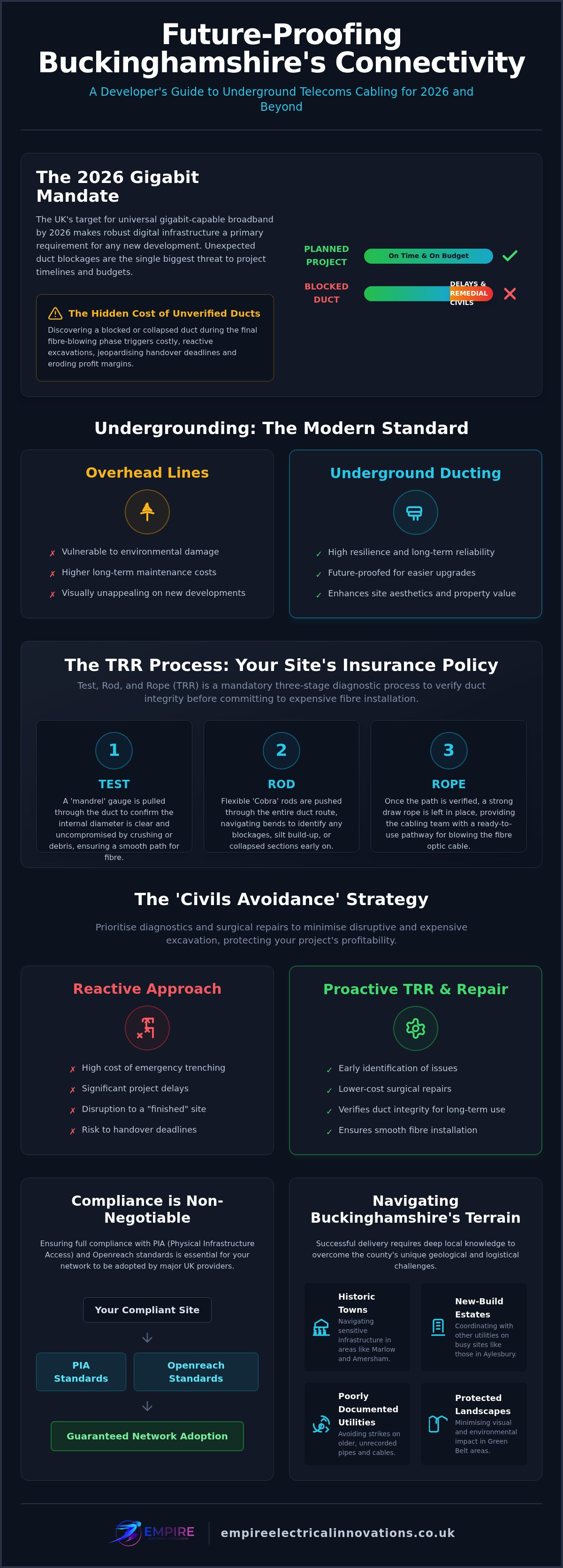
It's frustrating to face delays due to complex Openreach and PIA standards when you're striving to meet the 2026 UK gigabit-capable broadband targets. We recognise that the high costs of trenching and remedial civils can quickly erode a project's profitability. This guide explains how specialist underground telecoms cabling and TRR (Test, Rod, and Rope) services provide a reliable insurance policy for your site's connectivity. You'll learn how to verify duct integrity for long-term use and create a clear path for fibre-optic blowing, ensuring your commercial or residential development is future-proofed without the need for reactive, expensive excavations.
Table of Contents
Why Underground Telecoms Cabling is Critical in 2026
Underground telecoms cabling is the subterranean network of ducts and high-performance fibres that power modern connectivity across the region. As we move through 2026, the shift towards universal gigabit-capable broadband across the Home Counties has reached a critical point. Developers no longer view digital infrastructure as a secondary utility; instead, it's a primary requirement for any viable commercial or residential project. Underground telecoms cabling is the backbone of smart-city and high-speed residential infrastructure.
Securing reliable underground telecoms cabling Buckinghamshire services is now a prerequisite for successful site handover and long-term asset value. Whilst some legacy systems might rely on a Direct-buried cable (DBC), modern 2026 standards prioritise duct-based installations. This approach creates a modular system where cables can be blown, repaired, or upgraded without the need for repeated, disruptive excavation. It represents a strategic move away from "fit and forget" towards an infrastructure that can scale with demand.
Connectivity. Resilience. Future-proofing.
Overhead lines are increasingly seen as a liability in the current market. They remain vulnerable to environmental damage, such as falling branches or high winds, which lead to costly service interruptions and maintenance headaches. For new housing developments in rural Buckinghamshire, the aesthetic benefit of undergrounding is equally significant. Removing unsightly poles creates a cleaner, more premium feel for the site, which directly impacts property desirability. Future-proofing means installing high-capacity ducting today. It ensures that as fibre technology evolves, the infrastructure can accommodate the higher-density fibres of tomorrow without any further groundworks or civil engineering costs.
Navigating Buckinghamshire’s Unique Terrain
Buckinghamshire presents a distinct set of challenges for infrastructure teams. Successfully delivering underground telecoms cabling Buckinghamshire projects requires an understanding of both modern standards and local geology. Installing cabling in historic market towns like Marlow or Amersham requires a far more delicate strategy than work on new-build business parks in Aylesbury. You need deep local knowledge to plan duct routes that avoid existing utilities, many of which are poorly documented in older borough records. Local authorities across the county are now prioritising underground infrastructure in planning permissions. They recognise that subterranean networks offer better long-term reliability and less visual impact on the region's protected landscapes and Green Belt areas.
The TRR Process: Preparing Buckinghamshire’s Ducts for Fibre
Successful underground telecoms cabling Buckinghamshire depends on more than just high-quality fibre; it requires a verified pathway. TRR stands for Test, Rod, and Rope. This three-stage process serves as the ultimate diagnostic tool for developers, ensuring that the subterranean infrastructure is ready to receive cable without the risk of snagging or mid-route failures. TRR identifies critical issues such as silt build-up, duct collapses, or misalignments that often occur during the construction phase of a project.
In the current landscape of telecoms ducting contractors Hertfordshire and Buckinghamshire, TRR has moved from a recommendation to a strict requirement. Adhering to the UK government guidance on data ducting is essential for ensuring that new-build infrastructure meets the rigorous standards of 2026. A successful TRR survey concludes with detailed documentation. This handover pack provides the cabling team with a "verified clear" status, detailing exactly where ropes are placed and highlighting any areas that required remedial attention. It is the bridge between civil engineering and active network deployment.
Step-by-Step: From Access Point to Draw Rope
The process begins with the use of 'Cobra' rods. These flexible, high-strength rods are designed to navigate complex bends and tight radii within the underground network. Once the rod successfully traverses the duct, we perform a 'mandrel' test. This involves pulling a cylindrical gauge through the pipe to ensure the internal diameter hasn't been compromised by crushing or debris. It's a vital step for 2026 fibre standards, where cable diameter and blowing pressures are precisely calculated. Finally, we secure high-tensile draw ropes. These ropes stay in the duct, providing the cabling team with a seamless, low-friction path for final installation.
Specialist Equipment for Commercial Sites
Manual rodding is often sufficient for short residential spurs, but commercial developments require a more robust approach. We utilise mechanical assistance for long-distance runs to maintain consistent pressure and prevent rod breakage. Precision is key. If a blockage is encountered, we use surface detection tools to locate the exact point of failure. This allows for surgical intervention rather than broad, expensive excavation. Empire Electrical Innovations uses industry-leading rodding technology to ensure every metre of your network is verified. If you are planning a new development, consulting with a specialist early can prevent significant infrastructure delays.
Civils Avoidance: Reducing Costs and Disruption
Civils avoidance is the primary objective for cost-conscious developers managing underground telecoms cabling Buckinghamshire projects in 2026. This strategy focuses on maximising the utility of existing subterranean pathways to bypass the need for expensive new groundworks. By using a thorough TRR survey, we identify the precise location of any obstruction. This allows for "surgical" repairs where only a small, targeted area is excavated to clear a blockage, rather than digging long, disruptive trenches across a site.
The environmental impact of traditional trenching is significant, involving heavy machinery, high carbon emissions, and large volumes of waste material. Modern cabling techniques, supported by verified duct integrity, offer a far greener alternative. Utilising existing infrastructure aligns with the broader UK telecommunications infrastructure overview, which emphasises the importance of efficient duct access to speed up national connectivity goals. TRR can save up to 60% on infrastructure costs by preventing unnecessary excavation and the associated labour and material expenses.
Financial ROI for Property Managers
Property managers often face the frustration of "aborted visits" from major network providers. If a provider like Openreach arrives to install fibre but finds a blocked or collapsed duct, the job is cancelled, and a fee is often applied for the failed attempt. Applying strategic telecoms infrastructure for London construction projects principles to Buckinghamshire developments ensures that every route is proven clear before the final cabling team arrives. This proactive approach eliminates the risk of hidden costs and keeps handover schedules on track. For more on essential site preparation, see our guide on fibre installation for construction sites.
Minimising Site Disruption
Keeping a site operational whilst upgrading underground telecoms cabling Buckinghamshire is a major logistical challenge. Traditional civils works can close access roads and public footways for days or weeks. In contrast, TRR and fibre blowing are rapid processes that cause minimal surface disturbance. Property developers prefer these "no-dig" solutions, especially for occupied business parks where tenant access must be maintained. The speed of these modern methods allows for infrastructure upgrades to be completed with a fraction of the noise, dust, and traffic management required by traditional civil engineering projects.
Compliance and Standards: PIA and Openreach in 2026
Physical Infrastructure Access (PIA) has revolutionised how we approach underground telecoms cabling Buckinghamshire. By allowing third-party operators and developers to use existing Openreach duct and pole infrastructure, the market has become far more competitive. This shift has significantly reduced the time and cost associated with new deployments, bypassing the need for extensive new trenching in many areas. However, access is not a free-for-all. Every metre of cable installed must meet precise technical specifications to ensure the network remains robust and adoptable by major providers. Compliance isn't just a hurdle; it's the foundation of modern connectivity.
Working with accredited contractors is the only way to guarantee your infrastructure meets the 2026 gigabit-capable requirements. Our fibre optic cabling Bedfordshire specialists apply these same high standards across the Home Counties, ensuring a consistent level of quality. These standards are under constant review, with Ofcom’s "Telecoms Access Review 2026-31" currently shaping the next five years of market regulation. Staying ahead of these changes is essential for any developer who wants their site to remain compliant and connected.
Understanding PIA for New Developments
PIA is a tool for speed. It lets developers avoid the "wait and see" approach of traditional network builds by leveraging what's already in the ground. To use this system, you must provide meticulous TRR reporting. These reports prove that the ducts are clear and that your installation won't damage existing services. The process concludes with "as-built" drawings. These documents are the final, critical step in the compliance chain. They provide a permanent record of exactly where your assets lie, which is vital for future maintenance and legal site handovers. Without accurate as-builts, your infrastructure may never be officially adopted.
The K8 Standard and Safety
The Openreach K8 standard is the benchmark for workmanship in the UK telecoms industry. It covers everything from the tensile strength of the draw ropes to the specific methods used for duct sealing. Rope strength is particularly important. If a rope snaps during a high-pressure fibre blowing operation, the resulting delay can cost thousands in lost labour and equipment time. Proper sealing is equally vital. It prevents future siltation and water ingress, which can lead to ice damage or cable degradation over time. Box integrity must also be maintained to prevent the entry of debris. Compliance is the foundation of our service delivery. If you need a partner who understands the nuances of 2026 standards, contact our infrastructure team for a detailed compliance audit today.
Specialist Telecoms Solutions with Empire Electrical Innovations
Empire Electrical Innovations stands as the premier partner for large-scale infrastructure projects across the region. We provide a comprehensive turnkey solution that integrates TRR, ducting, and the specialised work of fibre blowing contractors Hertfordshire. This holistic approach ensures that your underground telecoms cabling Buckinghamshire project is managed with total oversight from initial survey through to final connection. We are deeply committed to supporting the South East’s construction and renewable energy sectors with infrastructure that is built to last. By consolidating these technical services, we eliminate the friction often caused by managing multiple sub-contractors on a single site.
Our team understands that every development has a unique topography and set of challenges. We don't believe in one-size-fits-all solutions. Instead, we offer bespoke infrastructure planning that accounts for specific site requirements, from historic town centre retrofits to sprawling new-build industrial estates. This level of precision is what defines a "Trusted Specialist" in the 2026 market. We ensure that every metre of ducting is not only compliant with current standards but is also prepared for the high-density fibre demands of the next decade.
A Partnership-First Approach
Methodical. Disciplined. Reliable. These are the core pillars of our service delivery. We prioritise clear communication and methodical reporting at every stage of the project. This ensures that site managers and developers have a transparent view of progress and any potential hurdles. We support a diverse range of sectors, including local schools, business parks, and residential housing developments, with expert cabling solutions. Our role often extends beyond simple connectivity. We specialise in linking telecoms with commercial EV charger installation Hertfordshire for smart developments. This integrated utility strategy ensures your project is equipped with both the high-speed data and the power infrastructure required for a sustainable future.
Ready for Your Site Survey?
Early engagement is the most effective way to protect your construction timeline and budget. Booking a professional TRR survey at the start of your project identifies potential infrastructure bottlenecks before they become critical, costly delays. Our consultants provide the technical oversight needed to navigate the complex regulatory landscape of 2026 with absolute confidence. We invite you to discuss your bespoke infrastructure requirements with our specialist team to ensure your site is ready for the next generation of gigabit-capable connectivity. Contact Empire Electrical Innovations to discuss your Buckinghamshire telecoms project today and secure a partner who values workmanship as much as you do.
Securing Your Site’s Digital Future
The infrastructure landscape of 2026 demands a shift from reactive repairs to proactive, diagnostic-led installation. Prioritising TRR and civils avoidance ensures that your underground telecoms cabling Buckinghamshire project remains on schedule and within budget. These processes don't just clear a path for fibre; they provide the verified duct integrity required for long-term network reliability and official adoption. Precision is our standard.
Empire Electrical Innovations serves as a dedicated partner for developers across Buckinghamshire, London, and the Home Counties. As specialist telecoms infrastructure contractors, we bring deep expertise in civils avoidance and TRR to every site. Our methodical approach guarantees that your project meets the highest workmanship standards whilst minimising environmental impact and site disruption. We're ready to help you navigate the complexities of modern connectivity with professional oversight.
Request a Professional Telecoms Infrastructure Quote
We look forward to discussing your bespoke infrastructure requirements and ensuring your next development is fully prepared for the gigabit-capable future.
Frequently Asked Questions
What is underground telecoms cabling and how does it work?
Underground telecoms cabling is the subterranean infrastructure of protective ducts and fibre optic cables that power modern data networks. It works by routing high-speed connections through pipes buried safely below the frost line. This method protects the network from environmental damage and physical interference, providing a significantly more reliable service than traditional overhead lines. It is the essential standard for all 2026 gigabit-capable developments.
Why is Test, Rod, and Rope (TRR) necessary for my Buckinghamshire project?
TRR is a mandatory diagnostic process used to verify that underground telecoms cabling Buckinghamshire routes are clear and ready for use. It identifies hidden blockages, silt build-up, or structural collapses before the cabling team arrives on site. By rodding the duct's length and leaving a high-tensile draw rope, you ensure a seamless path for fibre installation. This proactive step prevents expensive aborted visits from network providers.
What is 'Civils Avoidance' and how does it save money?
Civils avoidance is the strategic practice of using existing duct infrastructure to bypass the need for new excavation. It saves money by drastically reducing the requirement for heavy machinery, extensive labour, and raw materials. By identifying the exact location of a blockage through TRR, we can perform a surgical repair instead of digging a new trench. This approach can save developers up to 60% on their total infrastructure costs.
Can you install fibre-optic cables in existing ducts?
Yes, fibre-optic cables can be installed in existing ducts provided the internal pathway is verified as clear and structurally sound. We use the TRR process to test the internal diameter and clear any debris that has accumulated over time. Once the duct's integrity is confirmed, we use specialised fibre blowing equipment to deploy the cable quickly. This is the most efficient way to upgrade connectivity in established business parks.
What are the current UK standards for underground cabling in 2026?
The primary benchmarks for 2026 are the Openreach K8 standard for workmanship and compliance with the Building Safety Act 2022. All installations must now support the UK government's gigabit-capable broadband targets. If you are using national duct networks, you must also adhere to Physical Infrastructure Access (PIA) rules. These standards ensure that your underground telecoms cabling Buckinghamshire is safe, reliable, and ready for official adoption.
How long does a typical TRR survey take for a commercial site?
The duration of a TRR survey depends entirely on the scale of the site and the complexity of the existing duct network. A small commercial unit might be surveyed and roped in a few hours. Larger developments with multiple access points and long-distance runs can take several days to complete. We provide a detailed timeframe following an initial review of your site's as-built drawings and infrastructure requirements.
What happens if a duct is found to be collapsed during rodding?
If we encounter a collapse, we use surface detection tools to pinpoint the exact location and depth of the failure. This allows us to perform a targeted excavation to replace only the damaged section of the duct. This surgical approach is much faster and more cost-effective than traditional trenching. Once the repair is complete, we re-test the entire length to ensure the pathway is fully restored and ready for cabling.
Do you provide fibre blowing services alongside cabling in Buckinghamshire?
Yes, Empire Electrical Innovations provides a comprehensive turnkey service that includes ducting, TRR, and fibre blowing. We manage the entire infrastructure lifecycle to ensure total consistency across the project. By using one specialist contractor for both the diagnostic work and the final cable deployment, you eliminate the risk of communication errors. This integrated approach ensures your site meets all technical standards for a successful handover.
Comments