
Workplace EV Charging: 2026 Strategic Guide for UK Firms

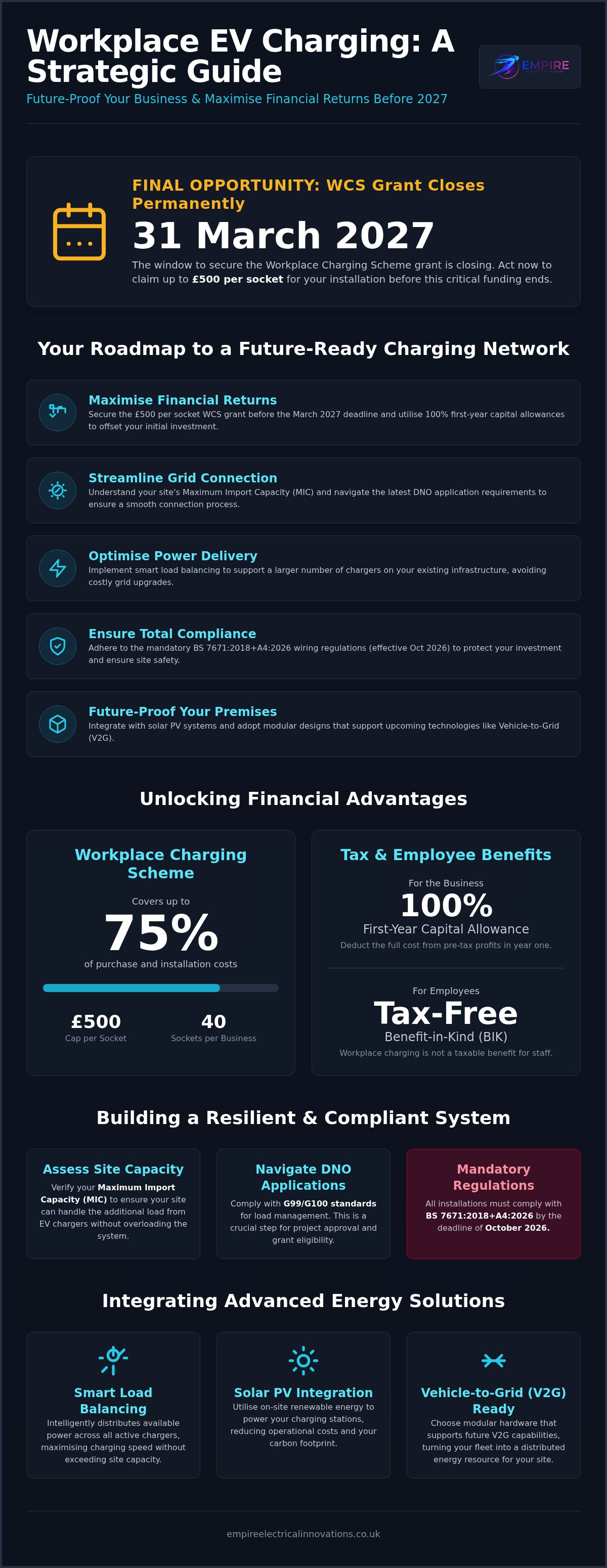
With the Workplace Charging Scheme (WCS) grant confirmed to close permanently on 31 March 2027, the window for UK firms to secure up to £500 per socket is rapidly narrowing. You likely recognise that a workplace EV charger installation is no longer a luxury; it is a strategic necessity for talent retention and corporate responsibility. However, the prospect of navigating complex DNO applications and the new BS 7671:2018+A4:2026 wiring regulations can feel like a technical minefield. It's a significant investment, and the fear of choosing obsolete technology or facing unexpected grid upgrade costs is a valid concern for any forward-thinking director.
This guide provides the technical and financial clarity you need to deploy a resilient, future-ready charging network. We'll show you how to secure the maximum available funding and take advantage of 100% first-year capital allowances to offset your initial expenditure. You will discover how to integrate charging with solar PV systems and manage employee access fairly whilst maintaining site safety. By the end of this article, you'll have a clear roadmap to transform your parking facilities into a high-performance energy asset that supports your business goals well into the next decade.
Table of Contents
The Business Case for Workplace EV Charger Installation
A workplace EV charger installation is no longer a peripheral facility; it's a sophisticated energy asset. In 2026, the definition of charging has evolved from simple hardware to a fully managed energy service. This shift reflects a move towards data-driven infrastructure that balances grid demand with operational needs. By deploying an electric vehicle charging station, firms gain granular control over their energy consumption whilst providing a vital utility to their workforce. Beyond the technical utility, this infrastructure serves as a visible commitment to corporate responsibility and modern operational standards.
The 2026 regulatory environment has sharpened the focus on electrification. With local clean air zones expanding across the UK and ESG targets becoming mandatory for many supply chains, the ability to support zero-emission transport is a commercial necessity. Employees now view on-site charging as a critical benefit, significantly reducing "range anxiety" for those unable to charge at home. This facility is a proven tool for talent retention. Furthermore, high-quality charging infrastructure increases commercial property value and offers potential revenue streams through public or visitor charging tariffs during out-of-office hours.
Financial Incentives and Tax Advantages
The financial landscape for 2026 remains highly favourable for early adopters. The Workplace Charging Scheme (WCS) currently provides up to 75% of the cost of purchase and installation, capped at £500 per socket. This grant is available for up to 40 sockets per business, but it's vital to note the scheme is confirmed to close permanently on 31 March 2027. Acting now secures this capital injection before the deadline.
Tax efficiency extends beyond the initial grant. Businesses can claim a 100% first-year capital allowance, allowing the full cost of the installation to be deducted from pre-tax profits. For employees, workplace charging is a tax-free benefit. It doesn't trigger Benefit-in-Kind (BIK) liabilities, even when charging a personal vehicle, provided the service is available to all staff. This creates a powerful, cost-neutral incentive for your team to transition to electric transport.
Enhancing Corporate Sustainability
Integrating EV charging into your premises directly addresses Scope 3 emissions. By supporting commuter electrification, firms can document significant reductions in their overall carbon footprint. This alignment is essential for maintaining ISO 14001 standards or achieving B Corp certification. In regions like the Home Counties, specialised commercial EV charger installation Hertfordshire projects are already forming the backbone of local green initiatives. These installations demonstrate that your business is prepared for a low-carbon future whilst contributing to the stability of the local electrical grid through smart, managed demand.
Assessing Capacity and Navigating DNO Applications
Before investing in hardware, you must understand your site's electrical ceiling. A workplace EV charger installation isn't a standalone appliance; it's a significant new load on your distribution network. Your Maximum Import Capacity (MIC) defines the total power your site can draw from the grid. If your current peak loads, such as air conditioning, machinery, and lighting, already sit near this limit, adding multiple 7kW or 22kW chargers will likely exceed your allowance. This makes the Distribution Network Operator (DNO) the ultimate gatekeeper of your project.
We distinguish between G99 and G100 applications based on your site's technical requirements. Whilst G99 is often associated with larger scale generation, G100 is the crucial standard for technical load management. This ensures your chargers don't trip the main fuse or violate the terms of your connection agreement. Adhering to these standards is also a prerequisite for the UK Government's Workplace Charging Scheme, which mandates smart-charging capabilities for all grant-funded units.
The Site Survey: What We Look For
A professional survey is the foundation of a reliable installation. We don't just look at where the chargers will sit; we evaluate the existing distribution board for spare capacity and physical space. Our specialists assess cable routes to minimise disruptive groundworks or expensive ducting. We also identify optimal locations for future solar PV integration or battery storage hubs, ensuring your infrastructure can scale as your fleet grows. This methodical approach prevents costly "re-work" and ensures your system remains compliant with the latest BS 7671 standards.
Working with Regional DNOs
In Hertfordshire and London, UK Power Networks (UKPN) manages the infrastructure. Navigating their requirements is a specialist task. DNO response times for a connection quote can range from 5 to 65 working days, so early engagement is vital. If the local grid is at capacity, a transformer upgrade might be required. In these scenarios, we explore alternatives like active load management or battery buffering to avoid six-figure infrastructure costs. Empire manages the entire application process, including the mandatory Letter of Authority and Head of Terms required for larger connections since June 2026. To begin your transition with a precise technical assessment, you can request a bespoke site survey from our engineering team.
Smart Charging and Renewable Energy Integration
A modern workplace EV charger installation requires more than just a connection to the grid. Legacy "dumb" chargers, which draw a constant, unmanaged current, are unsuitable for commercial environments where multiple vehicles charge simultaneously. Smart, networked hardware allows for dynamic load management. This technology ensures that your infrastructure never exceeds the site's electrical capacity by distributing available power across all active sockets based on priority or battery levels. It's a methodical way to ensure site safety whilst maximising charging speed.
Load balancing is the technical solution to grid constraints. It enables you to install ten chargers on a supply that would traditionally only support three. By intelligently throttling power during peak periods, you avoid the prohibitive costs of a substation upgrade whilst ensuring every vehicle is sufficiently charged by the start of the next shift. This data-led approach provides the stability needed for reliable fleet operations.
Leveraging Solar PV for Fleet Charging
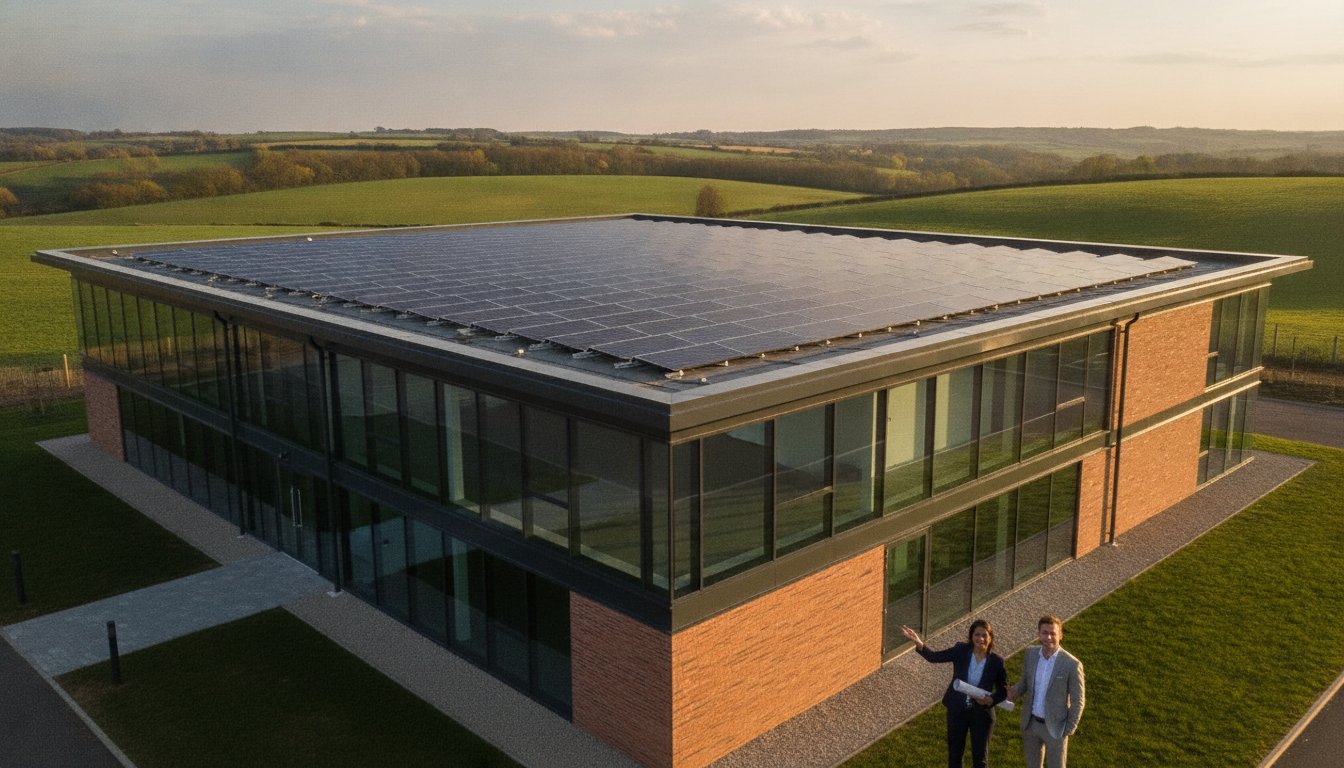
Integrating on-site generation transforms your car park into a self-sustaining fuel station. We calculate the potential for solar-to-EV energy transfer by analysing your roof orientation and daytime fleet dwell times. Utilising solar PV for commercial buildings provides the cheapest possible fuel source for your company vehicles by bypassing grid retail prices. Bespoke designs for solar carports and warehouse arrays allow you to harvest energy directly where it's consumed, significantly reducing the "cost per mile" for your business.
The Importance of Battery Storage
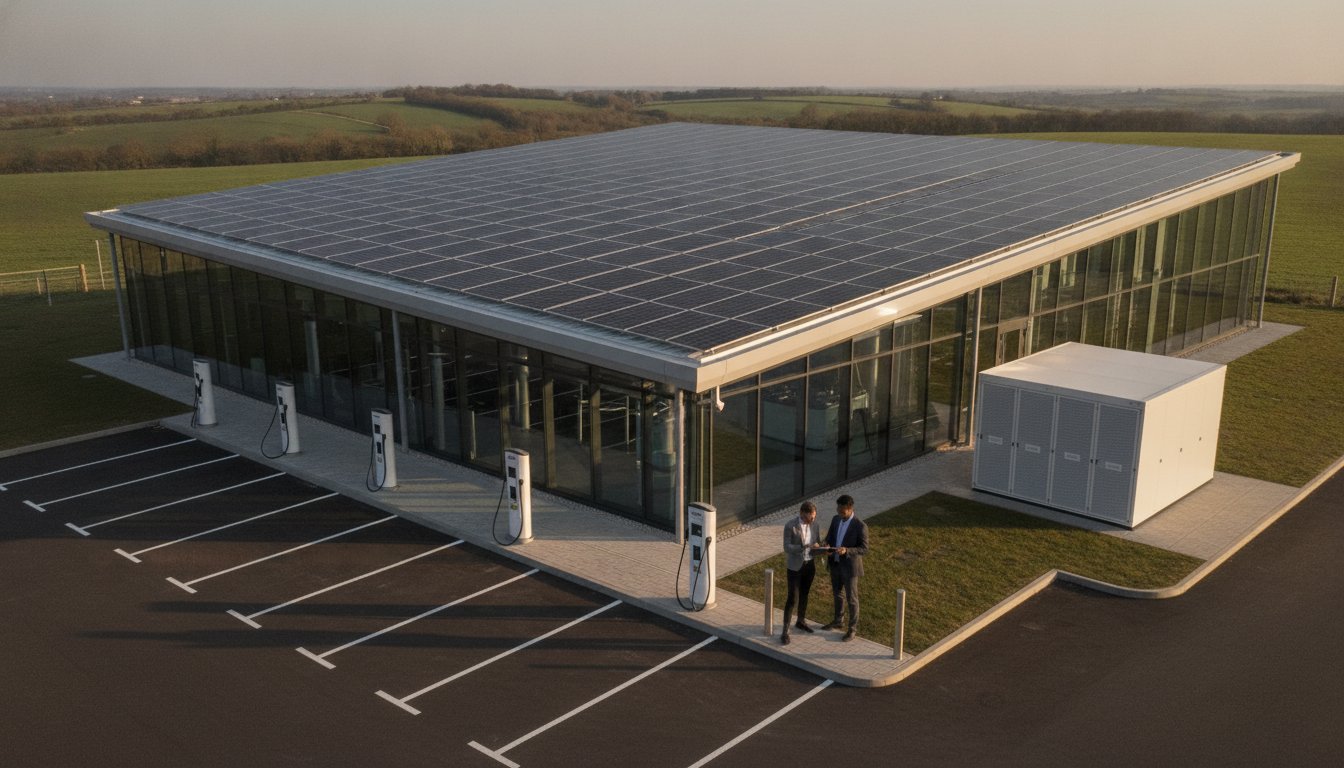
Battery storage systems provide the necessary buffer to manage the intermittency of solar power. By storing excess generation during the day, you can support evening fleet charging or supplement peak-time usage when grid tariffs are at their highest. A solar battery installation Hertfordshire acts as a vital buffer for the local grid, preventing surges and enabling "peak shaving." This industrial-scale storage is particularly effective for high-demand business parks, allowing for a larger workplace EV charger installation than the local DNO capacity would otherwise permit.
The Step-by-Step Installation and Commissioning Process
Moving from the design phase to the physical build requires a disciplined, project-managed approach. A successful workplace EV charger installation relies on a meticulous timeline to manage expectations and ensure minimal operational downtime. The process begins with the preparation of the site, followed by the physical mounting of hardware and the critical integration of data services. This methodical sequence ensures that the transition from a blueprint to the "first plug-in" is seamless and technically sound.
Robust data connectivity is a frequently overlooked component of commercial charging. Without a stable Wi-Fi, 4G, or Ethernet link, smart chargers cannot perform essential functions like dynamic load balancing or usage reporting. We prioritise hardwired Ethernet connections for commercial environments to ensure 100% uptime. This stability is vital for sites that require accurate billing data or those integrated with broader building management systems.
Civil Works and Infrastructure
High-quality civil works form the backbone of your charging network. This is where technical precision is most visible. Utilising the expertise of telecoms ducting contractors Hertfordshire ensures that all cabling is protected and the installation remains tidy. We focus on minimising disruption to car park operations by using phased groundwork schedules. A key strategy for future-proofing is the installation of additional "spare" ducting during this phase. It's a cost-effective way to allow for future network expansion without the need for repeated, expensive excavations as your EV fleet grows.
Commissioning and Software Setup
Once the hardware is mounted, the commissioning phase begins. This involves configuring the back-end management software to handle billing, reporting, and access control. We set up RFID access or app-based charging for staff and visitors, ensuring that usage is tracked accurately. Final safety checks are the most critical part of this stage. Every workplace EV charger installation must undergo rigorous testing to ensure full compliance with the IET Wiring Regulations, specifically the mandatory Section 722 requirements for electric vehicle charging. The process concludes with a formal handover to your facility management team, including a full demonstration of the software dashboard and the provision of all compliance certification. To begin planning your site's physical transformation, book a technical consultation with our engineering department.
Future-Proofing Your Commercial EV Charging Strategy
The final stage of a workplace EV charger installation involves looking beyond the immediate horizon. As we move towards 2030, the role of the electric vehicle is shifting from a simple transport method to a dynamic energy participant. Vehicle-to-Grid (V2G) technology is the next significant frontier. This allows businesses to use their fleet batteries as mobile energy storage units, discharging power back into the building or the grid during peak tariff periods. Selecting hardware that supports ISO 15118 protocols today ensures your business is ready for these revenue-generating opportunities tomorrow.
Reliability is the currency of successful infrastructure. A charging network is only valuable if it is operational. Ongoing Operation and Maintenance (O&M) contracts are essential for commercial sites to ensure maximum uptime. Regular firmware updates, physical safety inspections, and remote diagnostics prevent the "out of order" signs that frustrate employees and disrupt fleet logistics. A partnership with a regional specialist provides a level of responsiveness that national "one-size-fits-all" providers often struggle to match, particularly when technical faults require an on-site presence.
Scalability and Modular Design
A disciplined approach to design involves preparing for a full-fleet future. Even if you only require two chargers today, your underlying infrastructure should be built for twenty. This means installing oversized ducting and distribution boards with sufficient physical space for additional switchgear. Such foresight avoids the need for disruptive civil works in three years' time. For those involved in new commercial developments, compliance is mandatory. The 2026 Developer’s Guide to Part L outlines the specific requirements for charge point provision and cable routes in non-residential buildings. Adhering to these standards from the outset protects your property's value and ensures long-term regulatory compliance.
The Empire Electrical Innovations Difference
Our approach is defined by quiet authority. We are methodical, disciplined, and focused on the technical precision that commercial infrastructure demands. We don't rely on flashy marketing; we rely on workmanship and clear communication. With deep roots in Hertfordshire, Bedfordshire, and Buckinghamshire, we understand the specific local grid challenges and DNO requirements of the region. We view every workplace EV charger installation as a long-term partnership rather than a simple transaction. Our role is to act as your trusted consultant, guiding you through the complexities of energy integration with confidence. We invite you to begin this process with a collaborative start by booking a bespoke expert site survey to assess your premises' unique requirements.
Securing Your Energy Independence
A successful workplace EV charger installation is a multi-layered project that requires a deep understanding of grid capacity, technical compliance, and renewable integration. By acting before the March 2027 grant deadline, your business can significantly reduce capital expenditure whilst establishing a high-performance energy hub. It's a strategic move that protects your premises from rising energy costs and grid constraints through smart load management and on-site solar generation.
As accredited OZEV installers and specialists in solar-integrated charging, Empire Electrical Innovations provides the methodical, disciplined support needed for complex commercial sites. We offer local expertise across Hertfordshire, Bedfordshire, and Buckinghamshire. Our team ensures your infrastructure is compliant with the latest October 2026 wiring regulations, providing a secure foundation for your fleet's electrification. It's about workmanship and clear communication, not just hardware.
Book your expert site survey for workplace EV charging to begin your transition with a trusted technical partner. We look forward to helping you build a resilient, sustainable future for your business.
Frequently Asked Questions
Do I need planning permission for workplace EV charger installation?
Planning permission is generally not required for most workplace EV charger installation projects under Permitted Development rights updated in May 2025. This exemption applies provided the units aren't located in sensitive areas like listed buildings or conservation zones. We always verify the specific status of your site during our technical assessment to ensure full compliance with local authority guidelines before any physical work commences on the premises.
How much does it cost to install a commercial EV charging point in 2026?
The total investment for a commercial installation depends on hardware specifications, the extent of civil works, and required DNO connection upgrades. Factors such as the distance from the distribution board and the choice between 7kW or 22kW units significantly influence the final budget. We don't provide fixed pricing without a survey; instead, we deliver bespoke, transparent quotes following a comprehensive technical site assessment of your infrastructure.
What is the difference between AC and DC charging for businesses?
AC charging (7kW to 22kW) is the standard for staff vehicles parked for several hours during the working day. DC rapid charging (50kW+) is designed for fleet depots or visitor bays where a fast turnaround is essential. AC units are more cost-effective to install and maintain, making them the preferred choice for most office environments where employees remain on-site for extended periods.
Can I charge my employees for the electricity they use at work?
You can charge employees for electricity usage using networked back-end software that tracks individual consumption via RFID tags or mobile apps. Many firms choose to offer charging as a free benefit, which currently carries no Benefit-in-Kind (BIK) tax liability. Alternatively, you can set "at-cost" tariffs to recover electricity expenses whilst still providing a significantly cheaper rate than public rapid-charging networks.
How long does a typical workplace EV charger installation take?
A typical physical installation takes between one and five days depending on the number of sockets and the complexity of the cable routes. However, the total project timeline is often extended by the DNO application process, which can take up to 65 working days for a quote alone. We manage these administrative hurdles in parallel with our design phase to ensure the quickest possible commissioning.
What happens if our building reaches its maximum electrical capacity?
If your building reaches its maximum electrical capacity, we implement active load management or integrate battery storage to buffer demand. These solutions allow you to install more charging points than your current supply would traditionally permit by intelligently throttling power during peak periods. This methodical approach avoids the high costs and long lead times associated with physical substation upgrades or expensive grid reinforcement.
Are there still grants available for workplace EV charging in the UK?
Yes, the Workplace Charging Scheme (WCS) remains open until 31 March 2027, providing up to £500 per socket for up to 40 units. Additionally, businesses can benefit from a 100% first-year capital allowance for green infrastructure. These incentives significantly offset the initial cost of a workplace EV charger installation, provided you use an OZEV-authorised installer like Empire to carry out the work.
How do I manage charging for a fleet of electric vans versus staff cars?
Managing a mixed fleet requires sophisticated back-end software to prioritise electric van charging over staff cars. Vans often require higher power levels and guaranteed "ready-by" times for morning departures. We configure your management dashboard to assign different priorities and pricing structures to various user groups, ensuring your operational fleet is always fully charged without compromising the charging benefits offered to your office-based staff.

Comments