
Commercial EV Charger Installation London: The 2026 Strategic Guide
- Empire Communications
- Aug 16
- 11 min read

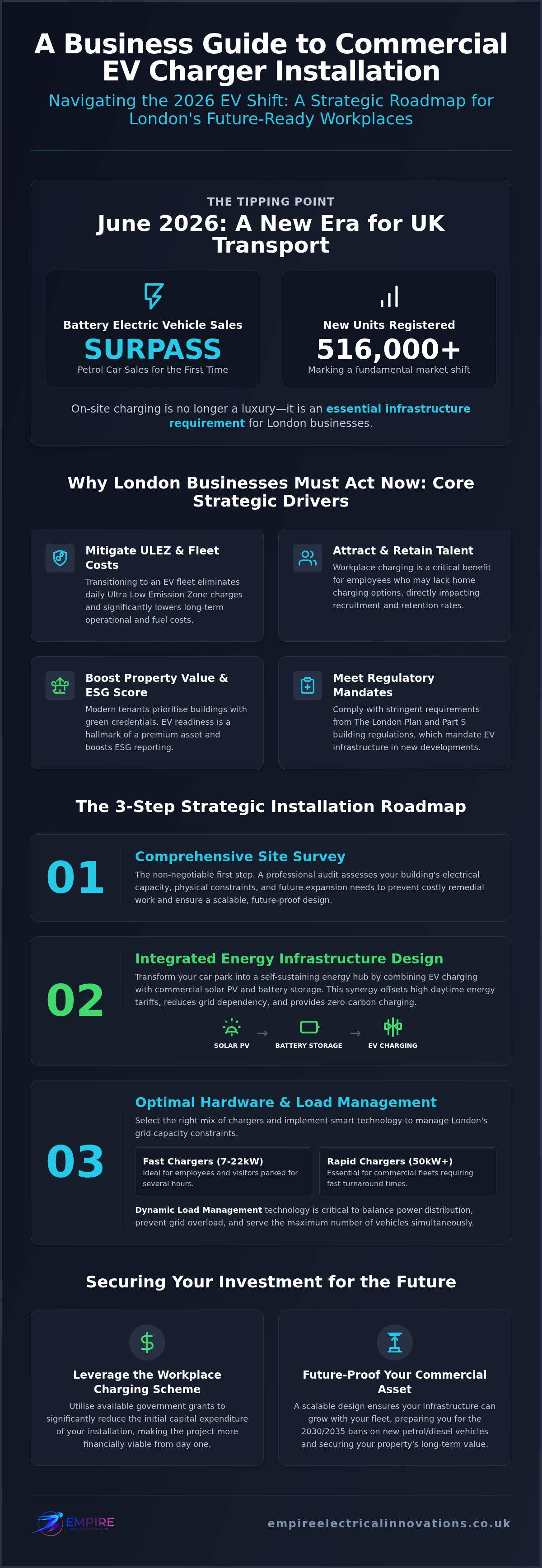
In June 2026, battery electric vehicle sales in the UK officially surpassed petrol car sales for the first time, with over 516,000 new units registered. For London businesses, this shift represents a critical turning point in operational strategy. You likely recognise that providing charging facilities is no longer a luxury but a fundamental requirement for employee retention and tenant satisfaction. However, the practicalities of commercial EV charger installation London often present significant hurdles, particularly when dealing with the restricted electrical capacity of the city's historic building stock and the complexities of multi-user management.
We understand that a successful rollout requires more than just hardware; it demands a bespoke, future-ready infrastructure that aligns with current UK standards. This guide provides a definitive roadmap to help you design a compliant network while maximising your return on investment. We will explore the latest 2026 grant updates, navigate the intricacies of Part S building regulations, and demonstrate how smart energy management can prevent grid overload. By the end of this article, you will have a clear strategy to transform your parking assets into high-value, sustainable infrastructure.
Table of Contents
Navigating the London Commercial EV Landscape in 2026
London's Ultra Low Emission Zone (ULEZ) has transitioned from a local policy to a primary driver of corporate procurement. For businesses operating within the capital, internal combustion engine (ICE) fleets are now a mounting financial liability. A strategic commercial EV charger installation London project provides the necessary infrastructure to mitigate daily charges and maintain operational efficiency. The rapid acceleration of UK plug-in vehicle adoption has left many office managers playing catch-up, yet those who invest early are securing a significant competitive advantage.
Workplace charging has shifted from a fringe benefit to a core business requirement. As more employees transition to electric mobility, the availability of reliable on-site charging directly influences recruitment and retention rates. Beyond personnel, these installations impact property valuations. Modern tenants prioritise buildings with established green credentials, viewing EV readiness as a hallmark of a premium commercial asset. Precision in planning ensures these assets remain relevant as technology evolves.
London Regulatory Pressures and ESG Compliance
The London Plan dictates stringent requirements for new developments, mandating that charging infrastructure is integrated from the design phase. Visible green infrastructure, such as solar-integrated charging hubs, serves as a powerful signal of a company's commitment to sustainability targets. ESG reporting in the context of EV charging is the formal process of documenting energy usage and carbon savings to demonstrate environmental accountability to investors and regulators. Meeting these mandates requires a methodical approach to data collection and reporting.
The Shift from Personal to Commercial Fleet Charging
Managing a commercial fleet in London presents unique logistical hurdles. High-density urban living means many employees lack the off-street parking required for home charging; this makes workplace provision their only reliable option. This creates a return-to-base requirement that places immense pressure on a building's electrical load. Navigating this shift requires a professional approach to grid applications and load balancing. With the 2030 and 2035 bans on new petrol and diesel vehicles approaching, businesses must act now to avoid a future bottleneck. A scalable commercial EV charger installation London ensures that today's infrastructure can support tomorrow's fleet growth without requiring a complete grid overhaul later. We focus on bespoke designs that account for these specific urban constraints.
Strategic Infrastructure Design: Beyond the Basic Charge Point
A successful commercial EV charger installation London project requires a shift in perspective. It is not a standalone utility. It is a strategic energy asset. A professional site survey is the non-negotiable first step. We assess your building's current electrical capacity, physical constraints, and future expansion needs. Without this audit, you risk costly remedial works or infrastructure that becomes obsolete within months. We look beyond the immediate requirement, ensuring your cable routes and switchgear can accommodate the inevitable growth of your electric fleet. Planning for scalability today prevents the need for disruptive and expensive groundwork tomorrow.
The Synergy of Solar, Battery, and EV Charging
Integrating EV chargers with commercial solar PV transforms your car park into a self-sustaining energy hub. This approach aligns with the official government strategy for decarbonising transport and reducing grid dependency. Solar energy offsets peak daytime electricity tariffs, which are notoriously high in London's business districts. Battery storage systems act as a critical buffer. They store excess solar generation to support high-power DC charging sessions during overcast periods or at night. This setup provides zero-carbon charging whilst insulating your business from volatile energy markets. It reduces your reliance on the National Grid and ensures your charging network remains operational even during peak demand windows.
Load Management and Grid Capacity Constraints
London's grid is under immense pressure. Many commercial buildings lack the spare capacity for multiple rapid chargers. Dynamic load management is the solution. This technology monitors the building’s total power draw in real-time. It automatically adjusts the power sent to each vehicle to prevent circuit overloads or building-wide power outages. This intelligent balancing often bypasses the need for expensive substation upgrades. We also handle the complex DNO applications required for larger installations. A robust commercial EV charger installation London depends on this early-stage technical coordination. This methodical planning ensures compliance with technical standards whilst keeping project costs manageable. It's about finding the most efficient route to a fully functional network. If you're ready to explore how these systems can work for your site, our team can provide a bespoke infrastructure assessment tailored to your specific London location.
Selecting Hardware and Software for London Workplaces
Selecting the correct hardware for a commercial EV charger installation London requires a methodical assessment of your site's specific usage patterns. The choice between AC and DC technology is not merely a matter of speed; it is a fundamental design decision that affects both installation complexity and the user experience. In London's high-density commercial districts, hardware must be as durable as it is efficient. Vandal-resistant casings and weather-sealed components are essential for units located in public-facing or high-traffic areas. Longevity. Precision. Performance. These are the pillars of a reliable infrastructure.
AC vs. DC: Which Performance Level Fits Your Business?
AC charging units, typically ranging from 7kW to 22kW, are the logical choice for employees and residents who park for extended periods. These systems are easier to integrate into existing electrical frameworks and offer a reliable, cost-effective solution for long-stay parking. Conversely, DC rapid chargers are indispensable for commercial fleets and short-stay visitors requiring a significant top-up in under an hour. Whilst DC units involve more complex grid coordination, they are vital for maintaining the operational tempo of delivery services. To support these investments, businesses should consult the UK government's Workplace Charging Scheme, which provides financial support for compliant, smart-enabled hardware. We ensure every unit selected meets these rigorous standards for grant eligibility.
Software and Reporting for Property Managers
Modern charging networks rely on sophisticated back-office software to manage user access and financial transactions. Automation is key. Property managers can utilise these platforms to separate employee reimbursement from public billing, ensuring a seamless experience for all users. These systems provide real-time data on energy consumption and carbon reduction, which is critical for accurate ESG reporting. This data can be integrated directly into wider building management systems to optimise total site energy use. Smart charging also allows for remote diagnostics, reducing the need for on-site maintenance visits and ensuring your commercial EV charger installation London remains fully operational at all times. Choosing hardware that supports the Open Charge Point Protocol (OCPP) ensures your software remains flexible as your needs evolve. We prioritise future-ready systems that allow for easy hardware and software upgrades without requiring a complete infrastructure overhaul.
The Installation Process: Compliance, Grants, and Logistics
A professional commercial EV charger installation London is a disciplined sequence of technical milestones. It's not merely about mounting hardware; it's about integrating a high-voltage asset into a complex urban environment. We follow a methodical five-step process to ensure every project is delivered to the highest professional standards. This structured approach guarantees that your infrastructure is safe, compliant, and ready for immediate operation.
Step 1: Professional site survey. We conduct a rigorous electrical capacity audit to determine if your existing infrastructure can support the additional load.
Step 2: Grant navigation. We identify and apply for all relevant government incentives to reduce your capital expenditure.
Step 3: Groundworks and infrastructure. This phase involves physical trenching and the installation of telecoms ducting to ensure robust network connectivity for smart charging features.
Step 4: Physical installation and commissioning. Our specialists install the units and perform comprehensive electrical testing to verify performance.
Step 5: Handover and maintenance. We provide staff training on the management software and establish a periodic maintenance schedule.
Securing Government Funding and Grants
Financial incentives remain a vital component of the transition to electric mobility. As of August 2026, the Workplace Charging Scheme (WCS) provides up to £500 per socket, an increase from the previous £350 rate established on April 1, 2026. This scheme is confirmed to run until March 31, 2027, and covers up to 75% of the total purchase and installation costs for up to 40 sockets. Specific grants are also available for SMEs, charities, and small accommodation providers to encourage wider adoption. OZEV-approved installers facilitate the grant process by managing the technical documentation and ensuring all hardware meets the stringent eligibility criteria required for a successful claim.
Ensuring Long-Term Safety and Compliance
Compliance is the foundation of our service. Every commercial EV charger installation London must adhere strictly to the latest IET Wiring Regulations (BS 7671). This ensures the safety of your employees, visitors, and the building itself. Beyond the initial setup, periodic testing is a legal necessity to maintain insurance validity and operational safety. In a high-traffic urban environment like London, physical security is equally important. We specify hardware with high impact resistance and integrated locking mechanisms to protect your assets from vandalism or unauthorised use. If you're ready to secure your site's future, you can book a professional installation consultation with our specialist team today.
Future-Proofing with Empire Electrical Innovations
At Empire Electrical Innovations, we believe that infrastructure is a long-term partnership rather than a one-off transaction. A successful commercial EV charger installation London depends on deep technical knowledge and a meticulous approach to commissioning. We don't just install hardware; we design integrated systems that grow with your business. Our extensive background in commercial EV charging infrastructure allows us to navigate the specific challenges of the London market, from grid constraints to regulatory compliance.
Connectivity is the backbone of modern smart charging. Our heritage in commercial telecoms infrastructure provides a unique advantage in ensuring your network remains stable and secure. We understand that a charger is only as good as its data connection. By utilising professional-grade ducting and high-bandwidth cabling, we eliminate the common connectivity issues that plague standard installations. This precision ensures that your reporting, billing, and load management software operate without interruption.
Bespoke London Solutions
London’s architectural diversity requires a tailored approach. Whether we are working with a historic office block in the City or a sprawling warehouse in a London business park, our designs are bespoke. We adapt our methods to suit the specific operational needs of different sectors, including schools, retail centres, and logistics hubs. For an educational facility, safety and accessible user-management are paramount; for a warehouse, the focus shifts to high-power DC turnover and fleet uptime. Our commitment to quiet authority means we deliver high-end workmanship with minimal disruption to your daily operations. To further enhance ROI, we specialise in solar battery installation, allowing you to capture and store energy to power your fleet whilst significantly reducing long-term overheads.
Start Your Journey
Building a resilient charging network begins with a professional assessment. Our specialist engineers offer free site surveys across London and the Home Counties to identify the most efficient route for your installation. Every project we undertake is backed by the Empire guarantee: compliance, precision, and performance. We don't just meet industry standards; we set them.
Transitioning to electric mobility is a significant milestone for any London business. We invite you to contact us for a collaborative consultation where we can discuss your specific requirements and design a roadmap for your transition. Let's build a future-proof charging network that adds lasting value to your property and supports your sustainability goals for 2026 and beyond.
Building Your Resilient London Charging Strategy
Navigating a commercial EV charger installation London requires more than just hardware selection. It demands a methodical approach to electrical capacity, regulatory compliance, and smart energy management. By integrating bespoke charging solutions with solar PV and battery storage, your business can bypass grid limitations whilst significantly reducing long-term operational costs. These systems aren't just utilities; they are strategic assets that enhance property value and employee satisfaction in an increasingly electric capital.
As OZEV Approved Installers and specialists in solar and battery integration, we provide the technical expertise required for complex urban projects. We serve London and the Home Counties with a focus on precision and professional standards. Our team ensures your project remains compliant with the latest wiring regulations whilst securing all eligible government funding. It's time to transform your parking facilities into a high-performance energy hub.
Book your professional site survey and bespoke quotation today. Transitioning your fleet is a significant step toward a cleaner, more efficient future.
Frequently Asked Questions
How much does commercial EV charger installation cost in London?
Industry data suggests a typical commercial EV charger installation London project ranges between £1,500 and £15,000 per charging point. For small workplaces installing one or two 7kW or 22kW units, costs usually fall between £2,500 and £3,500. These figures vary based on site conditions, required groundworks, and electrical upgrades. We recommend a professional survey to determine the exact infrastructure requirements for your specific London location.
What is the Workplace Charging Scheme (WCS) and is my business eligible?
The Workplace Charging Scheme is a voucher-based grant that supports businesses with the upfront costs of installing EV infrastructure. As of August 2026, the grant provides up to £500 per socket, covering 75% of total purchase and installation costs. Most UK businesses, charities, and public sector organisations are eligible for up to 40 sockets across multiple sites. This incentive is currently confirmed to remain active until March 31, 2027.
Can our building’s existing electrical supply handle multiple EV chargers?
Most commercial buildings in London have finite electrical capacity that may require management when adding multiple chargers. We utilise dynamic load balancing technology to monitor total power draw in real-time. This system automatically distributes available electricity to vehicles without overloading the building's main fuse. For larger installations, we manage the necessary applications with the Distribution Network Operator to ensure your supply is sufficient and compliant with national grid standards.
Do we need planning permission for commercial EV charging points in London?
Under permitted development rights updated in May 2025, most commercial EV installations do not require formal planning permission. Free-standing upstands are permitted up to a height of 2.7 metres in off-street parking areas. Wall-mounted units are also permitted provided the casing does not exceed 0.2 cubic metres. However, specific restrictions apply to listed buildings or sites in conservation areas, where a consultation with the local London planning authority is essential.
How long does the installation process typically take for a workplace?
A standard workplace installation typically takes between one and three days once the design and grid approvals are finalised. The timeline depends heavily on the complexity of required groundworks and the distance between the charging units and the main distribution board. Larger projects involving multiple rapid chargers or substation upgrades require longer lead times for equipment procurement and DNO coordination. We provide a detailed project timeline following your initial site survey.
What is the difference between tethered and untethered commercial chargers?
Tethered chargers feature a permanently attached cable, providing convenience for employees who use the same charging spot daily. Untethered units, or socketed chargers, require the driver to provide their own cable. This is often the preferred choice for commercial EV charger installation London projects in public-facing or multi-tenant environments. Socketed units are more versatile as they accommodate all vehicle types and are less prone to cable damage or vandalism in high-traffic areas.
How can we bill employees or the public for using our charging points?
Modern charging hardware utilises back-office software to automate billing and user access. You can set different tariffs for employees, visitors, or the general public using RFID cards or mobile apps. These systems track energy consumption per user and generate automated reports for reimbursement or tax purposes. This level of data visibility is crucial for ESG reporting and ensures that your infrastructure remains a self-sustaining asset rather than an overhead.
Why should we integrate solar panels with our EV charging station?
Integrating solar PV allows you to generate zero-carbon electricity on-site to power your fleet directly. This significantly reduces your reliance on the National Grid and protects your business from volatile energy prices. When combined with battery storage, you can store excess solar energy generated during the day to support high-power charging sessions at any time. This holistic approach maximises your return on investment whilst demonstrating a clear commitment to corporate sustainability goals.


Comments