
Commercial Solar Panel Installation Cost 2026: The Complete UK Business Guide

Reliable. Compliant. Future-ready. Most online calculators for commercial solar panel installation cost fail to account for the technical realities of the 2026 UK market, often ignoring London logistics and structural reinforcement needs. Relying on a generic estimate can lead to a significant discrepancy in your final capital expenditure. You've likely encountered conflicting data regarding 2026 VAT changes or how battery integration affects your payback period. It's difficult to build a business case when the financial variables feel like a moving target.
This guide provides a transparent framework to help you navigate these complexities with confidence. We'll examine the impact of high-efficiency cell technology, explain the permanent 100% Annual Investment Allowance, and detail how integrated EV infrastructure drives long-term value. You'll gain the clarity needed to compare quotes accurately and secure a robust ROI for your South East operations.
Table of Contents
The 2026 Commercial Solar Financial Landscape: Beyond Hardware Costs
Technical Specification Tiers: How Component Choice Dictates Investment
Regional Logistics and Structural Variables in London and the Home Counties
Financial Performance and Payback Modelling for UK Businesses
Procuring a Bespoke Commercial Energy Solution with Empire Electrical Innovations
The 2026 Commercial Solar Financial Landscape: Beyond Hardware Costs
The UK solar power landscape has matured significantly over the last decade. In 2026, calculating the commercial solar panel installation cost requires looking far beyond the price of silicon. Hardware costs have stabilised following global supply chain corrections, yet the total cost of ownership (TCO) now includes sophisticated integration layers. Modern businesses aren't just buying panels; they're investing in energy autonomy. This shift means that financial modelling must account for software, synchronisation, and long-term maintenance rather than just the initial purchase price.
Small office rooftops and large-scale distribution centres face different financial realities. Whilst hardware is cheaper per watt for larger arrays, the complexity of grid synchronisation and structural compliance often increases. A standalone PV approach is becoming obsolete. The 2026 market favours "Integrated Energy Ecosystems" that combine generation, storage, and demand management into a single financial model. This approach ensures that energy is not just generated but utilised with maximum efficiency, protecting the business against future price volatility.
The Integrated Infrastructure Budgeting Model
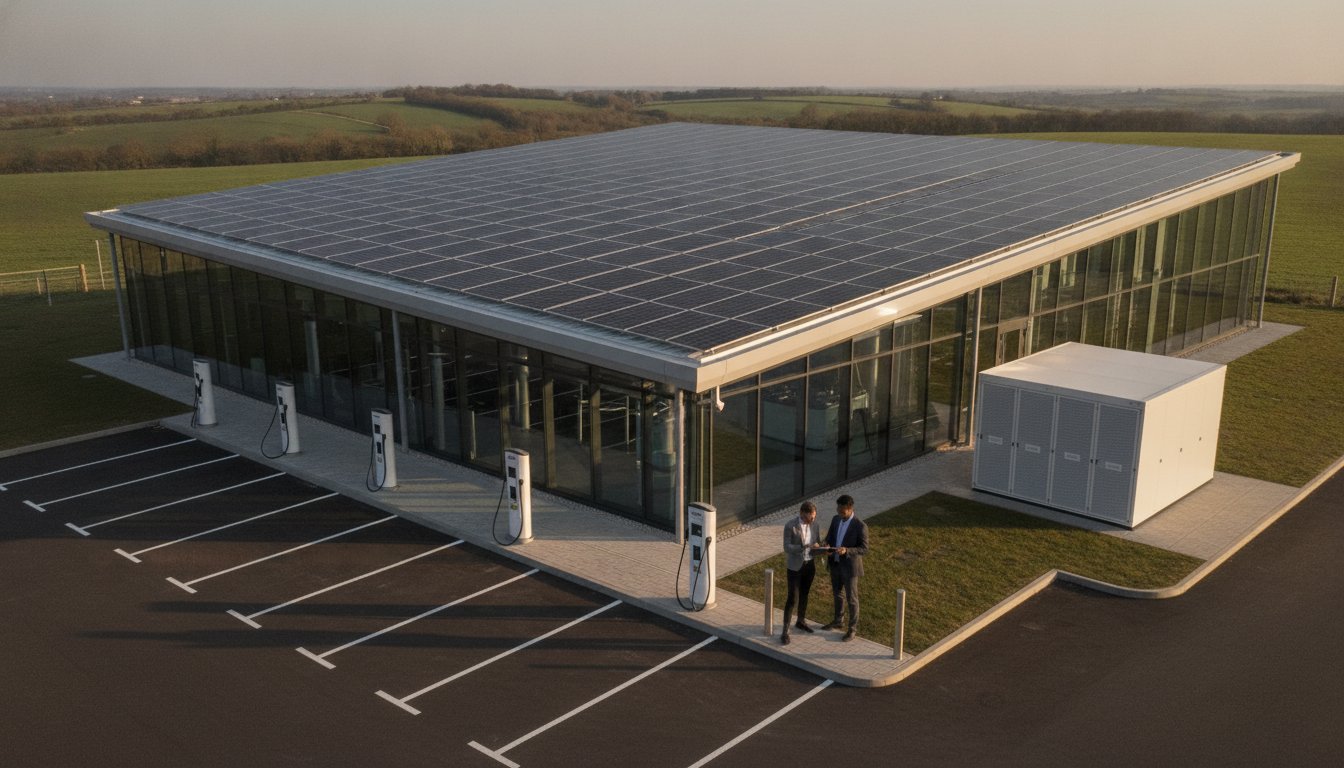
Smart. Scalable. Secure. Designing a system that includes commercial EV charger installation from the outset is now standard practice for UK firms. Integrating solar PV with EV infrastructure and battery storage creates a synergy that accelerates ROI. The cost-benefit of simultaneous battery storage commissioning is clear; it allows for higher self-consumption rates during peak tariff periods. It's often 40% more cost-effective to install excess capacity during the initial phase than to upgrade a constrained system three years later. Future-proofing your technical infrastructure today prevents redundant labour costs tomorrow.
Hard Costs vs Soft Costs in Commercial Projects
Hardware represents only a portion of the total commercial solar panel installation cost. Hard costs include high-efficiency N-Type panels, hybrid inverters, and specialised mounting systems. However, soft costs often define the ultimate success and longevity of a project. These essential expenses include:
Structural engineering reports: Ensuring roof integrity for the added weight of the array.
DNO applications: Managing the formal G99 process with the local grid operator.
Bespoke design fees: Creating a tailored system that matches your specific half-hourly load profile.
A bespoke design is a critical investment. It ensures the system performs to its technical potential for 25 years or more. Choosing a standardised "kit" may seem cheaper initially, but it often leads to underperformance or non-compliance with commercial insurance standards. Professional project management ensures that these soft costs are handled precisely, providing a seamless transition to renewable energy.
Technical Specification Tiers: How Component Choice Dictates Investment
Hardware selection is the primary lever for adjusting the commercial solar panel installation cost. In 2026, the market has shifted decisively toward N-Type cell technology, such as TOPCon and Heterojunction (HJT) modules. These cells offer an efficiency premium, typically ranging from 22% to 24.1%, which far exceeds the older P-Type standards. Whilst the upfront cost for N-Type modules is higher, the investment is justified by superior temperature coefficients and significantly lower annual degradation rates. For a business, this translates to more kilowatt-hours generated per square metre over the system's lifespan.
Inverter architecture also plays a vital role in financial modelling. String inverters remain the cost-effective choice for large, unobstructed rooftops. However, micro-inverters or DC optimisers are increasingly specified for complex commercial environments. These components allow for panel-level monitoring and mitigate the impact of shading or debris. While they increase the initial expenditure, they often provide a better long-term yield. Every technical choice should be validated through a bespoke site survey to ensure the hardware aligns with your operational energy profile.
Panel Efficiency and 25-Year Degradation Costs
Efficiency dictates footprint. High-efficiency panels (22%+) reduce the total number of modules required to reach a target output. This reduction directly lowers the cost of mounting hardware and decreases the labour time required for installation. Beyond the initial build, the value lies in the performance warranty. Tier 1 manufacturers now offer 30-year linear performance guarantees, ensuring the system remains a bankable asset for decades. Choosing panels with a lower degradation rate protects your ROI against the rising costs of grid-supplied electricity.
Smart Energy Management and Monitoring Systems
Modern commercial arrays are no longer passive assets. Integrating your solar system with a Building Management System (BMS) allows for real-time demand response and load shifting. This level of control is essential for businesses looking to maximise the Smart Export Guarantee (SEG) by strategically timing energy exports.
Storage chemistry has also standardised. Lithium Iron Phosphate (LiFePO4) is the 2026 commercial benchmark due to its safety profile and high cycle life. Working with specialist GivEnergy battery storage installers ensures that your generation and storage layers are perfectly synchronised. This integration allows the system to store surplus midday generation for use during expensive peak evening periods, further insulating the business from market volatility.
Regional Logistics and Structural Variables in London and the Home Counties
National averages often provide a misleading picture of the commercial solar panel installation cost. For businesses operating across Hertfordshire, Bedfordshire, Cambridgeshire, and Buckinghamshire, regional economic factors introduce a 15-25% premium on labour and logistics. Operating in high-density urban environments within these counties requires meticulous planning. Delivery windows are frequently restricted, and the cost of parking permits or local access charges for installation teams must be factored into the initial budget. These are not hidden costs; they are the technical realities of delivering high-end infrastructure in these key regional hubs.
Access and scaffolding represent another significant variable. A single-storey warehouse in a rural setting presents fewer challenges than a multi-storey office block in a busy Home Counties town centre. Scaffolding requirements for high-rise installations involve pavement licenses and complex safety hoardings, particularly when working over public thoroughfares. Roof material also dictates the mounting strategy. Metal standing seam roofs allow for efficient clamping, whereas flat roofs often require ballasted systems to maintain the integrity of the waterproof membrane. Each variable requires a precise technical response to ensure long-term system stability.
Structural Integrity and Surveying Costs
Safety. Compliance. Standards. A professional structural survey is a non-negotiable CAPEX item for any commercial project. You cannot safely install a large-scale array without first verifying the roof's capacity for dead loads and wind uplift. Older commercial properties in the Home Counties may require structural reinforcements before an installation can proceed. When planning your array, it is also vital to consider the technical trade-offs between on-roof vs in-roof solar panels. Whilst in-roof systems offer a flush, aesthetic finish favoured in sensitive planning zones, they often command higher labour costs compared to traditional on-roof mounting.
Grid Connection and G99 Application Fees
Navigating the District Network Operator (DNO) landscape is a critical phase of the project. Any system exceeding 3.68kW per phase requires a formal G99 application. This is a technical negotiation, not just an administrative task. According to industry insights from Solar Energy UK, early engagement with the DNO is essential to identify potential grid constraints. If the local network requires reinforcement to handle your exported energy, the DNO may levy significant upgrade fees. Working with a contractor like Empire Electrical Innovations, who understands complex telecoms and electrical infrastructure, ensures these applications are managed with the precision required to avoid unnecessary delays or inflated connection costs.
Financial Performance and Payback Modelling for UK Businesses
Generating your own power is a strategic financial decision. In 2026, the commercial solar panel installation cost is best viewed through the lens of avoided costs and tax efficiency. Typical payback periods for commercial systems now range between four and seven years, with annual returns on investment (ROI) reaching up to 45% for energy-intensive operations. These projections are underpinned by 2026 electricity price forecasts, which continue to show volatility. By locking in a fixed cost for generation today, businesses create a hedge against future market surges, transforming a variable operational expense into a predictable capital asset.
Tax efficiency remains a primary driver for UK commercial solar adoption. Under the permanent Annual Investment Allowance (AIA), businesses can deduct 100% of qualifying expenditure on solar panels from their taxable profits in the year of purchase. For companies subject to a 25% corporation tax rate, this effectively provides a tax saving of 25% of the total system cost. For projects exceeding the £1 million AIA threshold, the 50% First Year Allowance (FYA) provides an additional mechanism for immediate relief. These incentives significantly lower the net commercial solar panel installation cost, accelerating the point of break-even.
The "Self-Consumption" factor is the most critical variable in your payback model. While the Smart Export Guarantee (SEG) provides a secondary revenue stream, the greatest value comes from using energy on-site. As of May 2026, top SEG rates have reached 25p/kWh from specialist providers, while standard rates from major suppliers like ScottishPower sit around 6p/kWh. However, since importing grid electricity remains significantly more expensive than these export rates, every kilowatt-hour consumed on-site represents a direct saving at the full retail price. Request a bespoke energy consultation to verify your potential ROI based on your specific half-hourly usage data.
Incentives and Funding in the South East
Regional support remains robust for businesses in the Home Counties. Various local authority grants are available for firms in Bedfordshire and Cambridgeshire that are looking to decarbonise. It's essential to review the Solar Panel Grants Bedfordshire: The 2026 Checklist to see if your project qualifies for regional funding. For businesses that prefer to preserve capital, Power Purchase Agreements (PPAs) offer a zero-CAPEX alternative, where a third party owns the system and sells the power back to the business at a discounted rate.
The Payback Curve of Battery Integration
Battery storage is no longer an optional add-on; it's a performance multiplier. By capturing surplus midday generation, batteries protect businesses from peak-time tariff surges that often occur during late afternoon shifts. This integration is particularly valuable for companies transitioning to a commercial EV fleet. Using stored solar energy to charge vehicles overnight or during peak periods dramatically lowers the total cost of transport. The "opportunity cost" of delaying an installation in 2026 is high; every month without solar is a month of exposure to unhedged energy prices and missed capital allowances.
Procuring a Bespoke Commercial Energy Solution with Empire Electrical Innovations
Precision. Performance. Partnership. At Empire Electrical Innovations, we recognise that a generic approach to renewable energy rarely delivers the promised ROI. We avoid "cookie-cutter" commercial kits because they fail to account for the unique operational rhythms of your business. A system designed for a refrigerated warehouse in Hertfordshire will differ fundamentally from one intended for a multi-storey office in London. By focusing on bespoke engineering, we ensure that your commercial solar panel installation cost is a precise investment in your specific infrastructure needs.
Compliance remains the foundation of our service. As a specialist contractor, we maintain full MCS accreditation and RECC membership. These aren't just badges of quality; they are essential requirements for commercial insurance and for accessing the Smart Export Guarantee. Beyond the installation phase, we provide long-term support through structured Operation and Maintenance (O&M) programmes. Annual O&M costs for commercial systems typically range between £7 and £15 per kWp. This proactive care protects your 25-year performance warranty and ensures the system operates at peak technical efficiency.
The Empire Survey and Design Process
Methodical. Disciplined. Transparent. Our process begins with a comprehensive site survey where we model your specific energy load profile. We don't just look at your roof; we analyse your half-hourly meter data to size the array for maximum self-consumption. Transparency in quoting is a core pillar of our "quiet authority" approach. When we provide a fixed-price quotation, it includes all technical variables, from scaffolding and access logistics to DNO grid applications. You won't encounter hidden "extra" costs mid-project. Our commitment to high-end workmanship standards ensures that every component is integrated seamlessly into your existing electrical and telecoms infrastructure.
Starting Your 2026 Energy Transformation
Organising a feasibility study is the first step toward energy autonomy. For businesses in Hertfordshire, London, or the Home Counties, this study provides the data-driven evidence needed to secure board-level approval. We guide you through the transition, ensuring your premises are prepared for the physical and technical integration of PV, battery storage, and EV infrastructure. For a deeper look at the procurement process, refer to our Professional Solar Panel Installation in Hertfordshire: Buyer’s Guide.
The 2026 energy market rewards businesses that take a future-proofed approach to their technical assets. By choosing a partner that values workmanship over empty marketing promises, you ensure that your commercial solar panel installation cost delivers a robust, compliant, and high-performing energy ecosystem for decades to come. Contact our specialist team today to begin your bespoke site assessment.
Securing Your Business Energy Future
Expertise. Longevity. Precision. Investing in renewable energy in 2026 requires a shift from viewing solar as a standalone product to seeing it as a core part of your technical infrastructure. We've explored how the commercial solar panel installation cost is defined by the synergy of high-efficiency N-Type panels, battery storage, and EV charging. By leveraging permanent tax allowances and prioritising on-site self-consumption, your business can lock in long-term energy security and a predictable ROI.
As MCS Accredited specialist installers with deep expertise in London and South East infrastructure, we focus on compliance and future-proofed design. Our systems are backed by comprehensive 25-year performance guarantees, ensuring your asset remains bankable for decades. It's time to move beyond generic estimates and secure a solution tailored to your operational load profile. Request Your Bespoke Commercial Solar Survey and Fixed-Price Quote to begin your energy transformation. Taking control of your power generation today is the most effective way to insulate your business from the uncertainties of tomorrow's energy market.
Frequently Asked Questions
How much does a 50kW commercial solar system cost in 2026?
Industry benchmarks for 2026 suggest that a 50kW system typically ranges between £660 and £1,200 per kilowatt installed. While larger 100kW arrays benefit from greater economies of scale, a 50kW system remains a highly efficient choice for medium-sized commercial premises. The final commercial solar panel installation cost for this scale depends heavily on the chosen panel efficiency and the complexity of the roof mounting system.
Can my business claim the full cost of solar panels against tax in 2026?
Yes, UK businesses can utilise the Annual Investment Allowance (AIA) to deduct 100% of the cost of solar PV from their taxable profits in the year of purchase. This permanent incentive applies to investments up to £1 million. For projects exceeding this limit, a 50% First Year Allowance is available, providing a significant immediate tax saving that effectively reduces the net expenditure of the installation.
What is the average payback period for a commercial solar installation in the UK?
The typical payback period for a commercial solar system currently sits between four and seven years. This timeline is driven by the high efficiency of modern N-Type cells and the rising cost of grid-supplied electricity. Depending on your specific energy consumption profile, businesses can expect an annual return on investment (ROI) ranging from 14% to 45%, making it one of the most secure capital investments available in 2026.
How much extra does scaffolding add to a commercial solar quote?
Scaffolding costs are highly variable and depend on building height, roof pitch, and the necessity for pavement licenses. For multi-storey commercial properties in urban centres like London, complex access requirements can represent a significant portion of the total budget. It's essential to ensure your quote includes a detailed access plan to avoid unexpected logistical expenses during the installation phase.
Are there specific solar grants for businesses in Hertfordshire or Bedfordshire?
While universal national grants are no longer standard, targeted schemes like the Improving Farm Productivity Grant provide up to 25% funding for agricultural solar. Businesses in Hertfordshire and Bedfordshire can also access the Industrial Energy Transformation Fund (IETF) for decarbonisation projects. Many local authorities in the Home Counties offer regional green grants for small to medium enterprises, which are best identified through a bespoke site survey.
Does the Smart Export Guarantee (SEG) still provide a good return in 2026?
The Smart Export Guarantee remains a valuable secondary revenue stream, with some providers offering rates as high as 25p/kWh as of May 2026. However, the most significant financial gains are achieved through self-consumption. By using your generated power on-site, you avoid the much higher retail cost of importing electricity from the grid, which provides a far better return than exporting surplus energy.
Is it cheaper to install solar panels and EV chargers at the same time?
Yes, integrating solar PV and EV charger installation into a single project reduces the total commercial solar panel installation cost through shared labour and plant hire. A unified installation allows for a streamlined electrical design, ensuring that your solar generation is prioritised for vehicle charging. This integrated approach also minimises operational disruption by completing all infrastructure upgrades in a single deployment.
What is the cost difference between on-roof and integrated in-roof commercial solar?
Integrated in-roof systems are generally more expensive than traditional on-roof mounting due to the increased labour and specialised flashing kits required. Whilst on-roof systems are the standard for most commercial warehouses and offices due to their ease of installation, in-roof systems are often preferred for new-build projects or buildings in sensitive planning areas. The choice usually involves balancing aesthetic requirements against the lower capital outlay of on-roof arrays.
Comments