
Fibre Optic for Business Parks: 2026 Infrastructure Guide
- Empire Communications
- Aug 14
- 11 min read

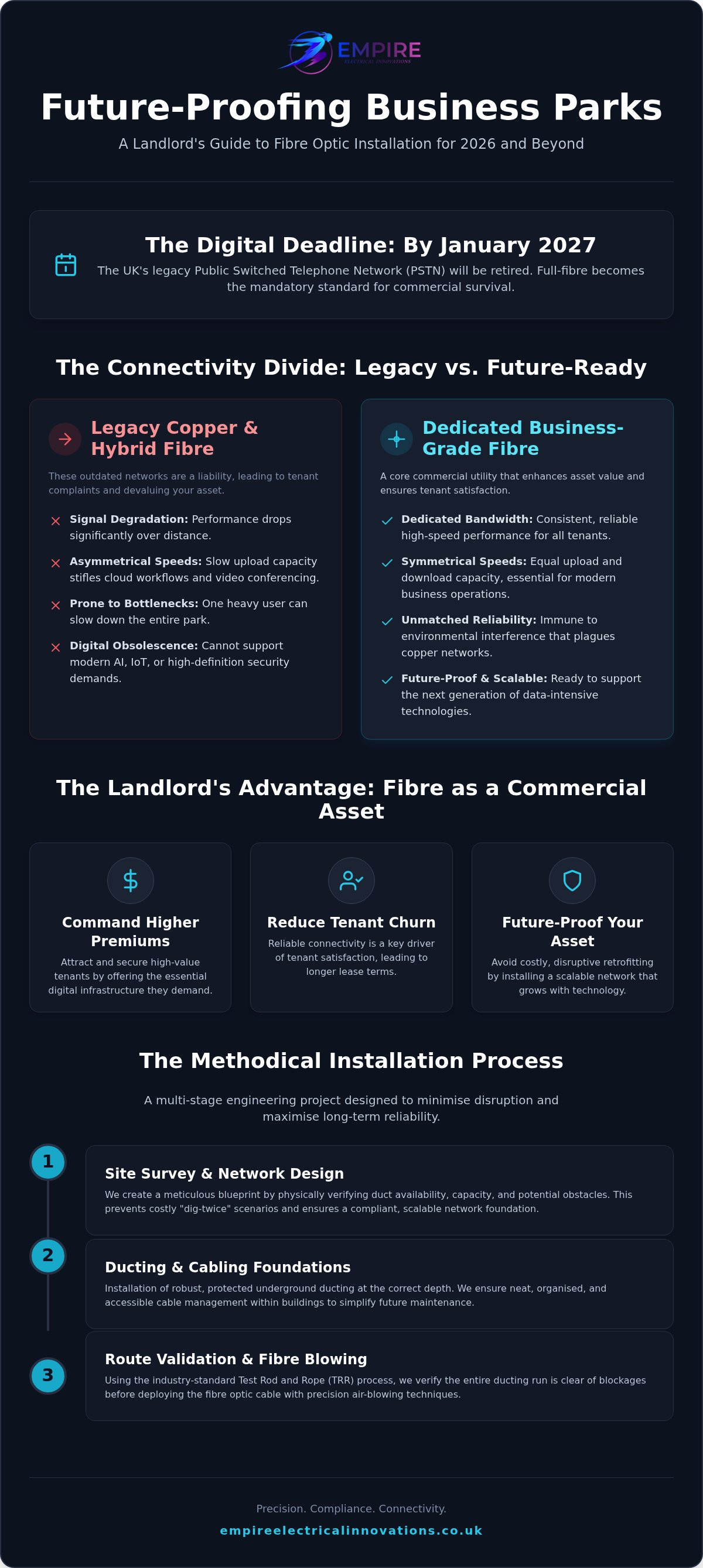
By January 2027, the UK's legacy PSTN network will be officially retired, making full-fibre connectivity the only viable standard for commercial survival. For landlords and developers, the challenge isn't just providing internet. It's about delivering reliability without the disruption of poorly planned groundworks. You understand that tenant satisfaction hinges on seamless digital infrastructure. Frequent complaints about slow speeds or unreliable connections can quickly devalue a site.
This guide provides a comprehensive roadmap for fibre optic installation for business parks in 2026. We'll show you how to enhance your asset value while navigating the latest regulatory shifts, such as the September dispensation for minor cable entry works. Discover how to integrate future-proofed telecoms with existing utilities using a methodical, specialist approach. We'll cover everything from network validation to fibre blowing, ensuring your infrastructure remains robust for the next decade. Precision. Compliance. Connectivity.
Table of Contents
Why Business Parks Require Dedicated Fibre Infrastructure
Modern business parks are no longer just collections of office space; they're high-performance digital hubs. To maintain a competitive edge, landlords must treat digital connectivity with the same priority as power, water, and transport links. Relying on "best-effort" residential-grade connections is a risk that few commercial tenants are willing to take. Professional business-grade infrastructure provides dedicated bandwidth. This ensures that a single heavy user doesn't degrade the experience for the entire park. It's about reliability. It's about performance. It's about trust.
One of the most critical advantages of a professional Fiber-optic communication network is the provision of symmetrical speeds. Unlike residential packages that prioritise downloads, modern business operations require equal upload and download capacity to support seamless cloud-based workflows, video conferencing, and real-time data backups. Without this, tenants face bottlenecks that stifle productivity and frustrate staff. High-capacity networks allow for multiple business units to operate simultaneously without latency, which is essential for any site housing diverse industries.
Connectivity as a Commercial Asset
Digital infrastructure is now a primary driver of rental yields. High-growth tech firms and data-heavy organisations prioritise sites where the physical groundwork is already laid. By investing in fibre optic installation for business parks, developers can command higher premiums and secure longer lease terms. Full Fibre, in the context of commercial property, is an end-to-end optical connection that removes the performance ceiling of legacy systems and directly enhances the asset's valuation. It transforms a standard office block into a future-ready facility capable of supporting the most demanding industrial requirements. Reliable connectivity reduces tenant churn. If the internet works perfectly, tenants stay.
The Limitations of Legacy Copper Networks
Traditional copper and hybrid fibre-to-the-cabinet (FTTC) networks are rapidly becoming obsolete. These systems suffer from signal degradation over distance and environmental interference, leading to the "slow and unreliable" complaints that plague many older sites. As the UK moves toward the total retirement of the PSTN network by early 2027, the risk of digital obsolescence is real. Modern applications like AI-driven analytics, building automation (IoT), and high-definition security systems require massive bandwidth that copper simply cannot deliver. Implementing a robust fibre optic installation for business parks ensures that your site can scale alongside these technological advancements. It prevents the need for disruptive retrofitting in the near future. Precision groundwork today saves significant capital expenditure tomorrow.
Essential Stages of Professional Fibre Optic Deployment
Professional fibre optic installation for business parks is a multi-stage engineering project, not a simple cable pull. It begins with a meticulous site survey and network design phase. We don't just look at schematics; we physically verify duct availability, capacity, and potential obstacles. This blueprint ensures that the final network is logical, scalable, and compliant with 2026 standards. A well-planned design prevents the costly "dig-twice" scenarios that frustrate landlords and tenants alike. Precision at this stage is the foundation of a reliable commercial asset.
Ducting and Cabling Foundations
The physical security of the network depends on robust underground ducting. These conduits must be installed at the correct depth to avoid accidental damage during future site maintenance, whilst remaining accessible via strategically placed chambers. High-quality ducting acts as a permanent protective shield for the fibre. For developments in the South East, working with specialised telecoms ducting contractors Hertfordshire ensures that local ground conditions and specific council regulations are met. Inside the buildings, organised cable management systems are equally vital. Neat, labelled, and accessible cabling within risers and server rooms prevents the "spaghetti" effect and simplifies future maintenance tasks.
Test Rod and Rope (TRR) and Fibre Blowing
Before any fibre is deployed, the route must be validated. Test Rod and Rope (TRR) is the industry-standard process for this verification. We use rods to traverse the entire ducting run, identifying any collapsed sections, silt build-up, or existing cable congestion that could hinder the installation. If the rod passes through without resistance, a draw-rope is left behind. This validation is a critical part of fibre optic installation for business parks, as it eliminates the risk of damaging expensive glass strands during the deployment phase. It's a methodical way to ensure the infrastructure is ready for the next step.
Once the route is confirmed, we utilise professional fibre blowing technology. Traditional pulling methods can put excessive tension on delicate fibre cables, leading to micro-fractures and signal degradation. Fibre blowing uses high-pressure compressed air to "float" the cable through the ducting. This tension-free method allows for significantly longer runs with fewer splice points, which improves overall signal integrity. It requires specialist equipment, including high-capacity compressors and precision blowing heads, to achieve the speed and accuracy required for high-density business park environments. Ensuring these technical stages are handled by a trusted specialist in commercial telecoms infrastructure is the only way to guarantee a future-proofed network.
Strategic Benefits of High-Capacity Network Infrastructure
High-capacity infrastructure acts as the digital backbone for every operational facet of a commercial estate. Beyond basic connectivity, a professional fibre optic installation for business parks allows landlords to centralise site management. It facilitates the flow of data from security cameras, access control systems, and environmental sensors into a single, cohesive dashboard. This visibility improves response times and reduces the need for physical on-site monitoring. It's a strategic move that lowers long-term operational costs whilst increasing the park's marketability to tech-centric enterprises. Robust networks ensure that as a tenant's business grows, the infrastructure supporting them doesn't become a bottleneck.
Supporting Smart Business Park Ecosystems
The modern commercial landscape is increasingly defined by sustainability and electrification. Effective management of these systems requires constant, high-speed data transmission. For instance, fibre enables the real-time monitoring of commercial EV charger installation Hertfordshire, allowing for load balancing and automated billing across multiple units. Similarly, high-speed data is vital for managing site-wide renewable energy systems, ensuring that power generation matches demand in real-time. Integrating reliable telecoms with solar PV for commercial buildings creates a smart energy network where data and electricity flow in parallel to maximise efficiency. This synergy ensures that every watt of energy is accounted for and utilised effectively. It's an integrated approach to utility management that defines the next generation of business parks.
Resilience and Security of Supply
Resilience is a core requirement for any business-critical application. Unlike traditional overhead copper lines, which are vulnerable to weather damage and physical interference, underground fibre is physically secure and remarkably durable. A well-designed fibre optic installation for business parks includes redundancy planning to ensure 99.9% uptime. By creating diverse routing paths, we ensure that the network remains operational even if a single point of failure occurs. This level of reliability is non-negotiable for modern tenants who rely on cloud-hosted infrastructure and global communication.
Dedicated fibre pathways also offer significant cyber security advantages over shared public networks. Data is transmitted as pulses of light through glass, making it nearly impossible to intercept without physical detection. For tenants in the financial, legal, or research sectors, this inherent security is a major selling point. By providing a secure, high-capacity foundation, landlords protect both their tenants' data and the long-term reputation of the asset. Reliability isn't just a technical metric. It's a commercial promise.
Best Practices for Fibre Installation Projects
Successful infrastructure projects require more than technical skill. They need logistical precision. Aligning fibre optic installation for business parks with existing site maintenance or construction phases reduces costs and tenant friction. If you're already preparing groundworks for EV chargers or solar arrays, it's efficient to lay telecoms ducting simultaneously. This integrated approach is a hallmark of a multi-disciplinary contractor. It ensures that various utilities don't conflict and that the site remains tidy and functional. Precision in scheduling is just as important as the installation itself.
Compliance and Standards
Adhering to strict industry standards is non-negotiable for commercial assets. Whether following Openreach specifications or those of an alternative network provider, compliance ensures the infrastructure is adoptable and maintainable for years to come. Accurate "as-built" documentation is a critical part of this process. It provides a definitive map of the network for future engineers. For new developments, these works often align with Part L building regulations solar panels, as developers look to combine digital connectivity with renewable energy targets. This cohesion between utilities creates a more sustainable and valuable commercial environment.
Managing the Installation Process
Disruption is the primary concern for active business parks. Minimising this requires a clear communication strategy for existing tenants. We provide transparent timelines and ensure that high-impact groundworks are scheduled during off-peak hours where possible. Health and safety is paramount. Working in public spaces requires rigorous risk assessments and clear cordoning to protect staff and visitors. This methodical approach ensures that the fibre optic installation for business parks doesn't compromise the daily operations of the site.
Once the physical deployment is complete, the testing and commissioning phase begins. We use calibrated equipment to verify signal strength and latency across every link. This validation ensures the network performs exactly as designed before it's handed over to the client. Every splice and connection is checked for integrity. For a seamless project delivery from initial survey to final commissioning, partner with an accredited commercial telecoms infrastructure contractor to guarantee long-term reliability.
Bespoke Telecoms Solutions with Empire Electrical Innovations
Empire Electrical Innovations stands as a premier provider of commercial telecoms infrastructure across the South East. Our team specialises in the physical layer of connectivity, from ducting and cabling to fibre blowing and TRR validation. We understand that project delivery in Hertfordshire and across the South East requires more than just technical skill; it demands deep local knowledge of ground conditions, council regulations, and the specific needs of urban business environments. By choosing a partner who manages the entire infrastructure lifecycle, you ensure your asset is built to the highest professional standards. Precision is our baseline. Reliability is our promise.
Our integrated approach sets us apart from standard contractors. We don't just install fibre. We design utility ecosystems. For many clients, we align fibre optic installation for business parks with solar PV arrays and EV charging networks. This consolidation reduces site disruption and simplifies project management. It's a methodical way to build a future-ready asset that meets all modern operational demands. By coordinating these installations, we ensure that your sub-surface infrastructure is logical, accessible, and ready for future expansion.
The Empire Electrical Innovations Advantage
We've earned our reputation as a "Trusted Specialist" throughout Buckinghamshire and Bedfordshire. Our team leads with quiet authority, focusing on professional workmanship and transparent communication. We recently modernised a multi-tenant business park where legacy copper was causing significant tenant dissatisfaction. By installing a high-capacity fibre backbone and clearing blocked ducting via TRR, we restored the park's digital reputation. The project was completed with minimal disruption to daily operations, protecting the landlord's rental yields. We value workmanship over empty promises. Every project starts with a detailed site survey to provide an accurate, fixed-price quotation tailored to your site's specific geography.
Partnering for Future-Ready Infrastructure
We believe in a partnership-first approach. This means collaborating with property developers from the earliest design phases to ensure fibre optic installation for business parks is integrated logically with other utilities. Our involvement doesn't end when the cable is blown. We provide ongoing support to ensure your network assets remain compliant with evolving UK standards and building regulations. This long-term commitment protects your investment and ensures your tenants always have the bandwidth they need to thrive. If you're ready to upgrade your commercial asset, enquire about our specialist telecoms services to discuss your requirements. We're here to help you build for 2026 and beyond.
Secure Your Commercial Asset’s Digital Future
A business park's value is no longer measured solely by square footage. It's defined by the strength of its sub-surface infrastructure. As we move closer to the 2027 PSTN retirement, professional fibre optic installation for business parks is the only way to ensure long-term tenant retention and operational resilience. By prioritising methodical network validation through TRR and precision fibre blowing, you protect your site from digital obsolescence. Integrating these works with renewable energy or EV charging further enhances site efficiency and asset value.
Empire Electrical Innovations brings a partnership-first approach to every project. We serve Hertfordshire, Bedfordshire, Buckinghamshire, and London with a focus on compliance and professional workmanship. Our specialist equipment and integrated expertise mean we don't just solve today's connectivity issues; we build the foundations for the next decade of commercial success. Don't leave your site's connectivity to chance. Request a Free Site Survey and Telecoms Quote today to start your infrastructure upgrade. We're ready to help you build a smarter, more connected commercial ecosystem.
Frequently Asked Questions
What is the difference between fibre to the cabinet and fibre to the premises for business parks?
Fibre to the cabinet (FTTC) relies on legacy copper wiring for the final leg of the connection from the street cabinet to the building. This often results in signal degradation and slower speeds. Fibre to the premises (FTTP) provides an end-to-end optical connection. For a modern fibre optic installation for business parks, FTTP is the required standard as it ensures symmetrical speeds and removes the performance ceiling associated with copper.
How long does a typical fibre optic installation take for a commercial site?
The duration of an installation varies depending on the scale of the park and the condition of existing underground infrastructure. A straightforward deployment might take a few days, whilst more complex sites requiring new ducting or extensive groundworks can take several weeks. We provide a definitive project timeline following a comprehensive site survey. This ensures that all stakeholders have a clear understanding of the delivery schedule from the outset.
Will my tenants experience any downtime during the fibre installation process?
Tenants typically experience little to no downtime during the physical installation phase. Most of the engineering work, such as ducting and fibre blowing, takes place externally or within common building risers. The final transition to the new network is meticulously planned to occur during off-peak hours. We prioritise clear communication with site managers to ensure that daily business operations continue without interruption whilst the new infrastructure is deployed.
Does fibre optic cabling require a specific type of ducting?
Yes, fibre optic cables require high-density polyethylene (HDPE) ducting specifically designed for telecommunications. These conduits feature low-friction internal walls to facilitate smooth cable deployment and protect the delicate glass strands from physical pressure or moisture. Using the correct colour-coded ducting ensures the installation remains compliant with UK building regulations and makes the network easily identifiable for any future maintenance or utility works on the site.
What is fibre blowing and why is it used for larger business parks?
Fibre blowing is a specialist technique that uses high-pressure compressed air to "float" optical cables through pre-installed ducting. It's the preferred method for larger business parks because it allows for tension-free installation over long-haul runs. This reduces the need for frequent splice points, which improves overall signal integrity. It's a faster and more efficient deployment method that significantly reduces the risk of cable damage compared to traditional pulling techniques.
Can I integrate my fibre network with my existing solar PV monitoring system?
You can certainly integrate your fibre network with solar PV monitoring and other smart building technologies. High-speed connectivity allows for real-time data transmission from solar inverters and battery storage systems to a central dashboard. This synergy ensures that energy generation and consumption are tracked with precision. It's a vital component for landlords looking to create an integrated, energy-efficient commercial environment that supports both digital and sustainable goals.
What are the typical costs associated with commercial fibre infrastructure?
Costs for fibre optic installation for business parks are influenced by several factors, including the distance from the nearest network break-out point and the state of existing on-site ducting. Whilst some installations are straightforward, others may require "FTTP on Demand" services which involve significant construction. Because every commercial site has unique geographical challenges, we recommend a professional site survey to receive a bespoke quotation that reflects the specific requirements of your asset.
How does dedicated fibre infrastructure affect the resale value of a business park?
Dedicated fibre infrastructure directly enhances the resale value of a business park by future-proofing the asset against digital obsolescence. High-growth tenants in the tech, legal, and financial sectors view "Class A" connectivity as a non-negotiable utility. A site with pre-installed, high-capacity fibre is more attractive to investors as it commands higher rental yields and reduces tenant turnover. It transforms a standard property into a high-performance hub ready for 2026 and beyond.


Comments