
Solar Panel Payback Period for UK Businesses: The 2026 ROI Guide

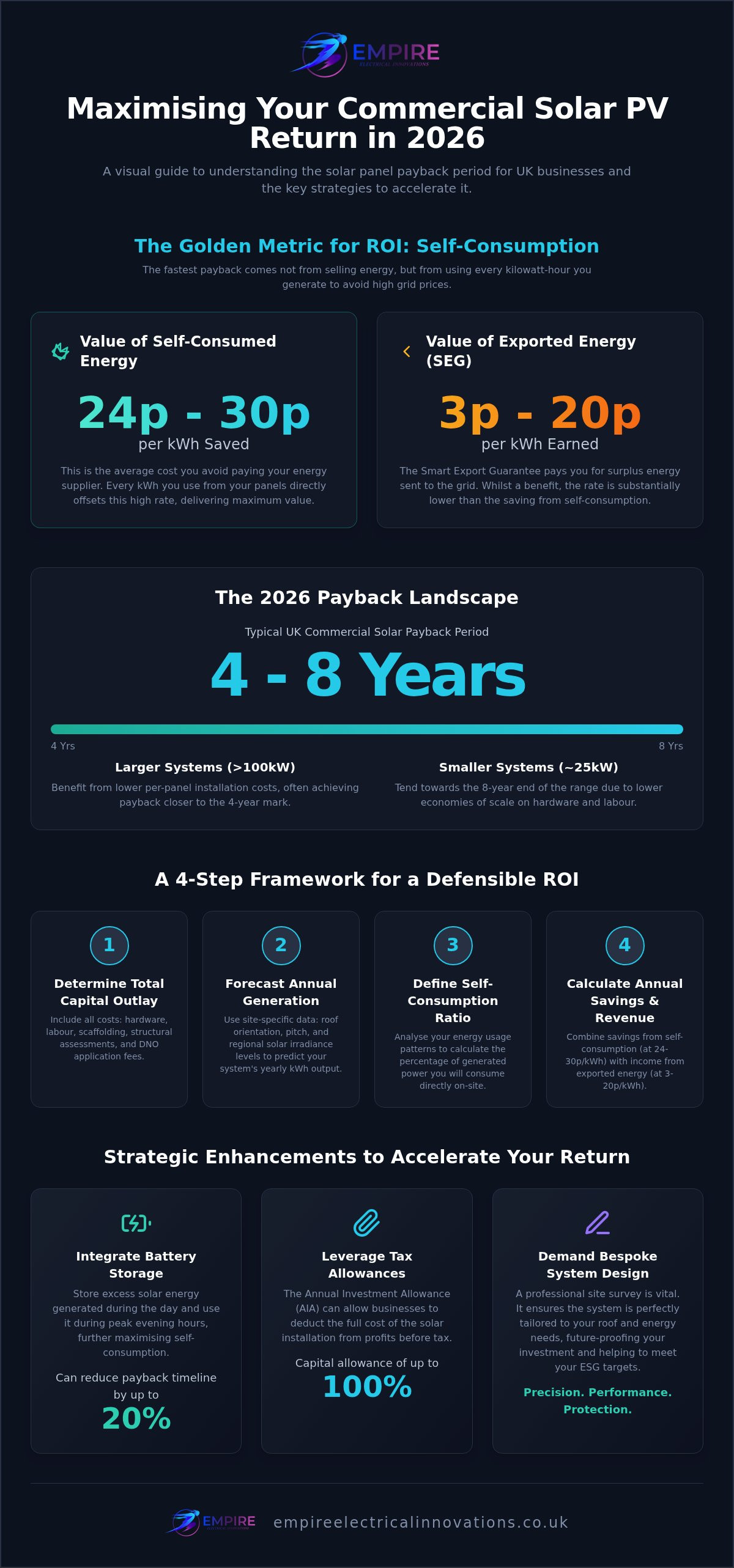
The most effective way to shorten the solar panel payback period UK business owners face in 2026 isn't by selling energy back to the grid. It's by ensuring you consume every unit you generate. With commercial electricity rates currently averaging between 24p and 30p per kWh, every kilowatt-hour pulled from your own roof is far more valuable than the 3p to 20p offered through the Smart Export Guarantee. Maximising self-consumption is now the primary driver of commercial ROI. Precision. Performance. Protection.
You're likely navigating the pressure of volatile energy costs whilst trying to meet ambitious ESG targets without depleting your cash flow. It's a difficult balance. This guide provides the exact variables, calculation frameworks, and strategic steps required to realise a rapid return on investment for your commercial solar PV system. We'll examine how the 100% Annual Investment Allowance, smart battery storage, and professional system design work together to create a clear, defensible timeline for energy independence and reduced operational overheads.
Table of Contents
Defining the Solar Panel Payback Period for UK Businesses in 2026
A Step-by-Step Template for Calculating Your Commercial Solar ROI
Critical Variables Influencing Your Financial Return Timeline
Strategic Enhancements: Integrating Battery Storage and EV Charging
Future-Proofing Your Enterprise with Empire Electrical Innovations
Defining the Solar Panel Payback Period for UK Businesses in 2026
The solar payback period represents the critical break-even point where the cumulative financial benefits of renewable infrastructure fully offset the initial capital investment. For most enterprises, this metric serves as the primary filter for capital expenditure approval. In the current economic climate, the solar panel payback period UK business owners experience has become a vital data point for long-term fiscal planning. 2026 has emerged as a pivotal year for this transition. Whilst grid prices remain unstable, locking in energy costs through photovoltaic (PV) systems provides a level of certainty that traditional tariffs cannot match. Precision. Performance. Protection.
When presenting to a board, it's essential to distinguish between simple and discounted payback. Simple payback is a straightforward calculation: total system cost divided by annual savings. It's a useful "back of the envelope" figure but lacks nuance. Discounted payback is the superior metric for corporate reporting. It accounts for the time value of money, factoring in inflation and the potential interest lost by not investing that capital elsewhere. This provides a more accurate reflection of when the system truly begins to generate a net profit for the organisation.
The 2026 Average Payback Landscape
Industry benchmarks for 2026 show that the typical solar panel payback period UK business leaders can expect ranges between 4 and 8 years. Smaller 25kW systems often sit at the higher end of this range due to lower economies of scale. Conversely, large-scale systems exceeding 100kW benefit from reduced per-panel installation costs, often reaching the break-even point significantly faster. The economic landscape of 2026 has shortened these timelines compared to a decade ago. This shift is driven by two factors: average business electricity rates hovering between 24p and 30p per kWh and significant improvements in panel conversion efficiency. Modern arrays generate more power per square metre, ensuring every inch of your roof works harder to recoup your investment.
Financial Metrics Beyond Simple Payback
A sophisticated ROI analysis looks past the initial break-even date. The Internal Rate of Return (IRR) is often a more compelling figure for finance directors, as it allows for a direct comparison between solar investment and other business growth opportunities. A well-designed commercial system in 2026 frequently delivers an IRR that outperforms standard market investments. Additionally, Net Present Value (NPV) calculations help facility managers understand the total value the system will add over its 25-year lifespan. Beyond direct energy savings, solar assets contribute to the overall valuation of commercial property. Buildings with high EPC ratings and established renewable infrastructure are increasingly viewed as premium assets, offering better long-term security for landlords and owner-occupiers alike.
A Step-by-Step Template for Calculating Your Commercial Solar ROI
Precision is paramount. Whilst many providers offer a simple cost-versus-savings estimate, a defensible solar panel payback period UK business calculation requires a deeper analysis of site-specific variables. Finance teams need a robust framework that stands up to board-level scrutiny. To establish an accurate timeline, follow this structured four-step template. Empire Electrical Innovations provides bespoke site surveys to ensure these data points are tailored to your specific facility.
Step 1: Determine Total Capital Expenditure. This must include hardware, structural roof assessments, scaffolding, and labour. Don't overlook the administrative costs of local Distribution Network Operator (DNO) applications and final commissioning.
Step 2: Forecast Annual Generation. Use regional irradiance data. Businesses in Hertfordshire and the South East typically see higher yields than the UK average. This data provides the baseline for your annual energy production.
Step 3: Define the Self-Consumption Ratio. This is the "golden metric" for ROI. It's the percentage of generated power your business consumes directly. Since grid electricity costs 24p to 30p per kWh, power used on-site is significantly more valuable than power exported.
Step 4: Calculate Export Revenue. Any surplus energy sent back to the grid generates income through the Smart Export Guarantee (SEG). Whilst rates vary between 3p and 20p per kWh, this remains a secondary benefit compared to self-consumption.
Accounting for Tax Incentives and Grants
The 2026 fiscal environment remains highly favourable for green energy investments. Under the Annual Investment Allowance (AIA), UK businesses can deduct 100% of the cost of a solar installation from their profits before tax in the year of purchase. With the AIA cap set at £1,000,000 and corporation tax at 25%, this is equivalent to an immediate 25% saving on the capital cost. VAT-registered businesses can also reclaim the 20% VAT on commercial installations, further reducing the net investment. These incentives are often the difference between a six-year and a four-year payback period.
Factoring in Operational Expenses (OPEX)
A realistic ROI model must account for the system's 25-year lifecycle. Annual maintenance, including panel cleaning and performance monitoring, typically costs a small fraction of the annual savings but ensures the array operates at peak efficiency. You should also budget for an inverter replacement, which usually occurs between years 10 and 15 of the project. Finally, account for natural panel degradation. Most modern tier-one panels lose approximately 0.5% of their efficiency annually. Factoring this into your 25-year Net Present Value (NPV) ensures your financial projections remain grounded and reliable.
Critical Variables Influencing Your Financial Return Timeline
The variables governing your return on investment are technical rather than purely financial. Whilst the initial cost is a fixed point, the speed at which you recoup that capital is fluid. The solar panel payback period UK business leaders calculate is most sensitive to your current electricity unit rate. High grid tariffs, which currently reach up to 30p per kWh, act as a catalyst for ROI. Every unit of solar power used on-site replaces an expensive grid unit. This directly protects your bottom line. Strategy. Stability. Savings.
Roof orientation and pitch remain fundamental. South-facing roofs in Hertfordshire provide the optimal yield. They capture the maximum irradiance throughout the day. However, your business operating hours are equally influential. A warehouse with high daytime energy demand aligns perfectly with peak solar production. In contrast, an office that remains empty during weekends may require a more tailored approach to ensure that generated energy isn't wasted. Matching the array size to your base load is almost always more profitable than oversizing for the purpose of over-exporting.
The Impact of Regional Irradiance
London and the South East benefit from higher solar yields compared to the UK average. This regional advantage can shave months off your payback timeline. However, local shading from neighbouring commercial buildings or mature trees can significantly impede performance. This is why professional solar PV design and installation is essential. A bespoke design identifies these obstructions early. It uses high-precision modelling to mitigate site-specific issues. This ensures your financial projections are grounded in reality.
Grid Constraints and Export Limits
Your ability to earn from surplus energy is often dictated by the local Distribution Network Operator (DNO). In certain areas of Cambridgeshire and Bedfordshire, grid constraints may lead to strict export limits. If your system exceeds local capacity, you may face the cost implications of grid reinforcement. To ensure your system is compliant and eligible for export payments, it must meet the standards of the Microgeneration Certification Scheme (MCS). Navigating these constraints requires a methodical approach to system sizing. Prioritising on-site consumption allows you to bypass grid limitations entirely and secures your energy independence.
Strategic Enhancements: Integrating Battery Storage and EV Charging
The most sophisticated commercial energy strategies in 2026 move beyond simple generation. By integrating solar PV with storage and transport infrastructure, you transform a passive rooftop array into a proactive energy hub. This shift significantly alters the solar panel payback period UK business owners forecast. It moves the focus from simple savings to comprehensive load management. Precision. Performance. Support.
Integrating battery storage for solar panels can slash your payback timeline by 15-20% through aggressive peak shaving. This creates a "closed-loop" system, particularly effective for industrial units and business parks where energy demand is high and constant. Storing self-generated energy for high-consumption night-time security lighting ensures that your array continues to drive ROI long after the sun has set.
Battery Storage as a Financial Catalyst
The primary financial advantage of commercial storage is the avoidance of "Red Band" Distribution Use of System (DUoS) charges. These are the highest tariffs applied by grid operators during periods of peak demand. By discharging stored solar power during these windows, your business bypasses the most expensive units of the day. Beyond cost, storage provides Uninterruptible Power Supply (UPS) functionality. This secures critical business data and protects sensitive machinery from grid fluctuations. In 2026, whilst lithium-ion remains the dominant technology, newer storage solutions are offering greater depth-of-discharge, ensuring your infrastructure remains future-ready for decades.
The EV Charging Synergy
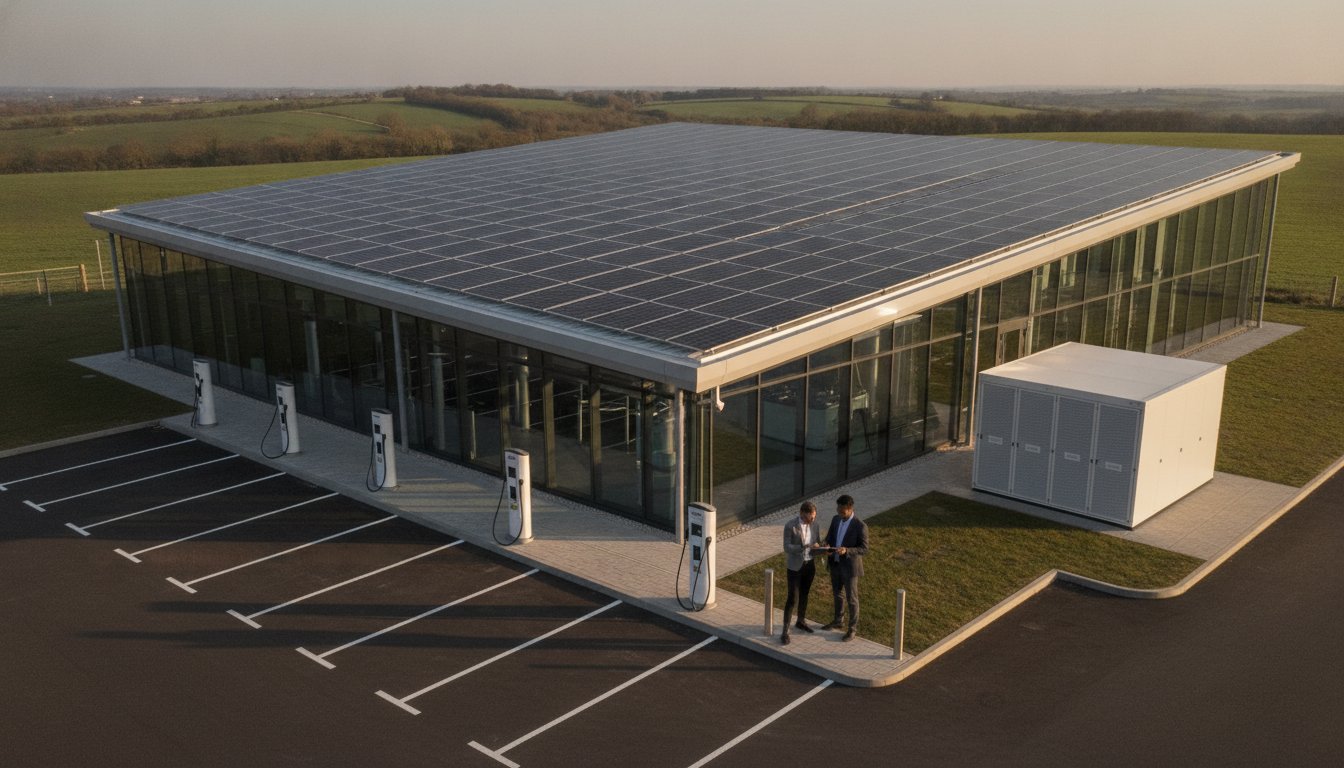
Electrification of commercial fleets is a primary driver for solar adoption. Installing commercial EV charging infrastructure provides a high-value destination for your excess solar energy. Instead of exporting surplus power to the grid at lower rates, you can use it to fuel your company vehicles or attract top-tier talent by offering subsidised charging to employees. This creates a secondary revenue stream if you choose to monetise charging points for visitors and clients. Smart charging software acts as the conductor for this system. It automatically prioritises solar-generated power for vehicle charging during peak daylight hours, ensuring you maximise every kilowatt-hour produced on-site.
To understand how storage and EV integration can specifically accelerate your return on investment, book a free site survey with our technical design team today.
Future-Proofing Your Enterprise with Empire Electrical Innovations
Realising the shortest possible solar panel payback period UK business owners can achieve requires more than just hardware. It demands a technical partnership rooted in precision and local expertise. A generic installation often fails to account for the specific load profiles or structural nuances of a commercial facility. Bespoke solar PV for commercial buildings requires a specialist contractor who understands the intersection of electrical infrastructure and long-term fiscal performance. We don't just install panels. We engineer energy independence. Precision. Performance. Longevity.
The Empire approach is methodical. We guide your project from the initial feasibility study through to commissioning and long-term performance monitoring. This disciplined sequence ensures that the data used for your board-level presentations is accurate and defensible. Compliance and standards are the foundation of our work. Every installation we perform meets rigorous UK safety and insurance requirements, protecting your asset and your personnel. Our local presence in Hertfordshire and Bedfordshire ensures we provide rapid response and support when your facility requires it most.
Our Commercial Installation Process
The process begins with a free site survey. This is the essential first step in establishing a realistic solar panel payback period UK business leaders can rely on. During this survey, we analyse your roof condition, shading risks, and half-hourly energy data. This allows us to tailor systems for specific sectors. A primary school has vastly different energy needs compared to a high-volume warehouse or a multi-tenant office complex. For complex urban projects, we act as specialist commercial solar panel installers in London, navigating the unique logistical and regulatory challenges of the capital's built environment.
Securing Your 2026 Energy Strategy
Delaying your transition to solar is a financial risk. Whilst it's tempting to wait for the next marginal gain in panel technology, the cost of inaction is significant. Every month spent relying solely on grid energy is a month of lost savings that could have been used to reconcile the capital cost of the system. The most successful enterprises in 2026 are those that lock in their energy costs now to insulate themselves against future market volatility. We invite you to initiate your project with a professional consultation to see how our technical expertise translates into tangible bottom-line results. Contact Empire Electrical Innovations for your bespoke solar ROI analysis and take the first step toward a secure, renewable future.
Securing Your Energy Independence
Achieving a rapid return on investment in 2026 relies on shifting from passive generation to active energy management. By prioritising self-consumption and leveraging the 100% Annual Investment Allowance, you can significantly reduce the solar panel payback period UK business owners typically expect. Integrating battery storage and EV charging infrastructure further enhances this financial return, turning your roof into a high-performance asset that delivers value for decades. Precision. Performance. Support.
Empire Electrical Innovations is an accredited specialist serving Hertfordshire, London, and the South East. Our team brings a proven track record in high-voltage and telecoms infrastructure to every project, ensuring your renewable transition is seamless, compliant, and technically sound. We provide bespoke ROI modelling for every commercial client, giving you the accurate data needed for board-level presentations and long-term fiscal planning. Don't leave your energy strategy to chance. Book Your Free Commercial Solar Feasibility Survey today to begin your journey towards long-term energy security. We look forward to helping your business thrive in a sustainable future.
Frequently Asked Questions
What is the average solar panel payback period for a UK business in 2026?
The typical solar panel payback period UK business entities experience in 2026 is between 4 and 8 years. This timeline is influenced by the size of the installation, with larger 100kW systems often reaching the break-even point faster than smaller 25kW arrays due to economies of scale. High grid electricity rates and modern panel efficiencies have made these timelines significantly shorter than they were a decade ago.
Do business solar panels qualify for Capital Allowances or tax breaks?
Commercial solar installations qualify for the Annual Investment Allowance (AIA), which allows your business to deduct 100% of the cost from profits before tax in the year of purchase. With the AIA cap at £1,000,000 and corporation tax at 25%, this provides an immediate and substantial reduction in the net capital cost. VAT-registered businesses can also reclaim the 20% VAT on their installation costs.
How does battery storage affect the payback period for a commercial system?
Battery storage can reduce the payback period by 15-20% by maximising on-site consumption and enabling peak shaving. By storing excess solar energy for use during expensive "Red Band" grid periods, your business avoids the highest unit rates. Whilst the initial capital expenditure increases, the accelerated annual savings often result in a faster break-even point for the total integrated system.
Is my commercial roof suitable for a solar PV installation?
Most commercial roofs are suitable for solar PV, provided they are structurally sound and have sufficient unshaded space. South-facing roofs offer the highest yield, but east-west configurations are increasingly popular for businesses with consistent daytime demand. A professional structural assessment and site survey are essential to confirm weight-bearing capacity and identify any potential shading from neighbouring commercial infrastructure.
What happens to the payback period if energy prices drop?
If grid energy prices drop, the financial value of each generated kilowatt-hour decreases, which can marginally extend the payback timeline. However, solar remains a vital hedge against future market volatility. Even with moderate price fluctuations, the 2026 energy market remains significantly higher than historic averages, ensuring that the solar panel payback period UK business owners calculate remains fiscally attractive.
Can I sell my surplus solar electricity back to the grid in 2026?
Businesses can sell surplus electricity back to the grid through the Smart Export Guarantee (SEG). In 2026, export rates typically range from 3p to 20p per kWh depending on your energy supplier. To qualify for these payments, your installation must be completed by an accredited specialist and meet the rigorous technical standards of the Microgeneration Certification Scheme (MCS).
Do I need planning permission for commercial solar panels in the UK?
Most commercial solar installations fall under Permitted Development rights and don't require full planning permission. However, exceptions apply if your building is listed, located in a Conservation Area, or situated within an Area of Outstanding Natural Beauty. You should always verify local requirements with your council or a specialist contractor before commencing work to ensure your project remains fully compliant.
How long do commercial solar panels actually last once they have paid for themselves?
Modern tier-one solar panels are engineered to last 25 to 30 years, continuing to generate clean energy long after the initial investment is recouped. Whilst efficiency degrades by approximately 0.5% annually, the system will provide nearly two decades of essentially free electricity after the break-even point. This longevity makes solar one of the most reliable long-term investments for modern facility management.
Comments